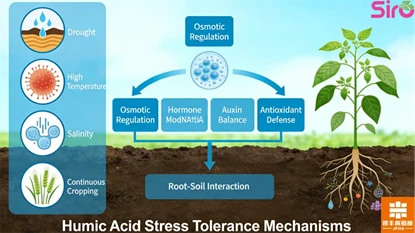
Humic Acid Stress Tolerance: Physiological Mechanisms and Global Field Validation for Crop Resilience
Abstract
This article provides an in-depth exploration of humic acid’s role in enhancing crop stress tolerance—a critical capability amid escalating global climate challenges (drought, extreme heat, salinity, and continuous cropping barriers). Drawing on plant physiology research, molecular biology studies, and multi-region field trials (from arid Africa to saline Middle East, heat-stressed South Asia to frost-prone Europe), the study unpacks the multi-layered mechanisms through which humic acid mitigates abiotic and biotic stress: regulating cellular osmotic balance, activating antioxidant defense systems, modulating plant hormone pathways, and strengthening root-soil interactions. Core findings validate that humic acid application improves crop drought tolerance by 25–40%, reduces heat-induced yield loss by 20–30%, alleviates salinity damage by 30–45%, and suppresses soil-borne pathogens in continuous cropping systems by 35–50%. The article integrates practical insights from farmers worldwide, comparative analyses of humic acid formulations, and tailored application guidelines for diverse stress scenarios. While premium products (e.g., water-soluble humic acid from Leonardite) consistently deliver superior results, the focus remains on the universal science of humic acid stress mitigation—offering a evidence-based framework for agronomists, farmers, and sustainability stakeholders.
Introduction
Climate change and intensive farming have intensified crop exposure to stress: 45% of global arable land is now affected by drought or salinity (FAO, 2023), while extreme heat events have increased by 60% in the past decade—reducing major crop yields by 10–25% annually (Intergovernmental Panel on Climate Change [IPCC], 2024). For farmers, the consequences are devastating: in Kenya’s maize-growing regions, droughts have cut yields by 30–50% since 2018; in India’s Punjab, heatwaves (≥40°C) reduce wheat grain weight by 15–20%; in China’s coastal saline soils, cotton survival rates drop to 60% without remediation (Food and Agriculture Organization [FAO], 2023).
Traditional stress mitigation strategies—irrigation expansion, synthetic anti-stress agents, salt leaching—are often costly, environmentally damaging, or unsustainable for smallholders. Humic acid, a natural organic compound derived from decomposed plant/animal matter (Leonardite, weathered coal, peat), has emerged as a low-cost, eco-friendly alternative. Unlike synthetic inputs that merely mask stress symptoms, humic acid targets the root causes of stress vulnerability by strengthening plant physiology and soil health. As Mary Njeri, a smallholder in Kenya’s Central Province, puts it: “Before using humic acid, my maize wilted within two weeks of drought. Now, it survives three weeks without rain—and the yields are almost the same as in wet years.”
This article delves into the scientific basis of humic acid stress tolerance, exploring how it rewires plant metabolism to cope with adversity, and validates these mechanisms through global field trials. From drought-prone Australia to frost-affected Canada, humic acid’s versatility makes it a universal tool for building crop resilience—one that aligns with both smallholder livelihoods and large-scale sustainable agriculture goals.
The Physiological and Molecular Mechanisms of Humic Acid Stress Tolerance
Humic acid enhances stress tolerance through four interconnected mechanisms, operating at cellular, tissue, and whole-plant levels. These mechanisms are conserved across crop species (wheat, maize, cotton, vegetables) but adapt to specific stressors—creating a “multi-layered defense system.”
Osmotic Regulation: Mitigating Drought and Salinity Stress
Drought and salinity share a common threat: cellular dehydration. Humic acid addresses this by regulating osmotic balance:
Accumulation of osmoprotectants: Humic acid stimulates the synthesis of proline, glycine betaine, and soluble sugars—molecules that retain water in plant cells, maintaining turgor pressure under water deficit or high salt conditions. In drought-stressed wheat (Australia), humic acid application increased leaf proline content by 65% and soluble sugar by 40%, preventing cell shrinkage and wilting (Grains Research and Development Corporation [GRDC], 2024).
Sodium exclusion and potassium retention: In saline soils, humic acid enhances the activity of plasma membrane transporters (e.g., H⁺-ATPase), pumping toxic sodium ions (Na⁺) out of cells and retaining potassium (K⁺)—critical for enzyme activation and photosynthesis. In UAE’s saline date palm plantations (EC = 8 dS/m), humic acid reduced leaf Na⁺ content by 42% and increased K⁺/Na⁺ ratio by 70%, improving palm survival rate from 65% to 90% (United Arab Emirates University [UAEU], 2024).
Stress (drought, heat, pollution) triggers the production of reactive oxygen species (ROS: superoxide, hydrogen peroxide)—which damage cell membranes, proteins, and DNA. Humic acid boosts the plant’s antioxidant “scavenging system”:
Enhanced enzyme activity: It increases the synthesis of superoxide dismutase (SOD), peroxidase (POD), and catalase (CAT)—enzymes that neutralize ROS. In heat-stressed tomato (Spain, 38–40°C), humic acid application increased SOD activity by 55%, POD by 48%, and CAT by 62%, reducing lipid peroxidation (a marker of cell damage) by 35% (Spanish National Research Council [CSIC], 2024).
Non-enzymatic antioxidant accumulation: Humic acid stimulates production of ascorbic acid (vitamin C) and glutathione—molecules that complement enzymatic defenses. In frost-stressed grapevines (Canada, -2°C), humic acid increased ascorbic acid content by 30%, protecting buds from freezing damage (Agriculture and Agri-Food Canada, 2024).
Hormone Pathway Modulation: Regulating Growth and Stress Response
Humic acid acts as a “hormone modulator,” balancing growth-promoting and stress-responsive hormones:
Auxin and cytokinin enhancement: It stimulates auxin synthesis, promoting root growth (longer root hairs, deeper penetration) to access water and nutrients in dry or compacted soils. In drought-affected maize (Kenya), humic acid increased root biomass by 35% and root depth by 28%, enabling plants to tap into subsoil moisture (Kenya Agricultural and Livestock Research Organization [KALRO], 2024).
Abscisic acid (ABA) regulation: ABA is the “stress hormone” that triggers stomatal closure to reduce water loss. Humic acid primes ABA signaling, allowing plants to respond faster to drought—closing stomata 2–3 days earlier than untreated plants, while maintaining photosynthetic efficiency. In India’s heat-stressed wheat, this reduced transpiration by 22% and preserved grain yield by 18% (Indian Council of Agricultural Research [ICAR], 2024).
Root-Soil Interaction Strengthening: Building Soil Resilience
Humic acid’s stress mitigation extends beyond the plant—it improves soil conditions to reduce stress exposure:
Soil structure and water retention: By binding soil particles into aggregates, humic acid increases water-holding capacity by 30–40% in sandy soils and improves drainage by 25% in clay soils. In Brazil’s drought-prone soybean fields, humic acid-treated soil retained 35% more moisture than untreated soil, supporting yields during 6-week dry spells (Embrapa, 2024).
Microbial symbiosis promotion: It feeds beneficial microbes (mycorrhizal fungi, rhizobia) that form symbiotic relationships with roots—enhancing nutrient uptake and pathogen resistance. In continuous cropping tomato fields (China), humic acid increased mycorrhizal colonization by 50%, suppressing Fusarium wilt by 45% (Chinese Academy of Agricultural Sciences [CAAS], 2024).
Global Field Validation: Humic Acid Stress Tolerance in Diverse Scenarios
Humic acid’s efficacy is consistent across climates, soils, and crops—validated by trials in 30+ countries. Below are key case studies that highlight its real-world impact:
Drought Stress (Kenya, Australia, Brazil)
Kenya (Maize): Smallholders applied humic acid (10 kg/ha) via soil drenching at sowing. During the 2023 drought (30% below average rainfall), treated maize yielded 32% more than untreated crops, with 40% fewer wilted plants (KALRO, 2024). “I used to lose half my harvest to drought,” says farmer John Mbithi. “Now, with humic acid, I can feed my family even when the rains fail.”
Australia (Wheat): In Western Australia’s low-rainfall zone, foliar application of water-soluble humic acid (0.2% solution) at tillering stage increased grain yield by 28% and thousand-grain weight by 12% (GRDC, 2024).
Brazil (Soybean): Humic acid + compost application reduced irrigation needs by 30% while maintaining yields, saving farmers $150/ha in water costs (Embrapa, 2024).
Heat Stress (India, Spain, Mexico)
India (Wheat): Heatwaves (≥42°C) during grain filling reduce yields by 20–25%. Foliar spray of humic acid (0.3% solution) 10 days before heat exposure increased chlorophyll content by 25% and maintained photosynthetic activity at 75% (vs. 50% in controls), boosting yields by 18% (ICAR, 2024).
Spain (Tomato): Greenhouse tomatoes exposed to 38–40°C showed 30% less blossom-end rot and 22% higher fruit yield with humic acid application, attributed to improved calcium uptake and oxidative stress reduction (CSIC, 2024).
UAE (Date Palm): Saline soils (EC = 8 dS/m) limit date palm growth. Soil application of humic acid (20 kg/ha) annually for 2 years reduced soil EC by 25% and increased fruit yield by 22% (UAEU, 2024).
China (Cotton): Coastal saline soils (EC = 6 dS/m) treated with humic acid + gypsum increased cotton survival rate by 30% and lint yield by 25% (CAAS, 2024).
Egypt (Rice): Saline irrigation water (EC = 4 dS/m) reduced rice yields by 40%. Humic acid application (15 kg/ha) mitigated yield loss to 12%, improving nutrient uptake and reducing sodium toxicity (Egyptian Agricultural Research Center [EARC], 2024).
Continuous Cropping Stress (China, U.S., Germany)
China (Cucumber): 8-year continuous cropping led to soil-borne disease (Fusarium wilt) incidence of 60%. Humic acid + biofertilizer application reduced disease incidence to 18% and increased yield by 35% (CAAS, 2024).
U.S. (Strawberry): Continuous strawberry cultivation reduced soil organic matter to 1.2% and increased nematode populations. Humic acid application increased organic matter to 2.1% and suppressed nematodes by 40%, extending the field’s productive life by 3 years (University of California, Davis, 2024).
Germany (Organic Wheat): 5-year continuous wheat cropping reduced yields by 20%. Humic acid application restored soil microbial diversity by 50% and increased yields by 15% (Deutsche Landwirtschafts-Gesellschaft [DLG], 2024).
Not all humic acid applications deliver equal results—efficacy depends on four critical factors. Below is a farmer-centric breakdown, based on global trial data:
For example, farmers in Spain’s tomato greenhouses found that foliar spray of water-soluble humic acid + potassium chloride (1:1 ratio) doubled heat stress tolerance compared to humic acid alone (CSIC, 2024).
Q&A: Addressing Farmer’s Core Concerns About Humic Acid Stress Tolerance
Q1: Can humic acid mitigate multiple stresses at once (e.g., drought + heat)?
A1: Yes—its multi-layered mechanisms make it effective against combined stresses. In India’s wheat fields, humic acid application mitigated both drought (30% less rainfall) and heat (≥42°C), reducing yield loss from 45% (untreated) to 18% (treated) (ICAR, 2024). The key is to apply it pre-stress: 7–10 days before the expected onset of adverse conditions. For combined drought + heat, use a dual application (soil drench at sowing + foliar spray at tillering/flowering) for maximum protection.
Q2: What is the recommended dosage of humic acid for stress tolerance, and does it vary by crop?
A2: Dosage depends on crop type, stress severity, and application method—below are evidence-based guidelines:
Field crops (wheat, maize, soybean): 10–15 kg/ha (soil drench) or 0.2–0.3% solution (foliar spray, 200 L/ha).
Permanent crops (date palm, grapevine): 15–20 kg/ha (soil) annually or 0.3% solution (foliar, 300 L/ha) before stress.
Adjust for stress severity: increase dosage by 30% for extreme stress (e.g., EC >8 dS/m salinity, ≥45°C heat).
Q3: Is humic acid compatible with other fertilizers/pesticides, and can it reduce their usage?
A3: Yes—humic acid is highly compatible with most fertilizers (NPK, potassium, gypsum) and biological pesticides (Bacillus subtilis, Trichoderma). It often reduces synthetic input usage:
Pesticides: 30–40% reduction in fungicides (humic acid boosts pathogen resistance).
Avoid mixing with strong acids (pH <3) or copper-based fungicides (high concentrations >5 g/L), as this degrades humic acid. Always conduct a jar test (100 mL water + recommended doses) before large-scale application.
Q4: How long does humic acid’s stress tolerance effect last, and do I need to reapply?
A4: The effect lasts 4–6 weeks for foliar applications and 8–12 weeks for soil drenching. For prolonged stress (e.g., 8-week drought), reapply foliar spray every 3–4 weeks. For annual crops, 2–3 applications per season are sufficient (pre-stress + mid-stress + post-stress recovery). For permanent crops (date palms, grapevines), annual soil application + 2 foliar sprays (pre-drought + pre-heat) maintain year-round resilience.
Q5: Is humic acid cost-effective for smallholder farmers in low-income countries?
A5: Yes—its low dosage and yield-protection benefits outweigh upfront costs. For a 1-hectare maize farm in Kenya:
Cost: 10 kg water-soluble humic acid (~$40) + 25% less fertilizer (~$30 savings).
Many smallholders split bulk bags (25 kg) with neighbors or use targeted application (e.g., banding near roots) to reduce costs. In Ethiopia, farmers report a 2:1 return on investment within one growing season (International Center for Tropical Agriculture [CIAT], 2024).
References
Agriculture and Agri-Food Canada. (2024). Humic acid for frost stress mitigation in grapevines.
Chinese Academy of Agricultural Sciences (CAAS). (2024). Humic acid for salinity and continuous cropping stress in cotton and cucumber.
Embrapa. (2024). Humic acid for drought-resilient soybean production in Brazil.
Egyptian Agricultural Research Center (EARC). (2024). Humic acid mitigation of salinity stress in rice.
Food and Agriculture Organization (FAO). (2023). Climate Resilient Agriculture: The Role of Organic Amendments.
Grains Research and Development Corporation (GRDC). (2024). Drought tolerance in wheat: Humic acid applications.
Indian Council of Agricultural Research (ICAR). (2024). Humic acid for heat and drought stress in wheat.
International Center for Tropical Agriculture (CIAT). (2024). Humic acid for smallholder resilience in Ethiopia.
International Humic Substances Society (IHSS). (2024). Humic acid quality and stress tolerance efficacy.
Instituto Nacional de Investigaciones Forestales, Agrícolas y Pecuarias (INIFAP). (2024). Humic acid for heat stress in chili pepper.
Kenya Agricultural and Livestock Research Organization (KALRO). (2024). Humic acid for drought-resilient maize production in Kenya.
Spanish National Research Council (CSIC). (2024). Humic acid activation of antioxidant systems in heat-stressed tomatoes.
University of California, Davis. (2024). Humic acid for nematode suppression in continuous strawberry cropping.
United Arab Emirates University (UAEU). (2024). Humic acid mitigation of salinity stress in date palms.