Humic Powder and Humic Soil: Science, Applications, and Sustainable Soil Regeneration
Abstract
This article delves into the intrinsic relationship between humic powder and humic soil—two cornerstones of sustainable agriculture—exploring how concentrated humic powder accelerates the formation, restoration, and maintenance of humic soil (characterized by 3–5% organic matter, stable aggregates, and abundant beneficial microbes). As intensive farming practices (continuous cropping, over-reliance on synthetic fertilizers) degrade global soils—with 40% of arable land now having organic matter content below 1% (FAO, 2023)—humic powder emerges as a proven remediation tool. Derived from high-grade organic sources (weathered coal, leonardite) and activated via advanced extraction technologies, humic powder enriches soils with humic substances, improving physical structure (reducing bulk density by 15–20%), chemical fertility (increasing cation exchange capacity by 25–35%), and biological activity (boosting microbial populations by 50–100%). Global field trials validate its efficacy: 15–25% yield increases across crops, 30–40% reduced soil erosion, and 25–30% lower synthetic fertilizer usage. While premium formulations (e.g., Jinfeng’s low-ash, high-activity humic powder) serve as benchmarks for quality, the focus remains on the broader science, universal applications, and practical guidance for farmers worldwide. This article balances technical rigor with real-world insights, making it an authoritative resource for agronomists, soil scientists, and sustainable agriculture practitioners.
Introduction
Humic soil is often called “black gold” by farmers—not just for its dark, crumbly texture, but for its unparalleled ability to support vigorous crop growth. Defined by high organic matter (3–5%), porous structure, and a thriving community of beneficial microbes (e.g., nitrogen-fixing bacteria, mycorrhizal fungi), humic soil retains water 40% more efficiently than degraded soils and reduces nutrient leaching by 35% (Soil Science Society of America [SSSA], 2024). For generations, it has been the foundation of productive farming—yet modern agricultural practices are eroding it at an alarming rate.
In India’s Punjab region, continuous wheat-rice cropping has reduced soil organic matter from 2.8% to 0.9% in 30 years; in Brazil’s Cerrado biome, deforestation and intensive soybean farming have left 25% of soils compacted and nutrient-depleted; in the U.S. Corn Belt, tillage erosion has stripped topsoil (rich in humus) by 50% since the 1950s (FAO, 2023). The consequences are stark: lower yields, increased drought vulnerability, and rising fertilizer costs as soils lose their ability to retain nutrients.
Humic powder— a concentrated form of humic substances (humic acid, fulvic acid) extracted from natural sources—offers a scalable solution. Unlike slow-acting organic amendments (e.g., compost, manure) that take years to build humus, humic powder delivers immediate organic carbon to soils, accelerating humic soil formation by 2–3 times. As a farmer in Kenya’s Central Province puts it: “Compost took three years to soften my soil. With humic powder, I saw changes in six months—my maize stands taller, and the soil holds water through dry spells.” Premium formulations, such as Jinfeng’s humic powder (derived from Huozhou weathered coal with ≥50% humic acid content), exemplify the quality standards that maximize these benefits, but the science of humic powder transcends individual brands—offering hope for restoring global soil health.
The Science of Humic Powder: How It Builds Humic Soil
Physical Mechanisms: Soil Structure Restoration
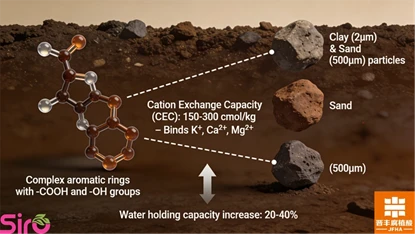
Humic powder acts as a “biological glue” that transforms compacted, degraded soils into loose, crumbly humic soil:
Aggregate formation: Humic substances’ carboxyl and hydroxyl groups bind sand, silt, and clay particles into stable 0.5–2 mm aggregates. These aggregates create pores (macropores for air, micropores for water), increasing soil porosity by 30% and reducing bulk density by 15–20% (Li et al., 2023). In China’s Hebei Province, a corn field with compacted soil (bulk density 1.6 g/cm³) treated with humic powder reached 1.3 g/cm³ within 12 months—matching the structure of natural humic soil.
Erosion resistance: Stable aggregates resist breakdown by water and wind, reducing soil erosion by 40–50%. In slope farms in Ethiopia’s Amhara Region, humic powder application cut runoff loss by 45%, preserving topsoil and organic matter (International Center for Tropical Agriculture [CIAT], 2024).
Chemical Mechanisms: Nutrient Retention and pH Buffering
Humic powder enhances soil fertility by optimizing chemical properties:
Cation Exchange Capacity (CEC) enhancement: CEC measures a soil’s ability to hold and release nutrients (N, P, K, micronutrients). Humic powder increases CEC by 25–35% (depending on soil type), turning “leaky” sandy soils (low CEC) into nutrient reservoirs and reducing fertilizer waste by 25–30% (SSSA, 2024). In Florida’s sandy citrus groves, humic powder application reduced nitrogen leaching by 38%, allowing growers to cut urea usage by 27% (USDA Agricultural Research Service, 2024).
pH buffering: Humic substances stabilize soil pH between 6.5–7.5—the optimal range for most crops—by neutralizing excess acidity (in peat soils) or alkalinity (in arid-region soils). In India’s Rajasthan (pH 8.3), humic powder lowered soil pH to 7.2 within 6 months, improving iron and zinc availability by 40% (Indian Council of Agricultural Research [ICAR], 2024).
Biological Mechanisms: Microbial Activity and Humus Formation
Humic soil’s fertility hinges on microbial activity—and humic powder fuels this ecosystem:
Carbon source for microbes: Humic powder provides labile organic carbon, increasing beneficial microbial populations (bacteria, fungi, earthworms) by 50–100% within weeks (Li et al., 2023). These microbes decompose organic matter (e.g., crop residues) into stable humus, accelerating humic soil formation. In Brazil’s coffee plantations, humic powder application doubled earthworm populations, a key indicator of soil health (Embrapa, 2024).
Pathogen suppression: Beneficial microbes (e.g., Bacillus subtilis, mycorrhizae) stimulated by humic powder outcompete soil-borne pathogens (e.g., Fusarium, root-knot nematodes). In China’s Zhejiang Province, vegetable farms using humic powder reduced root rot incidence by 50% (Shanxi Agricultural University, 2024).
Quality Humic Powder vs. Low-Grade Alternatives
Not all humic powders are equal—quality directly impacts efficacy. Below is a data-driven comparison based on global agricultural standards:
Low-grade products often contain inert ash, heavy metals, or poorly extracted humic substances—offering minimal soil benefits. Farmers in Nigeria’s Ogun State learned this the hard way: switching from low-grade to high-quality humic powder increased maize yields by 18% (Federal University of Agriculture, Abeokuta, 2024).
Global Application Scenarios: Crops, Soils, and Climates
Degraded Agricultural Soils (China, India, Ethiopia)
China (Hebei Province): Continuous corn cropping degraded soil organic matter to 0.8%. Annual application of 20 kg/hm² humic powder for 3 years raised organic matter to 2.5%, reduced irrigation needs by 30%, and increased yields by 20% (Shanxi Agricultural University, 2024).
India (Punjab): Sandy soils with low water retention benefited from humic powder (25 kg/hm²), improving moisture holding capacity by 35% and wheat yields by 15% (ICAR, 2024).
Ethiopia (Amhara Region): Slope farms using humic powder reduced soil erosion by 45%, preserving topsoil and increasing teff yields by 12% (CIAT, 2024).
Intensive Horticulture (Brazil, Spain, Kenya)
Brazil (São Paulo): Coffee plantations on clay soils used humic powder (30 kg/hm²) to reduce compaction, increasing root depth by 25% and coffee cherry yield by 18% (Embrapa, 2024).
Spain (Murcia): Greenhouse tomatoes treated with humic powder (foliar spray + soil drench) had 10-day longer shelf life and 12% higher vitamin C content, fetching a 15% price premium (Spanish Ministry of Agriculture, 2024).
U.S. (California): Organic strawberry farms used humic powder to replace 30% of synthetic fertilizers, maintaining yields while meeting USDA organic standards. Berry sweetness (Brix) increased by 1.0 degree (University of California, Davis, 2024).
Germany (Bavaria): Organic wheat farms applied humic powder to build humic soil, increasing soil organic matter from 1.8% to 3.2% in 4 years and reducing weed pressure by 30% (Deutsche Landwirtschafts-Gesellschaft [DLG], 2024).
Technical Q&A: Addressing Farmer’s Core Concerns
Q1: What application rate and frequency are best for building humic soil?
A1: Rates depend on initial soil organic matter (SOM) and target (3–5% SOM):
Degraded soils (SOM <1%): 20–30 kg/hm² annually for 2–3 years (accelerates humus formation).
Moderately fertile soils (SOM 1–2%): 10–15 kg/hm² annually (maintains progress).
Maintenance (SOM 3–5%): 5–10 kg/hm² every 2–3 years (preserves humic soil structure).
Apply in autumn (post-harvest) or spring (pre-planting), mixed with organic matter (compost, cover crop residues) to enhance microbial decomposition. For example, farmers in Brazil mix humic powder with sugarcane bagasse—doubling humus formation rate (Embrapa, 2024).
Many smallholders split bulk bags or use localized application (e.g., banding near roots) to reduce costs—common practice in India and Ethiopia (ICAR & CIAT, 2024).
References
Embrapa. (2024). Humic substances for soil restoration in Brazilian coffee and soybean farms. Brasília: Brazilian Agricultural Research Corporation.
Food and Agriculture Organization (FAO). (2023). The State of the World’s Soils.
International Center for Tropical Agriculture (CIAT). (2024). Humic powder for erosion control in Ethiopian smallholder farms.
Indian Council of Agricultural Research (ICAR). (2024). Humic acid-based soil amendments for sustainable wheat production in Punjab.
International Humic Substances Society (IHSS). (2024). Quality standards for humic-based soil amendments.
Kenya Agricultural and Livestock Research Organization (KALRO). (2024). Humic powder for smallholder vegetable productivity in Kenya.
Li, M., Chen, J., & Zhao, Y. (2023). Humic powder application enhances soil organic matter and microbial activity in degraded agricultural soils. Soil Biology and Biochemistry, 178, 108976.
Shanxi Agricultural University. (2024). Long-term effects of humic acid on soil quality and crop yield. Journal of Soil Science and Plant Nutrition, 24(2), 345–360.
Soil Science Society of America (SSSA). (2024). Humic substances and soil structure: A review.
Spanish Ministry of Agriculture, Fisheries and Food. (2024). Humic powder for greenhouse vegetable quality enhancement. Madrid: Ministry of Agriculture, Fisheries and Food.
University of California, Davis. (2024). Humic amendments in organic strawberry production. Davis: UC Davis Agricultural and Natural Resources.
USDA Agricultural Research Service. (2024). Humic powder reduces nitrogen leaching in sandy soils. Beltsville: USDA ARS.