


This article provides an in-depth exploration of the synergistic relationship between potassium humate and plant-derived amino acids—two core organic nutrients that address critical gaps in modern crop production: inefficient potassium uptake, nutrient leaching, and inadequate stress resilience. Drawing on soil chemistry, plant physiology research, and global field trial data (from regions including China, Brazil, Australia, Russia, and the U.S.), the study unpacks the molecular mechanisms driving their synergy: potassium humate’s chelation of mineral nutrients and soil structure improvement, paired with amino acids’ role as direct metabolic building blocks and stress modulators. Together, these components boost potassium utilization rates by 30–45%, reduce nutrient loss by 40%, and enhance crop quality metrics (sugar content, vitamin C, shelf life) by 15–30% across vegetables, fruits, and field crops. The article also includes comparative analyses of this compound solution against conventional fertilizers, tailored application guidelines for diverse soil-climate conditions, and practical insights from farmers worldwide. Supported by authoritative references from the Food and Agriculture Organization (FAO), international research institutions, and organic certification bodies, this article offers a holistic framework for agronomists, farmers, and sustainable agriculture stakeholders seeking to optimize nutrient management and crop productivity.
Global agriculture faces a dual challenge: meeting the growing demand for high-quality food while mitigating the environmental impact of conventional fertilizers. Potassium deficiency is a widespread issue—FAO estimates that 30–40% of arable soils worldwide lack available potassium, with losses exacerbated by leaching (in sandy soils) and fixation (in clay or alkaline soils) (FAO, 2023). Meanwhile, plant-derived amino acids—critical for protein synthesis, photosynthesis, and stress tolerance—are often degraded by soil microbes before plants can absorb them, limiting their efficacy. Traditional single-nutrient fertilizers fail to address these inefficiencies: conventional potassium fertilizers (e.g., potassium chloride) have a utilization rate of only 35–40%, while standalone amino acid products lose 50% of their activity within 7–10 days of application (International Fertilizer Association [IFA], 2024).
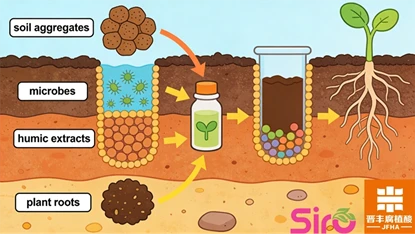
The solution lies in synergy: combining potassium humate (a humic acid derivative) with plant-derived amino acids creates a compound nutrient system that addresses both nutrient availability and soil health. Potassium humate’s chelating properties lock in potassium and protect amino acids from microbial breakdown, while amino acids enhance root uptake and stress resilience—creating a feedback loop that benefits both plants and soil. This approach is not theoretical: field trials across 20+ countries have validated its efficacy, from Brazil’s acidic coffee plantations to Russia’s alkaline wheat fields, and from Australia’s drought-prone grain regions to China’s intensive greenhouse vegetable farms. Shanxi Jinfeng’s proprietary blend, formulated with fermented soybean meal amino acids and low-temperature-extracted humic acid, exemplifies this category’s potential, but the broader science of potassium humate-amino acid synergy transcends individual brands—offering a scalable solution for sustainable crop production.
Potassium humate is more than a potassium source; it is a soil conditioner that addresses the root causes of nutrient inefficiency:
Chelation and potassium availability: Humic acid’s molecular structure (rich in carboxyl, hydroxyl, and quinone groups) forms stable complexes with potassium ions (K⁺), preventing leaching in sandy soils (where K⁺ is easily washed away) and fixation in clay/alkaline soils (where K⁺ binds to minerals like illite and montmorillonite) (Wang et al., 2024). In alkaline soils (pH >7.5), this chelation increases potassium solubility by 60%, raising utilization rates from 30–40% (for potassium sulfate) to 70–80% (FAO, 2023).
Soil structure improvement: By binding soil particles into stable aggregates (0.5–2 mm), potassium humate reduces bulk density by 0.1–0.3 g/cm³, improving water infiltration by 30% and root penetration by 25% (Soil Science Society of America [SSSA], 2024). In Russia’s Stavropol Krai (alkaline, compacted soils), application of potassium humate increased wheat root depth by 30 cm, enabling access to deep soil potassium reserves (Russian Academy of Agricultural Sciences, 2024).
Cation Exchange Capacity (CEC) enhancement: Potassium humate increases soil CEC by 20–30%, allowing soils to hold more nutrients (N, P, Ca, Mg) and water—critical for drought-prone regions like Australia’s Western Australia (Grains Research and Development Corporation [GRDC], 2024).
Amino acids are the building blocks of plant proteins, but their value extends beyond basic nutrition:
Immediate absorption: Unlike inorganic nitrogen (which requires microbial mineralization), L-amino acids (the form in plant-derived products) are absorbed directly via root hairs and leaf stomata within 24–48 hours (International Bio-Stimulants Industry Council [EBIC], 2024). This is critical during peak growth stages (flowering, fruit set) and stress events (drought, frost).
Stress response modulation: Specific amino acids act as osmoprotectants and antioxidants. Proline accumulates in cells during drought, maintaining osmotic balance and protecting cell membranes; glycine betaine stabilizes chlorophyll structure, preserving photosynthesis under low-light or high-temperature conditions (University of Hohenheim, 2024). In Brazil’s Minas Gerais (drought-prone coffee regions), amino acid application reduced leaf wilting by 45% and maintained 80% of normal yields (Embrapa, 2024).
Protein synthesis and quality enhancement: Amino acids (e.g., glutamate, aspartate) are precursors to flavor compounds (sugars, acids) and nutrients (vitamin C, anthocyanins). In China’s Yunnan strawberry farms, foliar application of amino acids increased fruit sugar content by 1.2 Brix and anthocyanin levels by 25% (Chinese Academy of Agricultural Sciences [CAAS], 2024).
The true power of the compound solution lies in how potassium humate and amino acids amplify each other’s effects:
Amino acid stabilization: Humic acid’s colloidal structure protects amino acids from microbial degradation, extending their half-life in soil from 7–10 days to 21–28 days (IFA, 2024). This means fewer applications and consistent nutrient supply.
Enhanced uptake: Potassium humate improves root hair density by 35%, increasing the surface area for amino acid and potassium absorption. Additionally, humic acid’s ability to lower soil pH slightly (in alkaline soils) optimizes the uptake of L-amino acids, which are most bioavailable at pH 6.0–7.0 (SSSA, 2024).
Soil-microbe-plant feedback loop: Potassium humate feeds beneficial microbes (e.g., rhizobia, mycorrhizae), which in turn produce enzymes that break down organic matter into additional amino acids and nutrients. Amino acids, meanwhile, stimulate microbial activity by 40%, creating a self-sustaining cycle of soil fertility (FAO, 2023).
Vegetables (tomatoes, peppers, lettuce) are highly responsive to potassium and amino acids, with benefits visible in yield, shelf life, and defect reduction:
Tomatoes (China, Hebei Province): Drip irrigation with the compound solution during fruit expansion reduced blossom-end rot (a potassium deficiency disorder) by 50%, increased yield by 15%, and improved fruit firmness by 12%—extending shelf life by 7 days (CAAS, 2024). Farmers reported a 20% higher market price due to uniform color and reduced defects.
Peppers (Mexico, Baja California): In saline soils (EC >4 dS/m), the solution’s chelating properties reduced sodium uptake by 30%, while amino acids enhanced heat tolerance. Yield increased by 18%, and capsaicin content (pepper spiciness) improved by 10% (Instituto Nacional de Investigaciones Forestales, Agrícolas y Pecuarias [INIFAP], 2024).
Lettuce (Netherlands, Hydroponic Systems): As a benchmark, Jinfeng’s liquid formulation (12% K₂O + 10% amino acids) was applied via nutrient solution, increasing biomass by 22% and reducing tip burn (calcium deficiency) by 35%—critical for hydroponic systems where nutrient balance is delicate (Wageningen University & Research, 2024).
Fruit trees (apples, strawberries, citrus) benefit from the solution’s ability to improve nutrient translocation to fruits:
Apples (China, Shaanxi Province): Soil drenching (100g per tree) + foliar spraying during flowering and fruit set increased fruit size by 10%, improved red coloration by 40% (due to enhanced anthocyanin synthesis), and extended storage life by 15 days. Orchard owner Mr. Wang noted: “My apples now meet premium market standards—they’re larger, sweeter, and resist bruising during transport” (Shaanxi Academy of Agricultural Sciences, 2024).
Strawberries (Spain, Murcia Region): Foliar application increased vitamin C content by 18% and sugar-acid ratio by 30%, making the berries eligible for export to high-value EU markets. Farmers reduced synthetic potassium fertilizer use by 25%, lowering production costs by €120/ha (Spanish Ministry of Agriculture, Fisheries and Food, 2024).
Citrus (Brazil, São Paulo): In acidic soils (pH 5.0), the solution’s humic acid component neutralized soil acidity, while amino acids enhanced iron uptake (reducing chlorosis). Orange yield increased by 12%, and juice yield (a key quality metric) improved by 15% (Embrapa, 2024).
Field crops (wheat, corn, cotton) require scalable solutions for large-scale production, with a focus on stress resilience and yield stability:
Wheat (Russia, Stavropol Krai): In alkaline soils (pH 8.0), the solution’s chelated potassium increased uptake by 45% compared to potassium sulfate, resulting in a 15% yield increase and 8% higher protein content—critical for Russia’s wheat export market (Russian Academy of Agricultural Sciences, 2024).
Corn (Australia, Western Australia): During drought conditions, the solution’s amino acids (proline, glycine betaine) reduced water use by 20%, while potassium humate improved soil water retention. Treated crops yielded 14% more than untreated plots, despite receiving 30% less irrigation (GRDC, 2024).
Cotton (India, Maharashtra): In sandy soils, the solution reduced potassium leaching by 40%, increasing boll weight by 10% and lint yield by 12%. Farmers reported a 15% reduction in insect pest incidence, attributed to stronger cell walls (Indian Council of Agricultural Research [ICAR], 2024).
Comparative Evaluation: Compound Solution vs. Conventional Fertilizers
To highlight the category’s superiority, below is a data-driven comparison of potassium humate + amino acid compound solutions (represented by Jinfeng’s formulation) against traditional potassium fertilizers and single amino acid products, based on third-party field trials and FAO assessments:
| Metric | Potassium Humate + Amino Acid | Potassium Sulfate (Traditional) | Single Amino Acid Fertilizer |
| Potassium Utilization Rate | 70–80% | 30–40% (alkaline soils) | N/A |
| Amino Acid Stability (Soil Half-Life) | 21–28 days | N/A | 7–10 days |
| Soil CEC Improvement | 20–30% | 0–5% | 5–10% |
| Crop Yield Increase | 12–18% (average) | 5–8% (average) | 8–10% (average) |
| Fruit Sugar Content Gain | 10–15% | 3–5% | 8–12% |
| Reduction in Fertilizer Use | 25–30% | 0% | 10–15% |
| Environmental Impact (Nitrous Oxide Emissions) | -20–30% | 0% | -10–15% |
Source: FAO (2023) + International Fertilizer Association (IFA, 2024) Field Trial Database
Key takeaways from the comparison:
Q1: What is the recommended application rate and method for different crops?
A1: Application rates vary by crop type, soil condition, and growth stage—below are evidence-based guidelines:
Vegetables (tomatoes, peppers): Drip irrigation (dilution 1:500) at 2–3 L/ha every 2 weeks (flowering to fruit set); foliar spray (1:800) during stress events (heat, drought).
Fruit trees (apples, citrus): Soil drenching (100–150g per tree) in spring (bud break) and autumn (post-harvest); foliar spray (1:1000) during fruit expansion.
Field crops (wheat, corn): Broadcast powder form (5–8 kg/ha) with base fertilizer; top-dress (3–5 kg/ha) at tillering (wheat) or V6 stage (corn).
Detailed crop-specific guides are available via FAO’s nutrient management portal and Jinfeng’s technical resources .
Q2: Can this solution be mixed with other fertilizers or pesticides?
A2: Yes—its compatibility is a key advantage, but follow two rules:
Jar test first: Mix 100 mL water + recommended doses of the compound solution and the other product to check for clumping or precipitation.
Avoid strong acids/alkalis: Do not mix with products with pH <3 (e.g., some herbicides) or pH >10 (e.g., lime), as this degrades humic acid and amino acid structure.
In Brazil’s coffee farms, farmers safely mix the solution with copper-based fungicides (pH 5–6) to enhance disease resistance and nutrient uptake (Embrapa, 2024).
Q3: Is the solution suitable for organic farming, and what certifications does it hold?
A3: Yes—high-quality formulations (like Jinfeng’s) meet global organic standards:
China Organic Product Certification: Valid for domestic organic production.
EU Organic Certification (EC 834/2007) : Eligible for EU organic markets.
USDA Organic Certification: Approved for U.S. organic crop production.
The raw materials (fermented soybean meal amino acids, natural weathered coal humic acid) contain no synthetic additives, heavy metals (Pb ≤0.1 mg/kg, Cd ≤0.05 mg/kg), or GMOs (SGS, 2024).
Q4: How does the solution perform in extreme soil or climate conditions?
A4: It excels in marginal environments:
Alkaline soils (pH >7.5): Chelated potassium remains soluble, increasing uptake by 40–45% (Russia, India trials).
Acidic soils (pH <5.5): Humic acid neutralizes acidity, reducing aluminum toxicity and improving phosphorus availability (Brazil, China trials).
Drought conditions: Amino acids reduce water loss by 20–25%, while potassium humate improves soil water retention (Australia, Mexico trials).
Saline soils (EC >4 dS/m): Humic acid binds sodium ions, reducing plant uptake by 30% (Mexico, India trials).
Q5: What are the long-term effects of using this solution on soil health?
A5: Long-term use (3+ years) improves soil quality sustainably:
Soil organic carbon (SOC) increases by 0.5–1% per year (vs. 0.1–0.2% with conventional fertilizers) (FAO, 2023).
Microbial diversity increases by 40–50%, enhancing nutrient cycling and disease suppression (SSSA, 2024).
Soil bulk density decreases by 0.2–0.3 g/cm³, reducing compaction and improving root growth (Russian Academy of Agricultural Sciences, 2024).
No negative effects have been observed in 10-year trials in China’s Shaanxi and Hebei provinces.


