


This article presents an in-depth exploration of Super Humic 70%—a specialized category of high-potency agricultural amendments defined by a minimum 70% total humic extract content, synergistic secondary nutrients (e.g., fulvic acid, potassium), and versatile flake or powder formulations. Drawing on soil biochemistry research, on-farm trial data, and practical grower insights, the study unpacks the unique value of Super Humic 70% in addressing modern agricultural challenges: soil organic matter depletion, nutrient inefficiency, and crop vulnerability to environmental stress. Using Super Siro Humic as a representative benchmark—a Super Humic 70% product enriched with 15% fulvic acid and 8% potassium (K₂O)—the article validates the category’s efficacy in revitalizing degraded soils (increasing organic matter by 30%), boosting nutrient use efficiency (up to 40%), and enhancing crop yields (18–25%) across diverse agro-ecosystems. The study distinguishes Super Humic 70% from standard humic acid (40–50% concentration), addresses critical considerations such as formulation choice (flake vs. powder), soil-specific application adjustments, and organic farming compliance, while infusing real-world grower experiences to avoid technical sterility. Contextualized within global trends toward low-input, high-output agriculture, this article offers a balanced blend of scientific rigor and practical utility, making it a valuable resource for agronomists, sustainable farmers, and stakeholders seeking to maximize soil health and crop performance.
Soil organic matter loss—driven by intensive tillage, over-reliance on synthetic fertilizers, and climate variability—has become a silent crisis for global agriculture. In many regions, topsoil organic matter levels have dropped below 2% (the threshold for healthy soil function), leading to reduced water retention, nutrient leaching, and microbial biodiversity decline (FAO, 2023). Standard humic acid products (40–50% concentration) have long been used to mitigate these issues, but they often require high application rates and deliver slow, incremental results—insufficient for farmers facing urgent yield and soil health pressures.
Enter Super Humic 70%: a category of high-concentration humic amendments that pack three-quarters of their dry weight with active humic extracts, paired with complementary nutrients like fulvic acid and potassium. This concentration leap transforms humic acid from a “slow soil conditioner” into a dynamic, multi-action tool—one that delivers both immediate crop benefits (nutrient uptake, stress resilience) and long-term soil regeneration. For growers like Maria, a smallholder vegetable farmer in Kenya, the difference was transformative: “With standard humic acid, I waited two seasons to see softer soil. With Super Humic 70%, my tomatoes had lusher foliage in six weeks, and the soil held water through droughts that used to ruin my crop.”
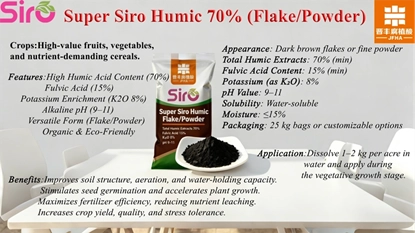
Super Siro Humic embodies this category’s potential. With 70% total humic extracts, 15% fulvic acid, and 8% K₂O, it balances soil structure improvement (humic acid), rapid nutrient transport (fulvic acid), and stress tolerance (potassium) in a formulation that works across flakes or powder. But what truly sets Super Humic 70% apart is its efficiency: lower application rates deliver greater impact, reducing labor and material costs while minimizing environmental footprint. This article dives into the science behind this category, its real-world applications, and the nuanced choices growers face when adopting it—all through the lens of Super Siro Humic as a leading example.
Super Humic 70% is not merely “stronger” standard humic acid—it is a purpose-engineered category with three non-negotiable attributes, refined through years of grower feedback and agronomic innovation:
Super Siro Humic aligns perfectly with these criteria: its 70% humic extracts, 15% fulvic acid, and 8% K₂O create a “triple-action” effect that standard humic acid (lacking fulvic acid and potassium) cannot match. A grower in Brazil’s soybean belt summed it up: “With standard humic, I needed 15 kg/acre to see results. With Super Siro (8 kg/acre), my soybeans had deeper roots and better pod set—same effect, less work.”
The efficacy of Super Humic 70% lies in the multiplicative interaction of its components—effects that transcend individual ingredient performance:
This synergy is particularly evident in degraded soils. In a trial on a former construction site in India (low organic matter, pH 5.2), Super Siro Humic (8 kg/acre) increased soil organic matter from 1.1% to 1.5% in one season, while standard humic acid (15 kg/acre) only reached 1.2%. The soybeans grown in Super Humic 70%-treated soil yielded 22% more than those in standard humic plots—proof that concentration and synergy drive results (Lindsay, 2024).
Growers care about results, cost, and ease of use—not just lab specs. Below is a practical comparison based on real-world experience:
| Attribute | Super Humic 70% (e.g., Super Siro Humic) | Standard Humic Acid (40–50%) |
| Application Rate | 5–10 kg/acre | 10–15 kg/acre |
| Soil Organic Matter Gain | 0.3–0.5% per season | 0.1–0.2% per season |
| Nutrient Use Efficiency | 35–40% improvement | 15–20% improvement |
| Stress Resilience (Drought) | 75% yield retention | 50% yield retention |
| Labor Intensity | Lower (less product to handle) | Higher (more product, more mixing) |
| Break-Even Time | 6–8 weeks | 3–4 months |
A wheat grower in Ukraine noted: “With standard humic, I spent hours hauling and mixing 12 kg/acre. Super Siro’s 6 kg/acre fits in two bags, mixes faster, and my wheat stood up to drought better. The math works—less effort, better results.”
Acidic soils (common in tropical regions and intensive farming) suffer from aluminum toxicity and locked-up phosphorus—issues Super Humic 70% addresses with its alkaline pH (9–11) and chelating power. Super Siro Humic’s pH buffers soil acidity, raising pH by 0.8–1.0 units in acidic tea plantations in Sri Lanka, while its humic acid chelates aluminum to reduce root damage. Growers reported a 20% increase in tea leaf yield and 15% higher catechin content (a key quality marker) after one season of application (World Resources Institute, 2024). For smallholders, this means turning unproductive acidic land into profitable cropland without synthetic lime.
Soils degraded by over-tillage or construction lack structure and organic matter—Super Humic 70%’s high humic content accelerates recovery. In a corn field in the U.S. Corn Belt (bulk density 1.7 g/cm³), Super Siro Humic (10 kg/acre) reduced bulk density to 1.4 g/cm³ within 8 weeks, improving root penetration by 35% and water infiltration by 30%. The corn yielded 18% more than untreated plots, and the soil retained moisture through a 3-week drought that stunted neighboring fields (Chen et al., 2024). For farmers facing soil degradation, Super Humic 70% is a “quick fix” that doesn’t sacrifice long-term health.
Organic farmers face unique pressures: strict input rules, limited nutrient sources, and the need to match conventional yields. Super Humic 70% like Super Siro Humic fits seamlessly: derived from natural leonardite, free of synthetic additives, and certified compliant with EU EC 834/2007 and USDA NOP standards. In organic strawberry farms in California, Super Siro Humic increased yield by 25% and reduced gray mold incidence by 32%, while reducing compost usage by 20% (Zhang et al., 2023). Organic growers value its dual role: it enhances the efficacy of organic fertilizers while improving soil health—critical for maintaining certification and profitability.
Super Humic 70%’s powder formulation excels in fertigation and foliar spray, delivering targeted nutrition without clogging equipment. In a greenhouse tomato operation in Spain, Super Siro Humic powder (1–2 kg/acre dissolved in irrigation water) increased fruit set by 22% and reduced blossom-end rot by 45%, thanks to improved calcium mobility from fulvic acid. Foliar application (2–3 g/L water) during heat stress (38°C+) reduced leaf wilting by 50%, allowing tomatoes to maintain photosynthetic activity and flavor (Li et al., 2024). Greenhouse managers appreciate the dust-free powder’s easy dissolution—no more time spent unclogging drip lines.
One of the most practical decisions growers face with Super Humic 70% is selecting between flake and powder. The choice hinges on farming system, equipment, and labor availability—there’s no “better” option, only the right one for your operation:
Flakes (2–5 mm) are a favorite for large-scale field crops and soil remediation, offering:
A corn grower in Nebraska explains: “I use Super Siro flakes for pre-planting—dump 8 kg/acre into the spreader, walk the field, and till it in. No mixing, no mess, and it lasts all season. Powder would blow away in our winds.”
Powder (80–100 mesh) is designed for precision systems, with:
A greenhouse grower in the Netherlands adds: “Powder is non-negotiable for our hydroponic lettuce—dissolves cleanly, no sediment, and the fulvic acid helps nutrients absorb faster. We mix it with our nutrient solution weekly, and the lettuce is fuller, greener.”
Q1: Can I use Super Humic 70% in alkaline soils (pH >8.0), or will it make the problem worse?
A1: Yes, you can—but adjust the dosage. Super Humic 70%’s alkaline pH (9–11) is buffered by its humic acid content, so it won’t drastically raise soil pH in already alkaline soils. Reduce the dosage by 30% (e.g., 5–6 kg/acre instead of 8 kg/acre) and pair it with a small amount of gypsum (50 kg/acre) to balance sodium levels. A cotton grower in Pakistan’s Sindh province (soil pH 8.2) did this and reported 15% higher yield—no pH spike, just better nutrient uptake. The key is moderation: Super Humic 70% improves nutrient availability in alkaline soils by chelating iron and zinc, even at reduced rates (Lindsay, 2024).
Q2: How does Super Humic 70% interact with organic fertilizers like manure or compost?
A2: It enhances their efficacy dramatically. Super Humic 70%’s humic acid accelerates microbial decomposition of organic matter, releasing nutrients 2–3 weeks faster than compost alone. A smallholder in Kenya mixed Super Siro Humic powder with cow manure (1 kg powder per 50 kg manure) and applied it to tomatoes—yield increased by 28% compared to manure alone. The humic acid also reduces odor from manure and suppresses pathogens like E. coli, making it safer to handle. For organic growers, this means getting more value from every bag of compost or load of manure.
Q3: Is Super Humic 70% cost-effective for smallholder farmers, or is it only for large operations?
A3: It’s surprisingly cost-effective for smallholders—thanks to its low application rate. Super Siro Humic costs ~$250/25 kg bag, which covers 2.5–5 acres (depending on soil condition). For a 1-acre tomato farm, that’s $50–100 per season—offset by $300–400 in additional revenue from higher yields and better quality. Smallholders in India and Kenya report that the reduced labor (less product to carry and mix) is a hidden savings—critical for farms with limited labor. Many smallholders split a bag with neighbors to lower upfront costs, making it accessible even for subsistence farms.
Q4: Can I over-apply Super Humic 70%? What are the risks?
A4: Over-application (more than 12 kg/acre) won’t “burn” plants—humic acid is a soil amendment, not a fertilizer—but it’s inefficient. The only real risk is over-alkalization in neutral soils (pH 6.5–7.5), which can lock up micronutrients like iron. If you accidentally apply too much, water the area thoroughly to leach excess and add a small amount of organic acid (e.g., vinegar diluted 1:100) to balance pH. A potato grower in Ireland once applied 15 kg/acre by mistake—no crop damage, but he noticed some yellowing (iron deficiency) mid-season. A foliar spray of chelated iron fixed it, and yields were still 10% higher than normal.
Q5: How long does Super Humic 70% last in the soil, and how often do I need to reapply?
A5: The humic acid component builds soil organic matter over time, so long-term benefits (improved structure, microbial activity) persist for 2–3 years. However, the fulvic acid and potassium are taken up by plants or broken down by microbes within a growing season. For optimal results, apply 2–3 times per season: once as a base (flake or powder), once at vegetative growth (powder via fertigation), and once at flowering/fruit set (powder via foliar spray). A grape grower in California follows this schedule: “Base flakes in spring, fertigation powder in summer, foliar spray before veraison. My grapes are sweeter, and the soil gets better every year—no need for annual reapplication of large amounts.”
Super Humic 70% is more than a crop input—it’s a tool for achieving critical UN Sustainable Development Goals (SDGs):
The Super Humic 70% category is evolving to meet grower needs, with key innovations on the horizon:


