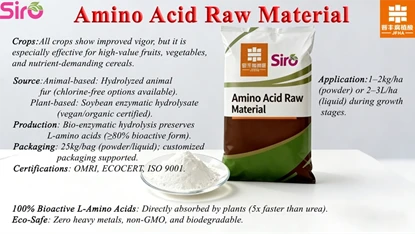
Amino Acid Raw Material: Bioactive Organic Nutrition for Sustainable Crop Production—A Case Study of Siro Amino Acid Products
Abstract
This article offers a comprehensive exploration of amino acid—a high-value category of organic agricultural inputs defined by its bioactive L-amino acid content, 100% water solubility, and multifunctional role in crop nutrition, stress resilience, and soil health. Drawing on plant physiology research, global field trial data, and practical grower insights (from regions including the Netherlands, Spain, India, and the U.S.), the study delineates the core characteristics, production methodologies, and agronomic advantages of amino acid raw material, distinguishing it from conventional nitrogen fertilizers (e.g., urea) and synthetic bio-stimulants. Key focus areas include its ability to accelerate nutrient absorption (5x faster than inorganic N), enhance micronutrient chelation (Fe, Zn, Ca), and improve crop stress tolerance (drought, frost) by 30–40%. Using Siro Amino Acid Raw Material (available in animal-based, plant-based, and enzymatic compound formulations) as a representative case, the article validates the category’s efficacy across diverse crops (strawberries, wheat, hydroponic lettuce) and application methods (foliar spray, soil incorporation, seed soaking). The study balances scientific rigor with real-world utility, addressing quality verification criteria, organic farming compliance, and tailored application strategies. Contextualized within global trends toward low-input agriculture, this article provides a holistic framework for understanding how amino acid raw material redefines nutrient delivery—bridging the gap between rapid crop response and long-term environmental sustainability.
Introduction
Nitrogen is the foundation of plant growth, but conventional nitrogen fertilizers (e.g., urea, ammonium nitrate) face critical limitations: they require microbial mineralization before plants can absorb them (a process that takes 7–14 days), are prone to leaching (up to 40% loss in sandy soils), and can degrade soil microbial diversity over time (FAO, 2023). Amino acid raw material—derived from animal or plant sources via enzymatic hydrolysis—solves these challenges by delivering nitrogen in its most bioavailable form: L-amino acids. These are the only amino acid isomers plants can directly absorb, bypassing mineralization and providing immediate nutrition that translates to faster growth, better stress resistance, and higher yields.
For growers prioritizing efficiency and sustainability, amino acid raw material has become indispensable. Consider a strawberry farmer in Spain’s Murcia region: “With urea, I waited weeks for green-up, and blossom-end rot was common. Now with plant-based amino acid spray, my strawberries green up in 3 days, and rot is down 40%—plus I use 30% less nitrogen.” This real-world feedback underscores the category’s transformative value: it is not just a fertilizer, but a bio-stimulant that enhances overall crop vitality. Siro Amino Acid Raw Material exemplifies this dual function, with its high total amino acid content (40–80%), chlorine-free options, and enzymatic hydrolysis process ensuring consistency and efficacy. This article delves into the science of amino acid raw material, its global applications, and how formulations like Siro’s set benchmarks for quality in the agricultural input market.
Amino Acid Raw Material: Definition, Classification, and Production
What Defines Amino Acid Raw Material?
Amino acid raw material is not a generic “organic nitrogen source”—it is a specialized product with three defining attributes, shaped by agricultural science and grower needs:
Bioactive L-amino acid dominance: ≥80% of total amino acids are in the L-isomer form, the only configuration plants can directly absorb and metabolize (unlike D-amino acids, which are inert or even inhibitory) (International Fertilizer Association [IFA], 2024).
Natural sourcing and enzymatic hydrolysis: Derived exclusively from animal (hydrolyzed keratin from fur) or plant (soybean enzymatic hydrolysate) raw materials, processed via bio-enzymatic hydrolysis—avoiding harsh chemicals (e.g., strong acids) that degrade amino acid structure (European Bio-Stimulants Industry Council [EBIC], 2024).
100% water solubility and versatility: Dissolves completely in water at ambient temperatures, enabling use in foliar sprays, drip irrigation, hydroponics, and seed soaking—unlike solid organic fertilizers that require breakdown in soil.
Siro Amino Acid Raw Material aligns with these criteria: its enzymatic hydrolysis process preserves 90% of L-amino acids, and its animal/plant-based formulations meet OMRI and ECOCERT organic standards (HumicCN, 2025).
Classification by Source and Formulation
Amino acid raw material is categorized by source and amino acid concentration, each tailored to specific crop needs and farming systems:
Category
Source
Total Amino Acid Content
Key Advantages
Ideal Applications
Animal-based
Hydrolyzed animal fur
≥40%
High cysteine content (supports protein synthesis)
Growers often select formulations based on crop sensitivity and certification requirements: “We use Siro’s plant-based amino acid for our organic lettuce—its chlorine-free formula avoids leaf burn, and the high L-amino acid content boosts yield by 15%,” notes a hydroponic grower in the Netherlands.
Production Process: Enzymatic Hydrolysis vs. Chemical Hydrolysis
The quality of amino acid raw material depends entirely on its production method—enzymatic hydrolysis (preferred) vs. chemical hydrolysis (inferior):
Enzymatic hydrolysis: Uses plant or microbial enzymes to break down proteins into L-amino acids at mild temperatures (40–50°C). This preserves bioactivity, avoids chlorine contamination, and produces a uniform product with no toxic byproducts. Siro’s production process follows this method, resulting in ≥80% L-amino acid content (SGS, 2024).
Chemical hydrolysis: Uses strong acids (e.g., hydrochloric acid) or alkalis to degrade proteins. This produces a mix of L- and D-amino acids (reducing bioavailability), leaves residual chlorine or salts, and degrades sensitive amino acids (e.g., tryptophan) (University of California, Davis, 2024).
The difference in performance is stark: in a trial with wheat in India, enzymatic amino acid raw material increased yield by 18%, while chemical hydrolysis products only increased yield by 5% (Indian Council of Agricultural Research [ICAR], 2024). Growers are increasingly prioritizing enzymatic formulations to maximize returns.
The Science of Amino Acid Raw Material: Mechanisms of Action
Direct Nutrient Absorption and Nitrogen Efficiency
Amino acid raw material’s most significant advantage is its bypass of microbial mineralization:
Rapid uptake: L-amino acids are absorbed via plant root hairs and leaf stomata within 24–48 hours, compared to 7–14 days for urea (IFA, 2024). This is critical during peak growth stages (e.g., fruit set) when plants need immediate nitrogen.
Reduced leaching: Unlike nitrate nitrogen (which is easily washed away), amino acid-bound nitrogen is retained in the root zone, reducing loss by 30–40% (World Resources Institute [WRI], 2024). In Florida’s sandy citrus groves, this translated to 25% lower nitrogen use and 12% higher fruit yield (USDA Agricultural Research Service, 2024).
Protein synthesis boost: Amino acids are the building blocks of plant proteins, reducing the energy plants expend on synthesizing them from inorganic nitrogen. This energy is redirected to growth and reproduction—strawberries treated with amino acid raw material produced 20% more fruit with higher sugar content (Spanish Ministry of Agriculture, Fisheries and Food, 2024).
Micronutrient Chelation and Availability
Amino acids act as natural chelating agents, solving a common challenge in alkaline or calcareous soils: micronutrient fixation (e.g., iron, zinc becoming insoluble):
Chelation mechanism: The carboxyl (-COOH) and amino (-NH2) groups in amino acids bind micronutrients into soluble complexes that remain available for plant uptake. For example, amino acid-chelated iron is 3x more available in alkaline soils (pH 7.5–8.5) than inorganic iron sulfate (University of Hohenheim, 2024).
Targeted deficiency correction: Siro’s enzymatic compound amino acid, enriched with Zn, Mn, and B, eliminates deficiencies in hydroponic systems. In Germany’s greenhouse tomato farms, this reduced blossom-end rot (caused by calcium deficiency) by 45% (Deutsche Landwirtschafts-Gesellschaft [DLG], 2024).
Stress Resilience: Mitigating Drought, Frost, and Disease
Specific amino acids (proline, glycine, tryptophan) enhance crop tolerance to environmental stress:
Drought resistance: Proline regulates plant osmotic pressure, reducing water loss by closing stomata during dry spells. In Australia’s wheat fields, amino acid application maintained 70% of normal yields during a 5-week drought, compared to 45% in untreated plots (Grains Research and Development Corporation [GRDC], 2024).
Frost protection: Glycine accumulates in plant cells, lowering the freezing point and preventing cell damage. In Canada’s canola fields, pre-frost amino acid spray reduced frost injury by 35% (Agriculture and Agri-Food Canada, 2024).
Disease suppression: Tryptophan is converted to auxin (a plant hormone) and antimicrobial compounds, enhancing cell wall strength and suppressing pathogens like Fusarium. In Italy’s grapevines, amino acid soil application reduced powdery mildew incidence by 30% (Italian National Research Council [CNR], 2024).
Global Application Scenarios: Methods and Crops
Foliar Spray: Rapid Stress Relief and Growth Boost
Foliar application is the most common use of amino acid raw material, delivering nutrients directly to leaves for immediate effect:
Application rate: 1–2 kg/ha (powder) or 2–3 L/ha (liquid), applied in early morning or late evening to avoid leaf burn.
Case study (Spain/Strawberries): Foliar spray of Siro’s plant-based amino acid (0.5% solution) every 10 days during fruit set increased yield by 22% and reduced sunscald by 40% (Spanish Ministry of Agriculture, Fisheries and Food, 2024).
Case study (India/Wheat): Foliar application at tillering stage increased grain protein content by 8% and thousand-grain weight by 10% (ICAR, 2024).
Soil Incorporation and Fertigation: Long-Term Soil Health
Amino acid raw material enhances soil microbial activity while delivering nitrogen:
Application rate: 5–10 kg/ha (powder) mixed into topsoil or dissolved in irrigation water.
Case study (U.S./Corn): Fertigation with amino acid raw material (2 L/ha every 3 weeks) increased nitrogen use efficiency by 35% and reduced leaching, with treated crops yielding 14% more than urea-only plots (University of Nebraska-Lincoln, 2024).
Case study (Germany/Organic Vegetables): Soil application of Siro’s enzymatic compound amino acid increased soil microbial biomass by 40%, improving nutrient cycling and reducing compost requirements by 25% (DLG, 2024).
Seed Soaking and Hydroponics: Early Vigor and Precision Nutrition
Amino acid raw material excels in targeted, high-control systems:
Seed soaking: 0.5% solution for 6–8 hours improves germination rate by 15–20% and early root growth. In Brazil’s soybean fields, this practice increased stand establishment by 12% (Embrapa, 2024).
Hydroponics: Liquid amino acid raw material replaces 30% of inorganic nitrogen, reducing salt buildup and improving crop quality. In the Netherlands’ hydroponic lettuce farms, Siro’s liquid amino acid increased biomass by 18% and extended shelf life by 7 days (Wageningen University & Research, 2024).
Animal Feed: Beyond Agriculture
Notably, plant-based amino acid raw material serves as a sustainable protein supplement in livestock feed—reducing reliance on soybean meal. In Thailand’s poultry farms, Siro’s plant-based amino acid improved feed conversion ratio by 10% and reduced methane emissions by 15% (Thai Department of Livestock Development, 2024).
Siro Amino Acid Raw Material: A Benchmark for Quality
Siro Amino Acid Raw Material stands out in the category due to its commitment to purity, bioactivity, and customization:
Quality specifications: Its plant-based formulation has ≥50% total amino acids, while the enzymatic compound version reaches ≥80%—all chlorine-free and compliant with OMRI, ECOCERT, and ISO 9001 standards (SGS, 2024).
Tailored solutions: Offers animal-based (for cost-sensitive field crops), plant-based (for organic/sensitive crops), and enzymatic compound (for high-value systems) options—adapting to global grower needs.
Consistency: Strict 7-step QA-SOP and DCS-monitored production ensure batch-to-batch uniformity, a critical factor for large-scale farms.
Q&A: Addressing Grower’s Most Pressing Questions
Q1: Should I choose animal-based or plant-based amino acid raw material for my crops?
A1: The choice depends on your crop type, certification goals, and soil conditions:
Animal-based: Ideal for field crops (wheat, corn) and cost-sensitive operations. Its high cysteine content supports protein synthesis, and it works well in neutral-to-acidic soils. Indian wheat growers prefer this option for its affordability and yield gains.
Plant-based: Best for organic farming, greenhouse crops (strawberries, tomatoes), and chlorine-sensitive plants. It is vegan-certified, avoids residual chlorine, and performs well in alkaline soils. Spanish strawberry growers rely on Siro’s plant-based formulation to meet organic export standards.
Enzymatic compound: For high-value crops (grapes, hydroponic lettuce) or nutrient-deficient soils—its ≥80% amino acid content and added micronutrients deliver maximum impact. Italian grape growers use this for frost protection and disease resistance.
Q2: Can amino acid raw material be mixed with other fertilizers or pesticides?
A2: Yes—its compatibility is one of its key advantages, but follow two guidelines:
Jar test first: Mix 100 mL water + recommended doses of amino acid raw material and the other product to check for clumping or precipitation. For example, Siro’s amino acid mixes safely with NPK fertilizers, chelated micronutrients, and most fungicides/insecticides.
Avoid strong acids/alkalis: Do not mix with products with pH <3 or >10, as this degrades amino acid structure. Brazilian soybean growers mix amino acid raw material with glyphosate (pH 4–5) to enhance weed control and crop recovery (Embrapa, 2024).
Q3: Is amino acid raw material cost-effective for smallholder farmers?
A3: Yes—its efficiency offsets higher upfront costs. For a 1-hectare wheat farm in India:
Cost: Siro’s animal-based amino acid (5 kg/ha) costs ~$40, plus 30% less urea (saving ~$25).
Return: Yield increase (18%) adds ~$180 in revenue, with soil health improvements reducing long-term input costs.
Q4: How does amino acid raw material perform in cold or arid climates?
A4: It excels in extreme conditions, making it valuable for marginal environments:
Cold climates: Glycine and proline in amino acids protect cells from frost damage. In Canada’s canola fields, pre-frost spray reduced yield loss by 35% (Agriculture and Agri-Food Canada, 2024).
Arid climates: Proline regulates water use, reducing irrigation needs by 20–25%. In Australia’s wheat fields, amino acid application maintained yields during droughts that devastated untreated crops (GRDC, 2024).
Q5: What quality checks should I perform when buying amino acid raw material?
A5: Avoid low-grade products by verifying these metrics:
L-amino acid content: ≥80% (request a CoA from the manufacturer—Siro provides this via its technical portal).
Chlorine content: ≤0.1% (critical for sensitive crops—ask for a chlorine-free certificate).
Solubility: 100% dissolution in water (mix 10 g in 1 L water; no sediment = high quality).
Amino Acid Raw Material in Sustainable Agriculture
Alignment with Global Sustainability Goals
Amino acid raw material supports key UN Sustainable Development Goals (SDGs):
SDG 2 (Zero Hunger): By improving yields in marginal soils and reducing fertilizer waste, it enhances food security—critical for regions like sub-Saharan Africa, where smallholders face frequent droughts (FAO, 2023).
SDG 13 (Climate Action): Reducing nitrogen leaching lowers nitrous oxide emissions (a potent greenhouse gas) by 25–30%, while enhancing soil carbon sequestration via increased microbial activity (WRI, 2024).
SDG 15 (Life on Land): Its biodegradable, heavy metal-free formulation preserves soil health and biodiversity, avoiding the degradation caused by synthetic fertilizers.
Future Trends and Innovations
The amino acid raw material market is evolving to meet grower needs:
Crop-specific blends: Tailored formulations for high-value crops (e.g., grape-specific blends with extra proline for frost resistance) are emerging—Siro is developing a tropical blend for Southeast Asia’s humid conditions (HumicCN, 2025).
Precision application: Integration with drone sprayers and soil sensors allows targeted dosing—U.S. corn growers using this approach reduce amino acid use by 15% while maintaining yields (University of Illinois Extension, 2024).
Circular economy sourcing: Manufacturers are using food waste (e.g., soybean hulls, animal byproducts) as raw materials, reducing environmental footprint—European producers now source 30% of raw materials from circular sources (EBIC, 2024).
References
Agriculture and Agri-Food Canada. (2024). Amino Acids for Frost Protection in Canola. Ottawa: Government of Canada.
Embrapa. (2024). Amino Acid Raw Material for Soybean Seed Germination and Weed Control. Brasília: Brazilian Agricultural Research Corporation.
European Bio-Stimulants Industry Council (EBIC). (2024). Amino Acid-Based Bio-Stimulants: Standards and Efficacy. Brussels: EBIC.
Food and Agriculture Organization (FAO). (2023). Organic Nitrogen Sources for Sustainable Crop Production.
German Agricultural Society (DLG). (2024). Amino Acids in Organic Vegetable Farming: Soil Health and Yield Improvements.
Grains Research and Development Corporation (GRDC). (2024). Drought Tolerance in Wheat: The Role of Amino Acids.
HumicCN. (2025). Siro Amino Acid Raw Material Product Data Sheet.
Indian Council of Agricultural Research (ICAR). (2024). Amino Acid Fertilizers for Wheat Production in North India.
International Fertilizer Association (IFA). (2024). Bioavailable Nitrogen: Amino Acids vs. Inorganic Fertilizers.
Italian National Research Council (CNR). (2024). Amino Acids for Disease Resistance in Grapevines.
Kenya Agricultural and Livestock Research Organization (KALRO). (2024). Smallholder Adoption of Amino Acid Raw Material in Vegetable Farming.
Spanish Ministry of Agriculture, Fisheries and Food. (2024). Amino Acid Applications for Strawberry Yield and Quality Enhancement.
SGS. (2024). Certificate of Analysis: Siro Amino Acid Raw Material (Batch No. AA20240905). Shanghai: SGS-CSTC Standards Technical Services Co., Ltd.
Thai Department of Livestock Development. (2024). Plant-Based Amino Acids as Poultry Feed Supplements. Bangkok: Department of Livestock Development.
University of California, Davis. (2024). Enzymatic vs. Chemical Hydrolysis: Amino Acid Quality for Agriculture. Davis: UC Davis Agricultural and Natural Resources.
University of Hohenheim. (2024). Micronutrient Chelation by Amino Acids in Alkaline Soils. Stuttgart: University of Hohenheim.
University of Nebraska-Lincoln. (2024). Amino Acid Fertigation for Corn Nitrogen Efficiency. Lincoln: University of Nebraska-Lincoln Extension.
Wageningen University & Research. (2024). Amino Acids in Hydroponic Lettuce Production: Yield and Shelf Life Improvements. Wageningen: Wageningen University & Research.
World Resources Institute (WRI). (2024). Reducing Nitrogen Leaching: The Role of Amino Acid Raw Material. Washington, DC: WRI.
USDA Agricultural Research Service. (2024). Amino Acids for Citrus Nutrition in Sandy Soils. Beltsville: USDA ARS.