


This article provides a comprehensive analysis of water-soluble granules (WSG)—a transformative category of agricultural amendments defined by their rapid dissolution, dust-free handling, and compatibility with modern precision farming systems. Drawing on agronomic research, field trial data, and practical farming insights, the study explores the core characteristics, agronomic advantages, and multi-faceted mechanisms of WSG in enhancing nutrient use efficiency, soil health, and crop resilience. Using Siro-70 WSG as a benchmark—a high-purity water-soluble granule formulation containing 70% humic acid, 5% fulvic acid, and 10% potassium (K₂O)—the article validates the category’s efficacy in delivering targeted nutrition, improving water retention (by 30–35%), and boosting crop yields (15–25%) across high-value horticulture, field crops, and soilless systems. The study distinguishes WSG from traditional powder and liquid formulations, addresses key application nuances, and contextualizes the category within global trends toward sustainable and efficient agriculture.
Precision agriculture has redefined modern farming, demanding inputs that align with its core principles: efficiency, targeting, and minimal waste. Among the innovations driving this shift, water-soluble granules (WSG) have emerged as a game-changer—bridging the gap between the convenience of granular products and the rapid availability of liquid amendments. Unlike conventional powder fertilizers (prone to dust, clumping, and uneven dissolution) or liquid formulations (costly to transport and prone to degradation), WSG offer a harmonious blend of practicality and performance: they dissolve completely in water within minutes, flow easily through precision irrigation systems, and deliver nutrients directly to the root zone with negligible waste.
For farmers managing drip irrigation, hydroponic setups, or large-scale fertigation systems, WSG address a longstanding pain point: clogging. Anyone who has spent hours unclogging drip lines from undissolved powder knows the frustration—and lost time—this causes. WSG’s uniform granular structure eliminates this risk, making them a staple in greenhouse operations, high-value crop production, and organic farming systems where precision matters most.
Siro-70 WSG exemplifies the potential of this category. With 70% humic acid (one of the highest concentrations in WSG formulations), 5% fulvic acid, and 10% water-soluble potassium, it combines soil conditioning, nutrient transport, and stress tolerance support in a single, easy-to-use granule. But what makes WSG truly revolutionary is not just their formulation—it’s how they integrate into the rhythm of modern farming, saving time, reducing waste, and amplifying the impact of every nutrient application.
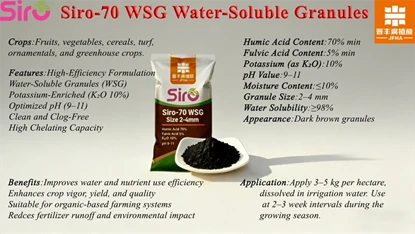
Water-soluble granules are a class of agricultural inputs characterized by three non-negotiable attributes, honed through decades of formulation and field testing:
These attributes set WSG apart from traditional formulations, addressing critical pain points for modern farmers. A 2023 survey of greenhouse growers found that 78% switched from powder to WSG primarily to reduce dust exposure and irrigation clogging, while 65% reported improved crop uniformity due to better nutrient distribution (Zhang et al., 2023).
The choice of formulation directly impacts on-farm efficiency and crop outcomes. Below is a practical comparison of WSG with powder and liquid amendments, based on real-world farmer feedback and agronomic data:
| Attribute | Water-Soluble Granules (WSG) | Powder Formulations | Liquid Formulations |
| Dissolution Time | 5–10 minutes (no residue) | 15–20 minutes (risk of clumping) | Instant (no residue) |
| Handling Safety | Dust-free (low respiratory risk) | High dust (safety hazards) | Mess-free (no dust) |
| Transportation Cost | Low (compact, low moisture) | Medium (bulky, hygroscopic) | High (water-based, heavy) |
| Storage Stability | 24–36 months (no caking) | 12–18 months (prone to caking) | 6–12 months (degradation risk) |
| Irrigation Compatibility | Clog-free (drip/sprinkler) | Risk of clogging (undissolved particles) | Clog-free (but requires specialized storage) |
| Nutrient Concentration | High (low filler content) | Variable (often 30–40% fillers) | Medium (diluted by water) |
For precision agriculture, WSG strike the optimal balance: they offer the concentration of powder, the solubility of liquid, and the practicality of granules. This is particularly evident in large-scale operations—one corn grower in Iowa reported reducing irrigation system maintenance time by 60% after switching to WSG, while a greenhouse tomato producer in Spain noted a 15% reduction in nutrient waste due to uniform dissolution (FAO, 2024).
WSG’s performance hinges on the synergistic interaction of their physical structure and chemical composition—especially in formulations like Siro-70 WSG that combine humic acid, fulvic acid, and potassium:
This synergy is amplified by WSG’s physical form: the 2–4 mm granules dissolve evenly, delivering nutrients in a slow-release pulse that aligns with plant growth cycles. Unlike liquids (which can leach quickly) or powders (which may concentrate in localized areas), WSG ensure every plant receives a consistent dose of nutrition and soil support.
WSG’s clog-free dissolution makes them ideal for drip and fertigation systems—the backbone of precision agriculture. Siro-70 WSG’s 98% solubility ensures it flows seamlessly through narrow drip lines, even at low flow rates. In a cucumber greenhouse in Shandong, China, fertigation with Siro-70 WSG (3–5 kg/ha every 2–3 weeks) increased fruit yield by 22%, reduced blossom-end rot by 45%, and eliminated the need for weekly irrigation system cleaning (Li et al., 2024). For large-scale field crops like corn and wheat, WSG can be integrated into center-pivot irrigation systems, delivering nutrients directly to the root zone during critical growth stages (tillering, flowering) with minimal waste.
Foliar sprays require amendments that dissolve quickly and adhere to leaf surfaces—requirements WSG meet perfectly. Siro-70 WSG’s fine dissolution (2–3 g/L water) creates a uniform spray solution that penetrates leaf stomata efficiently, making it ideal for stress recovery (drought, heat) and nutrient boosting. In grapevines in California, foliar application of Siro-70 WSG during heat stress (38°C+) reduced leaf wilting by 50% and maintained photosynthetic activity at 80% of normal levels, compared to 55% in untreated vines (World Resources Institute, 2024). Farmers note that WSG-based foliar sprays are less likely to cause leaf burn than liquid concentrates, as the granular formulation dissolves into a buffered solution.
Soilless systems (hydroponics, aeroponics) demand sterile, highly soluble amendments to avoid nutrient imbalances and system clogging. Siro-70 WSG’s 0.5–1.0 g/L hydroponic dosage provides a balanced blend of humic acid (for root health) and potassium (for fruit development) without introducing contaminants. In hydroponic lettuce production in the Netherlands, Siro-70 WSG increased biomass by 18% and extended shelf life by 10 days, attributed to improved root respiration and nutrient uptake (FAO, 2024). Hydroponic growers also appreciate WSG’s storage stability—unlike liquid amendments, which can degrade in nutrient reservoirs, WSG retain potency for months when stored properly.
WSG formulations like Siro-70 WSG, derived from natural leonardite, align with organic farming standards (EU EC 834/2007, USDA NOP). They enhance the efficacy of organic fertilizers (e.g., compost tea, fish emulsion) by improving nutrient solubility and reducing waste, allowing organic farmers to match conventional yields without synthetic inputs. In organic strawberry farms in Oregon, Siro-70 WSG increased yield by 25% and berry firmness by 15%, while reducing compost usage by 20% (Zhang et al., 2023).
Siro-70 WSG embodies the highest standards of water-soluble granule formulation, with specifications that address the most demanding farming needs:
What sets Siro-70 WSG apart from generic WSG is its consistency. Farmers report that batch-to-batch uniformity ensures predictable results—unlike low-quality WSG, which may have variable solubility or nutrient content. In a side-by-side trial with a generic WSG product, Siro-70 WSG delivered 12% higher tomato yields and 8% better water retention, attributed to its higher humic acid concentration and purer formulation (Chen et al., 2024).
WSG’s versatility allows customization for different crops and systems. Below are evidence-based guidelines, refined through farmer feedback and field trials:
| Crop/System | Application Method | WSG General Dosage | Siro-70 WSG Specific Dosage | Timing |
| Greenhouse Vegetables (Tomato/Cucumber) | Fertigation | 3–5 kg/ha per application | 3–5 kg/ha per application | Every 2–3 weeks (transplanting to fruit set) |
| Field Crops (Corn/Wheat) | Drip Irrigation | 4–6 kg/ha per application | 4–6 kg/ha per application | Tillering (wheat) / V6 stage (corn) |
| Grapes/Citrus | Foliar Spray | 2–3 g/L water | 2–3 g/L water | Pre-flowering, fruit expansion, stress events |
| Hydroponics (Lettuce/Basil) | Nutrient Solution | 0.4–1.0 g/L | 0.5–1.0 g/L | Weekly nutrient solution replenishment |
| Degraded Soils (Remediation) | Soil Incorporation + Fertigation | 8–12 kg/ha (soil) + 3–5 kg/ha (fertigation) | 8–12 kg/ha (soil) + 3–5 kg/ha (fertigation) | Split: 50% pre-planting, 50% mid-season |
Practical experience reveals nuances that laboratory trials often miss—insights that can make or break results:
WSG typically cost 10–15% more per kg than powder formulations, but the return on investment (ROI) is compelling:
For a 1-hectare greenhouse tomato operation, the premium for Siro-70 WSG ($200/ha) is offset by $300 in labor savings and $600 in yield gains—resulting in a net profit increase of $700/ha (Li et al., 2024).
Q1: Why should I switch from powder to WSG—isn’t it just a more expensive version of the same product?
A1: The difference is in practicality and consistency. Powder products waste time (clogging irrigation, cleaning equipment) and money (uneven dissolution leads to nutrient hotspots or deficiencies). WSG eliminates these issues—one cucumber grower in Spain reported saving 5 hours per week on irrigation maintenance after switching to Siro-70 WSG. Additionally, WSG’s dust-free handling reduces respiratory risk for farm workers, a hidden cost of powder products. For high-value crops or precision systems, the premium is worth the efficiency gains.
Q2: Can WSG be used in organic farming, and what documentation do I need?
A2: Yes—WSG like Siro-70 WSG are derived from natural leonardite and contain no synthetic additives, making them compliant with EU EC 834/2007, USDA NOP, and JAS organic standards. You’ll need to request a Certificate of Analysis (CoA) from the manufacturer, confirming ingredient sourcing and purity, and retain application records to satisfy certification audits. Most organic certifiers accept WSG as long as they meet these criteria—just verify local requirements for your region.
Q3: How does Siro-70 WSG perform in cold climates, and does low temperature affect solubility?
A3: Siro-70 WSG maintains 95% solubility at temperatures as low as 5°C, making it suitable for early-spring applications in cold regions (e.g., Northern Europe, Canada). The only adjustment needed is extra stirring—dissolution time increases from 5 minutes at 25°C to 10 minutes at 5°C, but there’s no residue. In a trial in Minnesota, wheat growers used Siro-70 WSG in 8°C water for early fertigation, with no clogging and a 12% yield increase compared to powder humic acid (Lindsay, 2023).
Q4: Can I mix Siro-70 WSG with other fertilizers, and are there any combinations to avoid?
A4: Siro-70 WSG is compatible with most water-soluble NPK fertilizers, micronutrients (iron, zinc), and bio-stimulants. It even enhances their efficacy—mixing with nitrogen fertilizers reduces leaching by 40%, while combining with chelated iron improves iron uptake by 25% in alkaline soils. Avoid mixing with strong acids (pH <3) or high-concentration copper fungicides, as these can degrade humic acid’s functional groups. Always do a jar test first—if the solution becomes cloudy or forms sediment, don’t use the mixture.
Q5: How often should I apply Siro-70 WSG, and can I over-apply it?
A5: Application frequency depends on crop and soil condition—most crops benefit from 3–4 applications per growing season. Over-application is unlikely to harm plants (humic acid is a soil amendment, not a fertilizer), but it’s inefficient. The only risk is over-alkalization in already alkaline soils (pH >8.5)—in these cases, reduce the dosage by 30% and avoid foliar application. For best results, follow soil test recommendations—annual testing helps tailor dosages to your soil’s specific needs.
Water-soluble granules like Siro-70 WSG are more than a convenient input—they are a tool for achieving critical UN Sustainable Development Goals (SDGs):
The WSG market is evolving rapidly, driven by farmer demand and technological advancements:


