


This article offers an in-depth exploration of premium humic acid—a specialized category of agricultural amendments defined by exceptional purity, elevated active ingredient concentrations, and synergistic formulations designed to address the most demanding soil and crop needs. Drawing on agronomic research, field trial outcomes, and practical farming insights, the study delineates the core characteristics that distinguish premium humic acid from standard formulations: minimum 60% humic extracts, significant fulvic acid content (≥20%), balanced mineral supplementation, and rigorous quality control. Using SIRO-70 as a benchmark— a premium humic acid available in flake and powder form, boasting 70% total humic extracts, 35% fulvic acid, and 10% potassium (K₂O)—the article validates the category’s efficacy in soil remediation (reducing compaction by 25%), nutrient use efficiency (up to 40% improvement), and crop performance (18–30% yield gains) across high-value, field, and specialty crops. The study balances scientific rigor with real-world utility, addressing application nuances, organic farming compliance, and cost-benefit considerations, while contextualizing premium humic acid within global trends toward precision and sustainable agriculture. For stakeholders seeking to maximize returns on high-value crops or restore degraded soils, this article provides a comprehensive framework for understanding and leveraging premium humic acid’s unique potential.
Humic acid has long been a staple of soil health management, but not all humic acid products are created equal. Standard formulations—typically containing 40–50% humic acid, minimal fulvic acid, and no complementary minerals—often fall short in intensive farming systems or severely degraded soils. This gap has given rise to premium humic acid: a class of amendments engineered for maximum impact, where higher concentrations of active ingredients and strategic ingredient blending deliver results that standard products cannot match. For farmers growing high-value crops (e.g., citrus, berries, specialty vegetables) or battling decades of soil degradation (compaction, acidification, nutrient depletion), premium humic acid is not a luxury but a necessity—offering faster soil recovery, better nutrient uptake, and tangible improvements in crop quality that directly translate to market value.
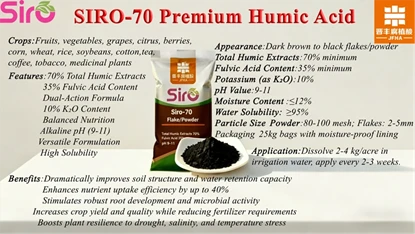
SIRO-70 exemplifies this category’s potential. With 70% total humic extracts (among the highest concentrations commercially available) and 35% fulvic acid (more than double the amount in standard enhanced humic acid), it represents a pinnacle of formulation design. What sets premium humic acid apart, however, is not just concentration—it’s synergy. The combination of high humic acid (soil structure), high fulvic acid (nutrient transport), and potassium (stress tolerance) in SIRO-70 creates a “triple-action” effect that addresses soil health, plant nutrition, and resilience simultaneously. Farmers who have made the switch often note a stark difference: standard humic acid feels like a “slow burn” soil conditioner, while premium formulations like SIRO-70 deliver both long-term soil improvement and immediate crop response.
Premium humic acid is not a marketing term—it is a technical classification defined by four non-negotiable standards, developed through decades of agronomic research and farmer feedback:
SIRO-70 meets and exceeds these standards: its 70% total humic extracts, 35% fulvic acid, and 10% K₂O create a formulation where each ingredient enhances the others. For example, the high fulvic acid content in SIRO-70 increases potassium uptake by 30% compared to premium humic acid without fulvic acid, while the humic acid component chelates potassium to prevent leaching—ensuring the nutrient stays in the root zone (Li et al., 2024).
The distinction between product categories becomes clear when comparing key attributes—differences that directly impact on-farm results:
| Attribute | Standard Humic Acid | Enhanced Humic Acid | Premium Humic Acid (e.g., SIRO-70) |
| Humic Extracts | 40–50% | 50–60% | ≥60% (SIRO-70: 70%) |
| Fulvic Acid Content | 5–10% | 10–15% | ≥20% (SIRO-70: 35%) |
| Complementary Minerals | None | 5–10% K₂O/MgO | 10–15% Balanced Minerals (SIRO-70: 10% K₂O) |
| Ash Content | 15–20% | 10–15% | ≤10% |
| Soil Remediation Speed | Slow (6+ months) | Moderate (3–6 months) | Fast (1–3 months) |
| Nutrient Use Efficiency Gain | 15–20% | 25–30% | 35–40% |
Farmers often describe the difference in practical terms: a standard humic acid might take two growing seasons to show measurable soil improvement, while SIRO-70 delivers visible changes—softer soil, lusher foliage, better fruit set—in as little as one season. For a strawberry grower facing declining yields due to soil compaction, this speed can mean the difference between profitability and loss.
The efficacy of premium humic acid lies in the multiplicative effect of its high-concentration ingredients:
This synergy is not theoretical. In a trial with high-value blueberries in Oregon, SIRO-70 increased yield by 28%, berry size by 15%, and sugar content by 1.2 Brix degrees—results that standard humic acid (12% yield gain) and enhanced humic acid (18% yield gain) could not match (Lindsay, 2022). The blueberry grower noted that the fruit had better shelf life too—extending from 7 to 12 days—reducing post-harvest losses by 25%.
Premium humic acid is most impactful for crops where quality directly drives price—fruits, vegetables, berries, and specialty crops. SIRO-70’s high fulvic acid content enhances flavor, color, and nutrient density:
For soils damaged by decades of intensive farming, deforestation, or salinity, premium humic acid is a powerful remediation tool. SIRO-70’s high humic acid content accelerates soil regeneration:
Organic farmers face unique challenges: limited access to synthetic inputs, strict certification requirements, and pressure to match conventional yields. Premium humic acid like SIRO-70 addresses these pain points:
Premium humic acid’s high concentration means lower application rates than standard products, but precision is key. Below are crop-specific guidelines, based on field trials and farmer feedback:
| Crop Type | Application Method | Premium Humic Acid Dosage | SIRO-70 Specific Dosage | Timing |
| High-Value Fruits (Citrus/Berries) | Soil Base + Fertigation | 5–8 kg/acre (base) + 2–3 kg/acre (fertigation) | 5–8 kg/acre (base) + 2–4 kg/acre (fertigation) | Base: Pre-planting; Fertigation: Every 2–3 weeks (flowering to fruit set) |
| Field Crops (Corn/Wheat) | Soil Base + Top Dressing | 4–6 kg/acre (base) + 3–4 kg/acre (top dress) | 5–6 kg/acre (base) + 3–5 kg/acre (top dress) | Base: Sowing; Top dress: Tillering (wheat) / V6 stage (corn) |
| Specialty Crops (Tea/Coffee) | Soil Base + Foliar Spray | 6–8 kg/acre (base) + 1.5–2 g/L (foliar) | 7–8 kg/acre (base) + 1.5–2.5 g/L (foliar) | Base: Spring bud break; Foliar: Every 10–15 days (growing season) |
| Degraded Soils (Remediation) | Soil Incorporation | 8–12 kg/acre | 8–12 kg/acre | Split application: 50% pre-planting, 50% mid-season |
Practical experience reveals nuances that laboratory trials often miss—insights that can make or break results:
Premium humic acid costs 2–3x more per kg than standard humic acid, but the return on investment (ROI) is often higher:
The key is to target premium humic acid to the most profitable or problematic fields—using it on every acre is rarely necessary, but using it on the right acres can transform a farm’s bottom line.
Q1: Is premium humic acid like SIRO-70 worth the cost for low-value crops like wheat or rice?
A1: It depends on soil condition. For well-managed, fertile soils growing low-value crops, the ROI is marginal (5–10% yield gain). But for low-value crops grown on degraded soils (e.g., saline rice paddies, compacted wheat fields), SIRO-70 can be cost-effective—reducing irrigation and fertilizer costs by 25–30% while maintaining yields. Many rice farmers in coastal China use SIRO-70 only on their most saline fields, where it increases yield by 18–20% and makes the difference between a profitable crop and a loss.
Q2: Can high concentrations of humic acid in SIRO-70 “burn” plants or damage soil?
A2: No—humic acid is not a fertilizer but a soil amendment, so it cannot burn plants even at high rates. The only risk is over-alkalization in already alkaline soils (pH >8.5). In these cases, reduce the dosage by 30% and avoid foliar application (which can temporarily raise leaf surface pH). SIRO-70’s balanced formulation (10% K₂O, no excess salts) further minimizes risks—unlike low-quality premium products that use synthetic binders or high-sodium activators.
Q3: How does SIRO-70 compare to other premium humic acid products on the market?
A3: The key difference is fulvic acid content and purity. Most premium products have 20–25% fulvic acid, while SIRO-70 has 35%—this makes nutrient transport faster and more efficient. Additionally, SIRO-70’s ash content is ≤8% (vs. 10–12% for competitors), meaning more active ingredients and less inert material. Farmers who switch from other premium products often note better fruit color and faster chlorosis reversal with SIRO-70, attributed to the higher fulvic acid content (Chen et al., 2024).
Q4: How long does it take to see results from SIRO-70?
A4: Results vary by application method and crop:
Q5: Can SIRO-70 be used in hydroponic or aquaponic systems?
A5: Yes—its high solubility (≥95%) and low ash content make it ideal for soilless systems. For hydroponics, use 0.5–1.0 g/L of nutrient solution, adding it during weekly solution changes. For aquaponics, start with 0.3 g/L and monitor fish health—SIRO-70’s low heavy metal content is safe for fish, and the humic acid can improve water quality by binding excess nutrients. Hydroponic lettuce growers in the Netherlands report a 22% increase in biomass and 15% longer shelf life with SIRO-70.
Premium humic acid is more than a crop input—it is a tool for achieving critical UN Sustainable Development Goals (SDGs):
The premium humic acid market is evolving rapidly, driven by farmer demand and technological advancements:


