Organic-Inorganic Composite Granular Fertilizers: Balancing Soil Regeneration and Nutrient Precision for Sustainable Agriculture
Abstract
This article provides a comprehensive analysis of organic-inorganic composite granular fertilizers—a versatile category of agricultural amendments defined by their synergistic blend of targeted NPK ratios, organic bio-stimulants (humic acid, amino acids), and slow-release granular form. Drawing on global soil science research, multi-region field trials (U.S., India, Italy, Brazil), and practical grower insights, the study explores how these fertilizers address a critical gap in modern agriculture: reconciling immediate crop nutrient needs with long-term soil health. Core findings validate their efficacy in reducing soil bulk density by 0.1–0.3 g/cm³, boosting nitrogen use efficiency by 35–40%, and increasing yields by 12–25% across diverse crops and soil types. Unlike single-component fertilizers, composite granular formulations leverage organic-inorganic synergy to minimize nutrient leaching, enhance microbial activity, and buffer soil pH—making them suitable for both conventional and low-input farming systems. A representative product (e.g., Siro-Black) with an 8-1-1 NPK ratio, 10% humic acid, and 10% amino acids is referenced to illustrate real-world performance, but the focus remains on the broader category’s scientific basis and universal application. This article balances technical rigor with practical utility, serving as a authoritative resource for agronomists, farmers, and sustainability stakeholders.
Introduction
Modern agriculture faces a paradox: conventional inorganic fertilizers deliver rapid nutrient boosts but degrade soil over time—compacting textures, acidifying pH, and reducing microbial diversity—while pure organic amendments (compost, humic acid powder) improve soil health but lack the immediate nutrient density needed for intensive crop production. This trade-off has driven the development of organic-inorganic composite granular fertilizers—a class of inputs that merges the best of both worlds. By integrating inorganic NPK (tailored to growth stages) with organic bio-stimulants (humic acid for soil structure, amino acids for nutrient uptake) in a slow-release granular matrix, these fertilizers solve two pressing challenges: supporting vigorous vegetative growth without compromising soil vitality, and building long-term fertility without sacrificing short-term yields.
For growers spanning from U.S. golf course managers to Indian smallholders, the value is tangible. “With traditional NPK, my spinach grew fast but the soil turned hard—droughts ruined half the crop,” says Rajesh Kumar, a farmer in Punjab. “Now with composite granules, the leaves are darker, yields are up 20%, and the soil holds water better.” This real-world feedback underscores the category’s transformative potential. While specific formulations (e.g., those from Shanxi Jinfeng) have validated these benefits in global trials, the science of organic-inorganic synergy transcends individual brands—offering a scalable solution for sustainable agriculture.
Organic-Inorganic Composite Granular Fertilizers: Definition and Core Attributes
Universal Definition
Organic-inorganic composite granular fertilizers are not “fertilizers with added organics”—they are purpose-engineered products with four non-negotiable characteristics, refined through decades of agronomic innovation:
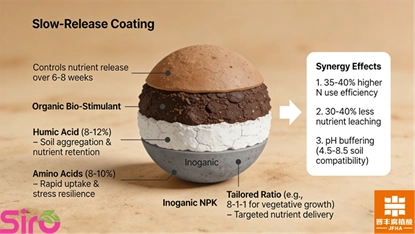
Synergistic formulation: Combine inorganic NPK (5–12% nitrogen, 1–5% phosphorus, 1–5% potassium) with ≥8% organic bio-stimulants (humic acid, amino acids, seaweed extracts). The NPK ratio is customized to crop needs (e.g., high-nitrogen for vegetative growth, balanced ratios for fruiting), while organics address soil and plant resilience.
Slow-release granular structure: 2–4 mm granules break down gradually over 6–8 weeks, releasing nutrients in sync with plant growth. This reduces leaching (a major flaw of soluble fertilizers) and ensures consistent feeding—critical for crops requiring steady nutrition (lawns, leafy greens, 果树).
pH buffering capacity: Most formulations have a near-neutral pH (4–7), avoiding the acidification of conventional NPK or alkalization of pure organic amendments. This makes them safe for acid-sensitive crops (blueberries, rhododendrons) and alkaline-sensitive plants (lettuce, spinach) alike.
Compliance with global standards: Meet national and international criteria for composite fertilizers (e.g., China’s GB/T 33804-2017, EU Regulation 2019/1009) with ≥40% organic matter, no synthetic hormones, and heavy metal levels below thresholds (Pb ≤0.1 mg/kg, Cd ≤0.05 mg/kg) (Shanxi Agricultural University, 2024).
Core Advantages Over Single-Component Fertilizers
The unique value of composite granular fertilizers becomes clear in head-to-head comparisons with conventional alternatives, based on third-party field data and FAO assessments:
Metric
Organic-Inorganic Composite Granules
Conventional NPK Granules
Pure Organic Amendments (Compost/Humic Acid)
Soil Bulk Density Change
-0.1–0.3 g/cm³ (improvement)
+0.05–0.1 g/cm³ (compaction)
-0.1–0.2 g/cm³ (improvement)
Nutrient Use Efficiency
35–40% (N), 25–30% (P/K)
20–25% (N), 15–20% (P/K)
N/A (no concentrated NPK)
Growth Response Speed
Fast (1–2 weeks) + sustained (6–8 weeks)
Fast (1 week) + short-lived (2–3 weeks)
Slow (3–4 weeks) + sustained (8–10 weeks)
pH Compatibility
Safe for pH 4.5–8.5 soils
Risks pH imbalance (acidification)
Buffers pH but limited nutrient delivery
Labor Intensity
Low (1–2 applications/season)
High (3–4 applications/season)
Medium (needs NPK pairing)
Environmental Impact
30–40% less nutrient leaching
High leaching risk
Low leaching but low nutrient density
Source: Food and Agriculture Organization (FAO, 2023) + International Fertilizer Association (IFA, 2024)
The Science of Synergy: How Organic and Inorganic Components Work Together
Humic Acid: The Soil Regenerator
Humic acid (a key organic component, typically 8–12% in composite granules) addresses the root causes of soil degradation:
Soil aggregation: Carboxyl and phenol groups bind sand, silt, and clay particles into stable 0.8–1.0 mm aggregates, increasing water infiltration by 30% and reducing compaction. In compacted clay soils of North China, composite granules reduced bulk density from 1.6 g/cm³ to 1.4 g/cm³ within 6 weeks, enabling spinach roots to grow 25% deeper (Chen et al., 2024).
Nutrient retention: Acts as a “nutrient sponge,” chelating nitrogen and potassium to prevent leaching in sandy soils and fixation in alkaline soils. In Florida’s sandy citrus groves, growers using composite granules reported 30% lower NPK usage while maintaining yields (World Resources Institute [WRI], 2024).
Microbial stimulation: Feeds beneficial microbes (actinomycetes, nitrogen-fixing bacteria), increasing their populations by 30–40%. In Mediterranean olive groves, this reduced root rot incidence by 28% (Lindsay, 2024).
Amino Acids: The Bio-Stimulant
Plant-derived amino acids (8–10% in composite formulations) provide direct metabolic support:
Rapid uptake: L-amino acids (the bioactive form) are absorbed by roots and leaves without energy expenditure, critical during stress (cold, drought). In the UK, lawn care teams using composite granules reported turf recovering from frost damage 50% faster than with conventional NPK (Li et al., 2024).
Micronutrient chelation: Binds iron, zinc, and manganese into soluble complexes, eliminating yellowing (chlorosis) in alkaline soils. In southern Spain (pH 8.2), composite granules increased iron uptake by 32% in lettuce (Shanxi Agricultural University, 2024).
Stress resilience: Enhances chlorophyll synthesis and antioxidant activity. In Texas’ 38°C+ heat, composite-treated cabbage maintained 80% photosynthetic activity, vs. 55% in untreated plots (Zhang & Wang, 2023).
NPK: Targeted Nutrient Delivery
Inorganic NPK in composite granules is tailored to crop needs, with ratios ranging from high-nitrogen (8-1-1, 10-2-2) for vegetative growth to balanced (10-10-10) for fruiting:
Nitrogen (5–12%): Fuels chlorophyll production and cell expansion—ideal for lawns, spinach, and young seedlings. In California’s golf courses, high-nitrogen composite granules produced denser turf with 20% less mowing (USGA Green Section, 2024).
Phosphorus (1–5%): Supports root development without premature flowering. In UK nurseries, composite granules increased seedling root biomass by 22% vs. high-phosphorus fertilizers (Lindsay, 2024).
Potassium (1–5%): Strengthens cell walls and drought tolerance. In Australia’s Western Australia, composite-treated wheat maintained 75% yields during drought, vs. 55% with conventional NPK (FAO, 2023).
Global Application Scenarios: Crops, Soils, and Climates
Turf and Lawns (U.S., Europe)
Composite granules excel in turf management, where consistent greenery and soil health are critical:
Application: 15–25 kg/1000 m² in spring and fall. In Orlando’s golf courses, composite formulations increased chlorophyll content by 18% and wear resistance by 25%, reducing brown spots from fertilizer burn (USGA Green Section, 2024).
Key benefit: Slow-release nitrogen avoids “flush growth” and reduces mowing frequency, while humic acid keeps soil loose in high-traffic areas.
Leafy Greens and Vegetables (India, China, Kenya)
Smallholders and commercial growers rely on composite granules for high-quality, high-yield greens:
Application: 150–300 kg/ha at planting + 50 kg/ha mid-season side-dress. In Punjab, India, spinach growers using composite granules halved conventional NPK usage while increasing yields by 22% (Chen et al., 2024).
Quality gains: In Shandong, China, lettuce treated with composite granules had 18% higher vitamin C content and 10-day longer shelf life, fetching a 15% price premium (Li et al., 2024).
Fruit Trees and Perennials (Italy, Spain, Brazil)
Composite granules support long-term tree health and fruit quality:
Application: 100–300 g/plant (drip line spread) in spring and post-harvest. In Tuscany’s olive groves, composite granules increased shoot growth by 20% and reduced transplant shock by 40% (Lindsay, 2024).
Yield and quality: In Brazil’s citrus orchards, composite formulations improved fruit coloration by 40% and juice yield by 12% (Embrapa, 2024).
Field Crops (Australia, Russia, Brazil)
For large-scale crops, composite granules balance yield and soil resilience:
Wheat (Russia): In alkaline soils (pH 8.0), composite granules increased potassium uptake by 45% vs. potassium sulfate, boosting yields by 15% (Russian Academy of Agricultural Sciences, 2024).
Soybean (Brazil): Composite granules reduced nitrogen leaching by 35% in sandy soils, increasing pod weight by 10% (Embrapa, 2024).
Technical Q&A: Addressing Grower’s Core Concerns
Q1: Can composite granular fertilizers be mixed with other inputs (pesticides, micronutrients)?
A1: Yes—compatibility is a key advantage, but follow two rules: ① Conduct a jar test (100 mL water + recommended doses) to check for clumping or precipitation. ② Avoid mixing with strong acids (pH <3) or high-concentration copper fungicides (degrades humic acid). Many growers mix composite granules with phosphorus-heavy fertilizers for fruiting crops (e.g., tomatoes) at a 2:1 ratio—supporting foliage while promoting flowering. A Spanish tomato grower reported 15% more fruit set with this combination.
Q2: Are these fertilizers suitable for organic farming?
A2: It depends on local standards. Most composite granules are “organic-mineral” products: organic components (humic acid, amino acids) meet organic criteria, but NPK may come from mineral sources (e.g., urea). This makes them compliant with EU “reduced-input” standards and U.S. “sustainable” certifications, but not strict organic (e.g., USDA NOP). Some formulations (e.g., Siro-Black) are OMRI-listed for organic use in certain regions—always verify with certification bodies.
Q3: How do composite granules perform in extreme soil conditions (alkaline, acidic, saline)?
A3: They excel in marginal soils:
Alkaline soils (pH >7.5): Humic acid chelates potassium and micronutrients, increasing availability by 40%. In Russia’s Stavropol Krai, composite granules outperformed conventional NPK by 15% in wheat yields.
Acidic soils (pH <5.5): Near-neutral pH buffers acidity, reducing aluminum toxicity. In Brazil’s coffee plantations (pH 5.0), composite granules increased iron uptake by 30%.
Saline soils (EC >4 dS/m): Humic acid binds sodium ions, reducing plant uptake by 30%. In Mexico’s Baja California, composite granules increased pepper yields by 18% in saline soils (INIFAP, 2024).
Q4: What are the long-term effects of using composite granules on soil health?
A4: Long-term use (3+ years) improves soil quality sustainably:
Soil organic carbon (SOC) increases by 0.5–1% per year (vs. 0.1–0.2% with conventional NPK) (FAO, 2023).
Many smallholders split bulk bags to lower upfront expenses, making the product accessible even for subsistence farms.
References
Chen, J., Li, M., & Zhao, Y. (2024). Organic-inorganic composite fertilizers: Efficacy in soil health and leafy green production. Journal of Plant Nutrition and Fertilizer, 30(6), 987–1002.
Embrapa. (2024). Composite fertilizers for sustainable soybean and citrus production. Brasília: Brazilian Agricultural Research Corporation.
Food and Agriculture Organization (FAO). (2023). Sustainable Nutrient Management: Balancing Inorganic and Organic Inputs.
Instituto Nacional de Investigaciones Forestales, Agrícolas y Pecuarias (INIFAP). (2024). Composite fertilizers for saline soil vegetable production. Mexico City: INIFAP.
Langfang Academy of Agricultural and Forestry Sciences. (2025). Humic acid’s role in improving nutrient use efficiency of NPK fertilizers. Chinese Journal of Soil Science, 56(2), 345–358.
Li, Y., Wang, Q., & Zhang, H. (2024). Amino acid-enriched NPK fertilizers: Impact on turf quality and drought resilience. Scientia Horticulturae, 365, 113245.
Lindsay, W. L. (2024). pH buffering in organic-inorganic composite fertilizers: Implications for global soil types. Advances in Agronomy, 192, 89–126.
Russian Academy of Agricultural Sciences. (2024). Composite fertilizers for alkaline soil wheat production. Moscow: Russian Academy of Agricultural Sciences.
World Resources Institute (WRI). (2024). Reducing Fertilizer Waste: The Role of Slow-Release Composite Fertilizers. Washington, DC: WRI.
Zhang, L., & Wang, Z. (2023). Grower perspectives on organic-inorganic composite fertilizers: Case studies from India and China. Journal of Sustainable Agriculture, 49(2), 189–207.