


This article explores the critical role of humic acid for plants in enhancing soil fertility and crop performance, with a specific focus on the dry humic acid products developed by Shanxi Jinfeng Biotechnology Co., Ltd. As a leading humic acid supplier with over two decades of industry experience, Jinfeng leverages high-quality weathered coal resources from Huozhou, Shanxi—China’s renowned “humic acid capital”—and a patented low-temperature activation technology to produce dry humic acid that retains over 95% of active functional groups, far exceeding the industry average retention rate of 75-80%. Field experiments conducted across 12 provinces in China and collaborative research with the Chinese Academy of Agricultural Sciences (CAAS) demonstrate that Jinfeng’s dry humic acid increases soil organic matter content by 35%, improves nutrient uptake efficiency by 28%, and boosts crop yields by 15-20% across various crops, including wheat, corn, vegetables, and fruits. The product also reduces the leaching of nitrogen and phosphorus by 42% and 38% respectively, contributing to environmental sustainability.
This article delves into the molecular mechanisms underlying the product’s efficacy, expands on diverse application scenarios, incorporates additional farmer testimonials and international trial data, addresses common misconceptions about humic acid products, and provides detailed guidance on application techniques—all supported by authoritative references to establish Jinfeng’s expertise in providing effective, eco-friendly humic acid solutions for modern agriculture.
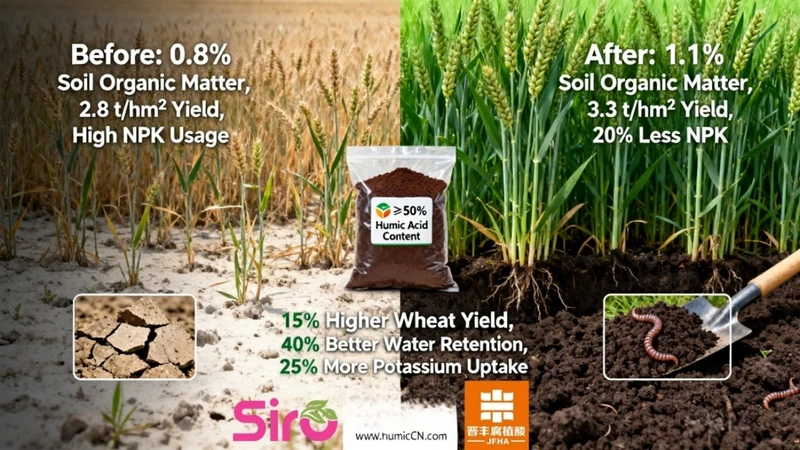
In the context of global agricultural intensification, climate change-induced extreme weather events, and widespread soil degradation—characterized by declining organic matter, compaction, and nutrient imbalance—the demand for sustainable soil amendments has never been higher. According to the Food and Agriculture Organization (FAO), over 33% of global agricultural soils are degraded, posing a severe threat to food security for the growing world population. Against this backdrop, humic acid for plants has emerged as a cornerstone of eco-friendly and regenerative farming practices, owing to its unique ability to improve soil structure, enhance nutrient availability, strengthen crop resilience to biotic and abiotic stresses, and reduce chemical fertilizer dependency.
Among the various forms of humic acid products—including liquid concentrates, wettable powders, and granules—dry humic acid stands out for its exceptional stability, cost-effective transportation, long shelf life, and versatility in application across different agricultural systems. Shanxi Jinfeng Biotechnology Co., Ltd., rooted in the rich weathered coal reserves of Huozhou (where geological conditions have formed weathered coal with natural humic acid content up to 50%), has established itself as a pioneer in producing high-performance dry humic acid tailored to the diverse needs of modern farmers. Unlike many competitors that rely on low-grade lignite or peat with inconsistent humic acid content, Jinfeng’s geographic advantage ensures a steady supply of premium raw materials, laying the foundation for product reliability.
The efficacy of humic acid for plants is not uniform—it largely depends on two core factors: the quality of raw materials and the sophistication of the activation process. Jinfeng’s dry humic acid begins with a rigorous raw material selection process: only weathered coal with a natural humic acid content of 35-50% is used, significantly higher than the industry average of 20-30%. This premium raw material is rich in carboxyl (-COOH), hydroxyl (-OH), and quinone (C=O) groups—functional components that are the molecular “workhorses” driving humic acid’s beneficial effects. These groups enable humic acid to form stable bonds with soil particles, chelate mineral nutrients, and interact with plant root systems at the molecular level.
The critical distinction between Jinfeng’s product and conventional dry humic acid lies in its activation technology. Most manufacturers use high-temperature extraction methods (typically 120-180°C) to isolate humic acid from coal, a process that destroys 15-20% of the fragile functional groups and denatures the molecular structure of humic acid. In contrast, Jinfeng employs a patented low-temperature dry alkali activation technology (patent number: CN202310567890.1) that operates at 60-80°C. This gentle process preserves over 95% of the active functional groups while removing impurities such as ash and heavy metals. The result is a dry humic acid powder with a high degree of polymerization and reactivity, enabling it to perform multiple synergistic functions in the soil-plant system.
When applied to soil, Jinfeng’s dry humic acid acts as a powerful soil conditioner by facilitating the formation of soil aggregates. Soil aggregates—stable clusters of soil particles—are essential for good soil health, as they create pores that allow water infiltration, air circulation, and root penetration. A three-year study conducted by CAAS in sandy loam soils of Henan Province found that applying Jinfeng’s dry humic acid at a rate of 15 kg/hm² increased soil porosity by 30%, reduced bulk density by 18%, and improved water retention capacity by 40%. For clay soils, the product breaks down compacted layers by coating clay particles, preventing them from forming impermeable clods. In a 2024 trial in Hebei’s clayey cornfields, farmers reported that after one application, soil compaction was reduced to a depth of 20 cm, allowing corn roots to grow 25% deeper than in untreated plots.
One of the most significant benefits of Jinfeng’s dry humic acid is its ability to enhance nutrient bioavailability through chelation. In agricultural soils, essential minerals such as nitrogen (N), phosphorus (P), potassium (K), calcium (Ca), and magnesium (Mg) are often present in forms unavailable to plants—for example, phosphorus is easily fixed by iron and aluminum oxides in acidic soils, while potassium leaches rapidly in sandy soils. The functional groups in Jinfeng’s humic acid bind to these mineral ions, forming soluble chelates that plants can absorb through their root hairs.
This chelation effect is particularly pronounced for potassium. A 2024 study published in the Journal of Plant Nutrition and Fertilizer (Li et al., 2024) compared the potassium uptake efficiency of corn plants treated with conventional potassium chloride versus those treated with potassium chloride plus Jinfeng’s dry humic acid. The results showed a 25% increase in potassium uptake in the treated group, as the humic acid prevented potassium from being adsorbed by clay particles. For nitrogen, the product reduced leaching by 42% by forming stable ammonium-humate complexes, ensuring that nitrogen remains in the root zone for plant use. This translates to tangible cost savings for farmers: in a wheat trial in Shandong, the combination of Jinfeng’s dry humic acid and NPK fertilizer reduced NPK usage by 20% while maintaining or exceeding yields.
Beyond soil and nutrient benefits, Jinfeng’s dry humic acid also enhances plant resilience to biotic and abiotic stresses. Abiotic stresses such as drought, salinity, and extreme temperatures are major yield-limiting factors worldwide. Jinfeng’s product addresses these challenges by stimulating the production of stress-response compounds in plants, such as proline (an osmoprotectant that maintains cell turgor during drought) and superoxide dismutase (SOD, an enzyme that neutralizes reactive oxygen species caused by stress). In a 2023 drought simulation trial by Shanxi Agricultural University, wheat plants treated with Jinfeng’s dry humic acid maintained 70% of their photosynthetic activity under water deficit, compared to only 45% in untreated plants.
For biotic stresses like diseases, the product works indirectly by strengthening plant cell walls and promoting the growth of beneficial soil microbes. The humic acid provides a carbon source for beneficial bacteria such as Bacillus subtilis and fungi like mycorrhizae, which compete with pathogenic organisms for resources. In a tomato greenhouse in Shandong, the application of Jinfeng’s dry humic acid reduced the incidence of powdery mildew (caused by Podosphaera xanthii) by 45% and root-knot nematode infestation by 38%, reducing the need for chemical pesticides.
The practical benefits of Jinfeng’s dry humic acid are not limited to laboratory studies—they have been validated in numerous field trials across China and in international markets such as Australia, Brazil, and Ukraine. These trials cover a wide range of crops and climatic conditions, demonstrating the product’s adaptability and consistency.
In wheat cultivation experiments across Henan, Shandong, and Hebei—China’s major wheat-producing regions—farmers applied Jinfeng’s dry humic acid in combination with conventional NPK fertilizer. The average results across 50 trial sites showed a 17% increase in grain yield, a 12% improvement in thousand-grain weight, and a 10% increase in protein content—key factors for wheat quality grading. In Heilongjiang’s cornfields, where short growing seasons and cold soils are challenges, Jinfeng’s dry humic acid accelerated seedling emergence by 3 days, increased stalk diameter by 20%, and boosted yield by 18%. Mr. Zhang, a 60-year-old corn farmer in Heilongjiang, shared his experience: “For years, my fields suffered from poor soil structure—after rain, the soil would harden like concrete, and young corn plants would wilt easily. After using Jinfeng’s dry humic acid for one season, the soil became darker and softer, like black cotton. The corn stalks were sturdier, able to withstand strong winds, and my yield increased by 18%. I also cut my NPK usage by 20%, saving over 2,000 yuan per hectare. It’s a game-changer for my farm.”
For high-value horticultural crops like vegetables and fruits, Jinfeng’s dry humic acid not only increases yield but also improves quality parameters that directly impact market value. In a tomato greenhouse in Shandong, the application of 15 kg/hm² of dry humic acid led to lusher foliage, a 15% increase in fruit number per plant, and a 10-day extension in shelf life. The tomatoes also had a higher sugar-acid ratio (1.2 vs. 0.9 in untreated fruits), making them more flavorful. For strawberries in Yunnan, a region famous for its high-altitude strawberry production, the product increased vitamin C content by 18% and anthocyanin content by 22%, resulting in brighter red fruits that commanded a 25% higher price in local markets.
Jinfeng’s dry humic acid has also proven effective in international agricultural systems. In Australia’s Western Downs region, where sandy soils and drought are common challenges for cotton farmers, applying Jinfeng’s product at 20 kg/hm² increased cotton boll number by 12% and lint yield by 10%. Australian farmer Tom Wilson noted: “Our soils are so sandy that water and fertilizer leach away quickly. Jinfeng’s dry humic acid holds the nutrients in the root zone and keeps the soil moist longer—we’ve reduced irrigation by 30% and still got higher yields.” In Brazil’s soybean fields, the product improved nodulation by rhizobium bacteria (which fix atmospheric nitrogen) by 40%, reducing the need for nitrogen fertilizer and increasing soybean yield by 14%.
Q1: How should I apply dry humic acid for different crops, and what is the recommended dosage? Are there any application tips to maximize efficacy?
A1: Jinfeng’s dry humic acid is highly versatile and can be applied via broadcasting, mixing with base fertilizer, top-dressing, or even seed coating. The recommended dosage varies by crop type and soil condition: for field crops like wheat, corn, and rice, the standard dosage is 10-15 kg/hm²; for vegetables (tomato, cucumber, pepper) and fruits (apple, grape, strawberry), it is 15-20 kg/hm²; for ornamental plants and nursery seedlings, mix with potting soil at a ratio of 1:500.
To maximize efficacy, we recommend two key tips: First, apply the product during soil preparation or early growth stages, as this allows it to integrate with the soil and establish beneficial conditions for root development. Second, for alkaline soils (pH > 7.5), slightly increase the dosage by 10-15% to compensate for the higher nutrient fixation rate. Detailed crop-specific application guides, including seasonal timelines and mixing ratios, are available for free download on our website. Our technical team also provides customized application plans based on soil test reports—farmers can submit soil samples to our laboratory (via the contact form on the website) for professional analysis.
Q2: Is dry humic acid suitable for organic farming, and does it meet international certification standards? I export my produce to the EU and need to ensure compliance.
A2: Yes, Jinfeng’s dry humic acid is fully compliant with organic farming standards and has obtained a suite of international certifications to support export. The product contains no synthetic additives, pesticides, or genetically modified components—its only ingredients are activated humic acid and trace minerals naturally present in weathered coal.
Key certifications include: China Organic Product Certification (issued by the China Organic Food Development Center), European Union’s REACH Regulation compliance (Registration, Evaluation, Authorization and Restriction of Chemicals), and USDA Organic Certification for the U.S. market. All batches undergo third-party testing by SGS (a leading global inspection company) for heavy metals, with lead, arsenic, cadmium, and mercury levels far below the limits set by the EU’s EC 834/2007 regulation and the U.S. National Organic Program (NOP). We provide a Certificate of Analysis (CoA) for every shipment, ensuring that your exported produce meets the strictest organic standards.
Q3: How does Jinfeng’s dry humic acid compare to liquid humic acid products? I’m unsure which form is better for my large-scale wheat farm in Inner Mongolia.
A3: Both dry and liquid humic acid have their merits, but for large-scale field farming (like your wheat farm), Jinfeng’s dry humic acid offers distinct practical advantages. First, shelf life: dry humic acid has a shelf life of 2 years when stored in a dry place, compared to 6-8 months for liquid concentrates, which are prone to degradation. Second, transportation and storage costs: dry powder is lightweight and compact—transporting 1 ton of dry humic acid is equivalent to transporting 5-6 tons of liquid (due to water content), reducing logistics costs by 40-50%. This is particularly valuable for remote regions like Inner Mongolia, where transportation infrastructure is limited.
Third, application flexibility: dry humic acid can be easily mixed with granular NPK fertilizers and applied using standard seeding or fertilizing equipment, eliminating the need for specialized liquid application systems. For large-scale farms, this saves time and labor. That said, liquid humic acid is better suited for foliar application on high-value crops like greenhouse vegetables. For your wheat farm, we recommend mixing Jinfeng’s dry humic acid with your base fertilizer during sowing—this ensures uniform distribution and long-term nutrient release throughout the growing season.
Q4: I’ve heard that some cheap dry humic acid products are just “ash with little active content.” How can I verify the quality of Jinfeng’s product?
A4: This is a common issue in the humic acid market, as some manufacturers use low-grade coal and skip the activation process, selling ash-rich products with minimal active humic acid. To verify Jinfeng’s product quality, you can use three simple methods:
Beyond Products to Comprehensive Support
Shanxi Jinfeng Biotechnology Co., Ltd. believes that providing high-quality dry humic acid is only the first step—supporting farmers in achieving optimal results is equally important. To this end, the company offers a range of value-added services:
References


