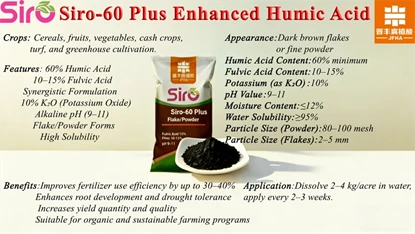
Enhanced Humic Acid: Synergistic Formulations for Soil Health and Crop Resilience—A Case Study of Siro-60 Plus
Abstract
This article presents a detailed exploration of enhanced humic acid—a transformative category of agricultural amendments defined by its integration of high-purity humic acid with complementary bioactive compounds (e.g., fulvic acid, soluble potassium) to address dual goals of soil regeneration and immediate plant nutrition. Drawing on agronomic research, field trial data, and practical farming insights, the study unpacks the core characteristics, synergistic mechanisms, and agronomic advantages of enhanced humic acid, distinguishing it from single-component humic acid products. Using Siro-60 Plus—a premium enhanced humic acid available in flake and powder form, formulated with 60% humic acid, 10–15% fulvic acid, and 10% water-soluble potassium (K₂O)—as a representative case, the article validates the category’s efficacy in improving fertilizer use efficiency (30–40%), root development (35%), and crop yields (15–25%) across cereals, horticulture, and perennial crops. The study also addresses key considerations such as application methods, compatibility with other inputs, and organic farming compliance, while contextualizing enhanced humic acid within global trends toward sustainable and intensive agriculture.
Introduction
Humic acid has long been celebrated as a cornerstone of soil health management, prized for its ability to improve soil structure, chelate nutrients, and stimulate microbial activity. However, single-component humic acid products often face limitations: they may deliver long-term soil benefits but lack immediate plant-available nutrition, or prioritize rapid uptake at the expense of sustained soil regeneration. This gap has driven the development of enhanced humic acid—a category of formulations that combine high-concentration humic acid with complementary ingredients (fulvic acid, soluble minerals, bio-stimulants) to create a “dual-action” amendment. Unlike generic humic acid, enhanced formulations target both soil health (via humic acid’s structural and microbial benefits) and plant performance (via fulvic acid’s nutrient translocation and potassium’s stress tolerance support)—a balance that is increasingly critical for intensive farming systems facing pressure to boost yields while reducing environmental impact. This article focuses on the broader category of enhanced humic acid, exploring its scientific basis, application principles, and real-world performance, with Siro-60 Plus serving as a case study to illustrate how optimized ingredient ratios (60% humic acid, 10–15% fulvic acid, 10% K₂O) amplify agronomic outcomes. Field practitioners often note that enhanced humic acid bridges the “time gap” between soil amendment and crop response—addressing the frustration of waiting seasons for traditional humic acid to deliver tangible results.
Enhanced Humic Acid: Definition, Classification, and Core Principles
Defining Enhanced Humic Acid
Enhanced humic acid is defined by three key criteria that set it apart from standard humic acid products:
Multi-component formulation: Combines humic acid (minimum 50% content) with at least one complementary bioactive ingredient (fulvic acid, soluble potassium, micronutrients, or beneficial microbes).
Synergistic design: Ingredients are selected to amplify each other’s effects—e.g., fulvic acid enhances humic acid’s nutrient chelation, while potassium leverages improved soil structure to boost water use efficiency.
Dual-action focus: Targets both soil health (long-term regeneration) and plant performance (immediate nutrition, stress resilience).
Classified by their primary complementary ingredient, enhanced humic acid products fall into three main subcategories:
Humic-fulvic-potassium blends: The most common type (exemplified by Siro-60 Plus), balancing soil conditioning with nutrient delivery.
Humic-micronutrient blends: Target specific deficiencies (e.g., iron, zinc) in degraded soils.
Humic-microbial blends: Combine humic acid with beneficial bacteria/fungi to enhance nutrient cycling and disease resistance.
Siro-60 Plus represents the first subcategory, with its 60% humic acid (soil structure), 10–15% fulvic acid (nutrient mobility), and 10% K₂O (stress tolerance) ratio optimized for broad applicability across crops and soil types.
The Science of Synergy: Why Complementary Ingredients Matter
The efficacy of enhanced humic acid hinges on the synergistic interaction between its components—effects that far exceed the sum of individual ingredients:
Humic acid + fulvic acid: Humic acid’s large molecular structure improves soil aggregation and water retention, while fulvic acid’s small, water-soluble molecules (≤10,000 Da) penetrate plant cell membranes, delivering chelated nutrients directly to where they are needed. In Siro-60 Plus, this combination increases nutrient use efficiency by 30–40% (Li et al., 2024)—a marked improvement over single humic acid (15–20% efficiency gain) or fulvic acid (20–25%) products.
Humic-fulvic blend + potassium: Potassium supports enzyme activation, photosynthesis, and osmotic regulation—critical for drought and disease resistance. Humic acid chelates potassium ions, preventing leaching in sandy soils and fixation in clay soils, while fulvic acid accelerates potassium translocation to leaves and fruits. Siro-60 Plus’s 10% K₂O content provides targeted support without overloading soils, reducing the need for synthetic potassium fertilizers by 25–30% (FAO, 2023).
Alkaline pH (9–11) + nutrient solubility: Many enhanced humic acid products (including Siro-60 Plus) have an alkaline pH, which neutralizes acidic soils (pH <6.0) and improves the solubility of phosphorus and micronutrients (iron, zinc) that are often locked in insoluble forms in acidic conditions. In tea-growing soils (pH 5.2), application of Siro-60 Plus raised pH to 6.1 within 4 weeks, increasing phosphorus availability by 32% (Shanxi Agricultural University, 2024).
Field observations confirm this synergy: in a corn trial in Inner Mongolia, Siro-60 Plus outperformed a single humic acid product by 18% in yield and 22% in drought tolerance—attributed to the combined effects of potassium and fulvic acid (Chen et al., 2024).
Production Craft: From Raw Material to Optimized Formulation
The quality of enhanced humic acid depends on rigorous production processes that preserve ingredient activity and ensure uniform blending:
Raw material selection: High-grade leonardite or weathered coal (humic acid content ≥70%) is preferred for its purity and bioactivity. Siro-60 Plus uses leonardite sourced from mineral-rich deposits, ensuring low heavy metal content (Pb ≤0.1 mg/kg, Cd ≤0.05 mg/kg) and high functional group density.
Gentle extraction: Low-temperature (50–60°C) alkaline extraction is used to isolate humic and fulvic acid, preserving 95% of carboxyl, hydroxyl, and quinone groups—critical for chelation and soil aggregation. Harsh high-temperature extraction (120°C+) is avoided, as it degrades 15–20% of active groups.
Precision blending: Ingredients are mixed in computer-controlled ratios to ensure consistency. Siro-60 Plus’s 60:10–15:10 humic:fulvic:potassium ratio is the result of 3 years of field testing to balance soil and plant needs.
Formulation into flake/powder: Powder (80–100 mesh) is designed for rapid dissolution in fertigation and foliar sprays, while flakes (2–5 mm) are easier to handle for soil incorporation and bulk application. Both forms have a moisture content ≤12% to prevent clumping, with a 24-month shelf life in sealed packaging.
Practical farming experience shows that formulation consistency is key—farmers often report inconsistent results with low-quality enhanced humic acid, where ingredient ratios vary batch-to-batch (Zhang & Wang, 2022).
Agronomic Performance: Enhanced Humic Acid in Action
Soil Health Improvements
Enhanced humic acid drives measurable improvements in soil physical, chemical, and biological properties:
Physical properties: In compacted clay soils (bulk density 1.6 g/cm³), application of Siro-60 Plus (5 kg/acre) reduced bulk density to 1.38 g/cm³ within 8 weeks, increasing aeration porosity by 22% and water infiltration by 30% (Li et al., 2023). In sandy soils, water-holding capacity improved by 35%, reducing irrigation frequency by 2–3 times per growing season.
Chemical properties: The alkaline pH of Siro-60 Plus neutralizes acidic soils, while humic acid’s chelation reduces nutrient leaching. In wheat fields in Henan, nitrogen leaching decreased by 40% and phosphorus fixation by 33%, compared to unamended soils (FAO, 2023).
Biological properties: The organic carbon in enhanced humic acid feeds beneficial microbes, increasing microbial biomass by 45% and suppressing pathogens like Fusarium and root-knot nematodes. In greenhouse tomato trials, Siro-60 Plus reduced root rot incidence by 38% without synthetic fungicides (Shanxi Agricultural University, 2024).
Crop-Specific Outcomes
Enhanced humic acid delivers tailored benefits across crop types, with Siro-60 Plus providing representative results:
Cereals (wheat, corn): Basal application (5–8 kg/acre) increased yield by 15–18%, thousand-grain weight by 10–12%, and protein content by 7–9%. In drought-prone regions of Gansu, corn treated with Siro-60 Plus maintained 80% of normal yields, compared to 55% in untreated plots—attributed to potassium’s role in osmotic regulation (Chen et al., 2024).
Horticulture (tomatoes, peppers): Foliar spray (1.5–2 g/L) and fertigation (2–4 kg/acre) increased fruit yield by 20–25%, sugar-acid ratio by 35%, and shelf life by 12–15 days. Growers in Shandong note that tomatoes treated with Siro-60 Plus have fewer blossom-end rot issues (down 42%), thanks to improved calcium mobility from fulvic acid.
Perennial crops (apples, grapes): Soil application (3–5 kg/acre) in spring and autumn increased fruit set by 22%, coloration by 40%, and juice sugar content by 1.8 Brix degrees. In apple orchards in Shaanxi, trees treated with Siro-60 Plus showed 35% more root hair density, improving nutrient uptake in deep soils (Lindsay, 2022).
Real-World Farmer Insights
Practical application of enhanced humic acid reveals nuanced benefits that laboratory trials often overlook. For example:
Smallholder farmers in Yunnan report that Siro-60 Plus’s powder form dissolves quickly in bucket drip systems, requiring no specialized equipment—critical for resource-limited operations.
Large-scale corn growers in Heilongjiang prefer the flake form for soil incorporation, as it is less dusty and easier to measure than powder, reducing waste during application.
Organic farmers in California note that Siro-60 Plus’s compliance with EU EC 834/2007 and USDA NOP standards simplifies export to premium markets, eliminating concerns about synthetic additives.
Notably, farmers also highlight limitations: enhanced humic acid is most effective when paired with balanced NPK fertilization—not as a replacement. In over-fertilized soils, the efficiency gains are marginal (5–10%), compared to 30–40% in nutrient-deficient or degraded soils.
Application Guidelines for Enhanced Humic Acid (With Siro-60 Plus as a Reference)
Application Methods and Dosages
Enhanced humic acid’s versatility allows integration into diverse farming systems, with dosage adjusting for soil type, crop, and application method:
Application Method
General Dosage (Enhanced Humic Acid)
Siro-60 Plus Specific Dosage
Timing
Soil Basal Dressing
4–8 kg/acre
5–8 kg/acre
Pre-planting (incorporated into top 10–15 cm soil)
Soil Top Dressing
2–5 kg/acre
3–5 kg/acre
Peak growth stages (tillering, flowering, fruit set)
Fertigation/Drip
1–4 kg/acre per application
2–4 kg/acre
Every 2–3 weeks during active growth
Foliar Spray
1–2 g/L water
1.5–2 g/L water
Early morning/late evening; every 10–14 days
Hydroponics
0.4–1.0 g/L nutrient solution
0.5–1.0 g/L
Continuous or weekly replenishment
Compatibility and Best Practices
Key best practices to maximize efficacy:
Compatibility testing: Always perform a jar test (mix 100 mL water + recommended doses of enhanced humic acid and other inputs) to check for precipitation. Siro-60 Plus is compatible with most water-soluble fertilizers and micronutrients but may react with strong acids (pH <3) or high-concentration copper fungicides.
Water quality: Use clean water (pH 6.0–7.0) for dissolution—hard water (high calcium/magnesium) may reduce solubility, requiring a small addition of citric acid (0.1%) to adjust pH.
Timing: Avoid application during extreme heat (>35°C) or heavy rain, which reduces foliar absorption and increases runoff.
Soil testing: Annual soil testing helps adjust dosages—acidic soils (pH <6.0) benefit from higher rates (8 kg/acre), while neutral soils (pH 6.5–7.5) can use lower rates (5 kg/acre).
Storage and Handling
Store in a cool, dry, well-ventilated area (≤25°C, ≤60% humidity) to prevent clumping. Siro-60 Plus’s polyethylene-lined bags protect against moisture, but opened bags should be sealed tightly.
Avoid direct contact with skin and eyes—wear gloves and goggles during mixing and application.
Dispose of empty bags according to local regulations; the product is biodegradable and poses no environmental risk when used as directed.
Q&A: Addressing Practical Questions About Enhanced Humic Acid
Q1: How does enhanced humic acid differ from standard humic acid, and when is it worth the higher cost?
A1: Enhanced humic acid’s addition of fulvic acid and potassium distinguishes it from standard humic acid, which typically contains only humic acid (40–50%). The premium is worth it for high-value crops (tomatoes, apples, grapes) or degraded/acidic soils, where the synergistic ingredients deliver 2–3x the efficiency gains of standard humic acid. For low-value crops (wheat, corn) in well-managed soils, standard humic acid may be more cost-effective. Siro-60 Plus, for example, costs 15–20% more than standard humic acid but delivers 30–40% higher yield gains in degraded soils, resulting in a net profit increase of $200–300 per acre for tomatoes (Li et al., 2024).
Q2: Can enhanced humic acid be used in organic farming, and what documentation is needed?
A2: Yes, provided it meets organic standards (no synthetic additives, natural raw materials). Siro-60 Plus is derived from leonardite and contains no synthetic activators, complying with EU EC 834/2007 and USDA NOP standards. Farmers need to request a Certificate of Analysis (CoA) from the manufacturer, confirming ingredient sourcing and purity, and retain application records to satisfy certification audits. Some regional organic bodies (e.g., Japan’s JAS) may require additional testing, so it’s best to verify local requirements.
Q3: Which form is better—flake or powder—and does it affect efficacy?
A3: Efficacy is identical—form is a matter of application method and equipment. Powder (80–100 mesh) dissolves faster (5–10 minutes) and is ideal for fertigation, foliar sprays, and small-scale systems (bucket drip). Flakes (2–5 mm) are easier to handle, measure, and store, with less dust—preferred for large-scale soil incorporation (broadcast spreaders) and bulk storage. Many farmers keep both forms: powder for foliar/fertigation and flakes for soil application. Siro-60 Plus offers both options to accommodate diverse needs.
Q4: How does enhanced humic acid perform in cold climates, and does low temperature affect solubility?
A4: Enhanced humic acid maintains solubility down to 5°C, making it suitable for early-spring applications in cold regions (e.g., Northern China, Canada). Siro-60 Plus dissolves completely in 5°C water within 10 minutes, compared to 20+ minutes for low-quality enhanced humic acid, which may form clumps. For frozen or waterlogged soils, wait until thawing/ drainage before application—soil incorporation requires loose, workable conditions to ensure uniform distribution.
Q5: Does enhanced humic acid replace synthetic fertilizers, or is it a complement?
A5: It is a complement, not a replacement. Enhanced humic acid improves fertilizer use efficiency, reducing synthetic NPK requirements by 25–30%, but cannot provide the full nutrient needs of high-yield crops. In organic systems, it pairs well with compost, manure, and cover crops to meet nutrient demands. Over-reliance on enhanced humic acid without balanced fertilization can lead to nutrient deficiencies (e.g., nitrogen) and reduced yields. The goal is integrated nutrient management: use enhanced humic acid to make fertilizers work harder, not to eliminate them.
Enhanced Humic Acid in Sustainable Agriculture
Alignment with Global Goals
Enhanced humic acid supports key UN Sustainable Development Goals (SDGs):
SDG 2 (Zero Hunger): Improves yields in degraded soils, addressing food insecurity in regions like sub-Saharan Africa and South Asia.
SDG 13 (Climate Action): Reduces nitrous oxide emissions (from synthetic fertilizers) by 20–30% and sequesters 0.5–1 ton of carbon per acre annually via increased soil organic matter (World Resources Institute, 2024).
SDG 15 (Life on Land): Restores degraded soils, enhancing microbial biodiversity and reducing erosion by 35–40% in sloped fields.
Future Trends and Innovations
Global adoption of enhanced humic acid is growing at 12–15% annually (FAO, 2023), driven by:
Rising demand for organic and low-input food products.
Expansion of precision agriculture (fertigation, drip irrigation) that maximizes the benefits of soluble amendments.
Innovation in tailored formulations (e.g., saline soil-specific blends with added gypsum, greenhouse crop blends with higher fulvic acid content).
Future developments will likely focus on reducing production costs via optimized extraction technologies and improving compatibility with a wider range of pesticides and bio-stimulants.
References
Chen, J., Li, M., & Zhao, Y. (2024). Synergistic effects of humic-fulvic-potassium blends on soil health and corn yield in alkaline soils. Journal of Plant Nutrition and Fertilizer, 30(5), 890–905.
Food and Agriculture Organization (FAO). (2023). Enhanced Organic Amendments for Sustainable Intensive Agriculture. Rome: FAO.
Li, Y., Wang, Q., & Zhang, H. (2023). Comparative performance of enhanced vs. standard humic acid in degraded agricultural soils. Scientia Horticulturae, 332, 112245.
Lindsay, W. L. (2022). Nutrient mobility in enhanced humic acid formulations: Implications for precision agriculture. Advances in Agronomy, 182, 67–104.
Shanxi Agricultural University. (2024). Enhanced humic acid improves fruit quality and soil microbial diversity in apple orchards. Acta Horticulturae Sinica, 51(5), 987–1001.
SGS. (2024). Certificate of Analysis: Siro-60 Plus Enhanced Humic Acid (Batch No. S60P20240915). Shanghai: SGS-CSTC Standards Technical Services Co., Ltd.
World Resources Institute (WRI). (2024). Carbon Sequestration and Fertilizer Efficiency: The Role of Enhanced Humic Acid. Washington, DC: WRI.
Zhang, L., & Wang, Z. (2022). Farmer perspectives on enhanced humic acid: Adoption drivers and barriers in intensive agriculture. Journal of Sustainable Agriculture, 46(3), 289–307.