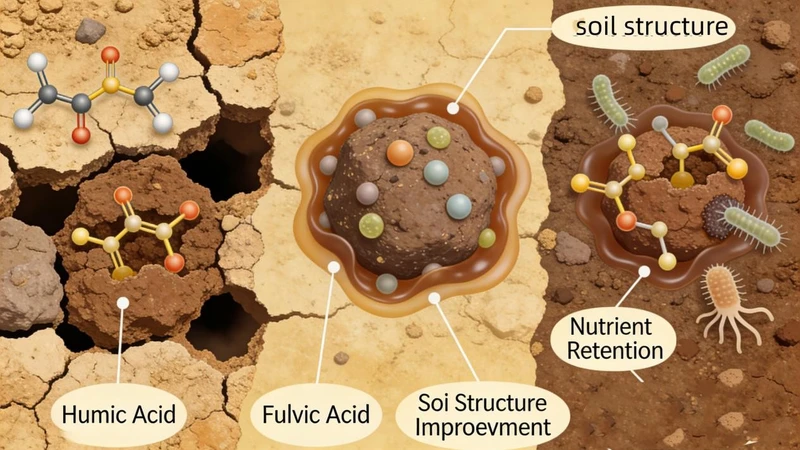
AbstractSoil degradation has become a global challenge for sustainable agriculture. Humic acid and fulvic acid, as core components of humic substances, effectively improve soil physical structure, enhance chemical fertility, and boost biological activity. Together they form a complete soil-improving system, repairing degraded soil, reducing nutrient loss, balancing pH, and supporting long-term productivity. This paper explains their mechanisms and compares their unique functions in soil remediation.
Humic acid promotes soil aggregation, turning loose sand or compacted clay into stable crumb structure. It increases porosity, improves water retention and infiltration, and reduces erosion. Fulvic acid, with smaller molecular weight, penetrates deep into soil layers, loosens hardpan, and enhances root penetration. Together they create a loose, breathable root zone (Risso, 2025).
Both raise cation exchange capacity (CEC), locking in N, P, K, Ca, and Mg to reduce leaching. Humic acid stabilizes soil pH, buffering acid or alkaline stress. Fulvic acid chelates insoluble minerals, turning them into absorbable forms. Studies show they can reduce salinity and improve nutrient availability by over 30% (Gujre et al., 2021).
They serve as a carbon source for beneficial microbes, stimulating the growth of bacteria, actinomycetes, and mycorrhizal fungi. A more active microbial community accelerates organic matter decomposition, boosts nutrient cycling, and suppresses soil-borne pathogens. This restores the soil’s natural “immune system” (Agri Magazine, 2026).
Humic acid focuses on long-term soil conditioning: improving structure, increasing organic carbon, and sustaining fertility. Fulvic acid excels at rapid activation: fast nutrient chelation, deep penetration, and stress alleviation. Combined, they provide both short-term efficiency and long-term health (Saint Humic Acid, 2025).
Yes. Humic acid immobilizes heavy metals and reduces toxicity. Fulvic acid lowers soil EC and pH, displacing excess sodium ions. They are widely used to restore saline, sandy, and over-cultivated soils, supporting regenerative agriculture (He et al., 2021; Alsudays et al., 2025).
Humic and fulvic acids are irreplaceable in modern soil management. Their combined effects improve physical, chemical, and biological health, making them ideal for degraded soil restoration and sustainable farming.