


In an era of unpredictable heatwaves and “flash droughts,” farming can feel like a high-stakes gamble. When the rain stops and the mercury rises, plants go into survival mode, often shutting down growth entirely.
But what if you could give your crops a “bio-shield”? That is exactly what humic acid drought resistance offers. It isn’t just a soil amendment; it’s a powerful anti-stress plant supplement that works both in the dirt and inside the plant’s cells. Let’s look at how this organic powerhouse is changing the game for water-efficient agriculture.
The first line of defense against drought is the soil itself. Humic acid acts as a biological “glue” that creates a crumb-like structure in the soil (flocculation).
This is where things get really cool. Humic acid doesn’t just sit in the soil; it triggers physiological changes inside the plant that build plant stress tolerance.
When a plant is thirsty, it loses “turgor pressure” (it wilts). Humic acid helps the plant maintain cellular resilience by:
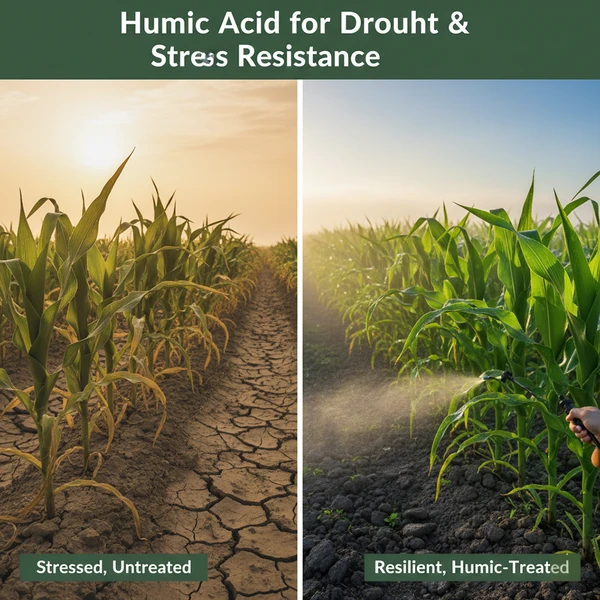
To maximize the anti-stress benefits, timing is everything. You don’t want to wait until the plant is brown and crispy to start treatment.
Q: Can humic acid actually replace irrigation? A: No, humic acid isn’t a replacement for water. However, it makes your irrigation much more efficient. In many cases, you can reduce the amount of water used while seeing the same or better plant stress tolerance.
Q: Is it effective in salty (saline) drought conditions? A: Yes! In fact, humic acid is a lifesaver for saline soils. It helps buffer the salt ions, preventing them from being absorbed by the plant, which is a major issue when water is scarce.
Q: How often should I apply it during a dry spell? A: During a prolonged drought, a soil drench every 3–4 weeks is ideal. If you are using foliar sprays, every 2 weeks can help maintain leaf turgidity.
Q: Does it work for all crops? A: While it benefits almost all plants, it is particularly effective for high-value vegetable crops (tomatoes, peppers) and broad-acre crops like corn and soy that are often at the mercy of the weather.
As we move toward a future of more extreme weather, humic acid is becoming an essential tool for water-efficient agriculture. By focusing on both water retention and cellular resilience, you aren’t just feeding your crops—you’re giving them the grit to survive the storm (or the lack of one).


