


If you’ve ever wished you could just tell your plants to “eat their vegetables” and see them perk up instantly, humic acid foliar spray is as close as it gets. By spraying a fine mist directly onto the leaves, you bypass the slow journey through the soil and roots, delivering bio-stimulants straight to the plant’s metabolic engine.
But because leaves are much more sensitive than roots, you can’t just pour it on. You need a dilution guide that respects the plant’s delicate “skin.”
The science is pretty cool: plants have tiny pores called stomata (mostly on the undersides of leaves) that act like little mouths. Research in Materials suggests that humic substances can increase the permeability of plant membranes, making it easier for other nutrients like Iron, Magnesium, and Nitrogen to hitch a ride inside.
The big wins include:
When using liquid humic acid for plants, the golden rule is: Dilute, then dilute again. A typical 12% humic acid concentrate is very potent.
| Crop Category | Recommended Dilution (Humic:Water) | Application Goal |
| Leafy Greens (Lettuce, Spinach) | 1:500 or 1:600 | Avoid spotting on tender leaves. |
| Vegetables (Tomatoes, Peppers) | 1:400 or 1:500 | Boost flowering and fruit set. |
| Fruit Trees & Berries | 1:300 or 1:400 | Strengthen waxy leaf cuticles. |
| Lawn & Turf | 1:200 | Deep greening without surge growth. |
Quick Math for Home Gardeners: For most garden veggies, aim for 1 tablespoon of liquid humic acid per gallon of water. If your plants are very young or stressed, cut that in half to be safe.
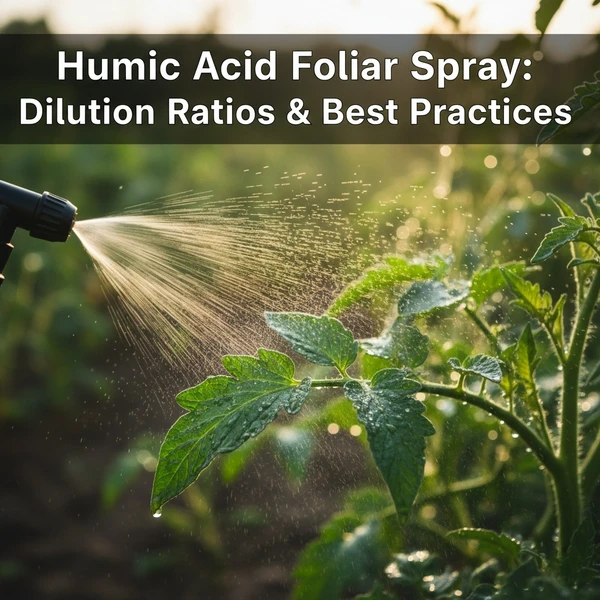
Timing isn’t just about your schedule; it’s about the plant’s biology.
To get the most out of your spray without damaging your garden, follow these steps:
Leaf burn happens when the solution is too strong or the sun is too hot. It looks like “scorched” or crispy brown edges on the leaves.
Q: Can humic acid replace my regular fertilizer?
A: Not exactly. Think of humic acid as the “vitamin” and fertilizer as the “meal.” It helps the plant eat the meal better, but it doesn’t contain the N-P-K (Nitrogen, Phosphorus, Potassium) that plants need to grow big.
Q: How often should I foliar spray?
A: Every 2 to 4 weeks during the active growing season is plenty. Over-spraying can lead to a buildup on the leaf surface that actually blocks sunlight.
Q: Will it stain my porch or siding?
A: Yes! Humic acid is essentially liquid organic matter (brown/black). It can stain concrete, wood, and light-colored siding. Always mix and spray away from your house.
Q: Can I spray in the rain?
A: No. A light rain will wash the humic acid off before the plant can “drink” it. You want at least 3-4 hours of dry weather after spraying.


