


If you’ve noticed your favorite monstera or patio hibiscus looking a bit “tired” despite regular watering, the problem might not be the plant—it’s the “biological cage” it lives in.
In a pot, soil is a closed system. Unlike the great outdoors, there are no earthworms to aerate the dirt and no natural decay to refresh the nutrients. Over time, potting mix becomes compacted, lifeless, and—worst of all—salty. Using humic acid for potted plants is like hitting the “refresh” button on your container soil, turning a stagnant pot into a thriving ecosystem.
In a container, roots have nowhere to go. If the soil structure collapses, the roots suffocate. Root health for potted plants depends entirely on the soil’s ability to hold oxygen and water simultaneously.
Research in HortTechnology indicates that humic substances improve the physical properties of container substrates, leading to better root branching and nutrient uptake. Essentially, it makes a small amount of soil work like a vast, fertile field.
When it comes to indoor plant humic acid, precision is your best friend. You aren’t trying to “drown” the plant in carbon; you’re trying to “season” the soil.
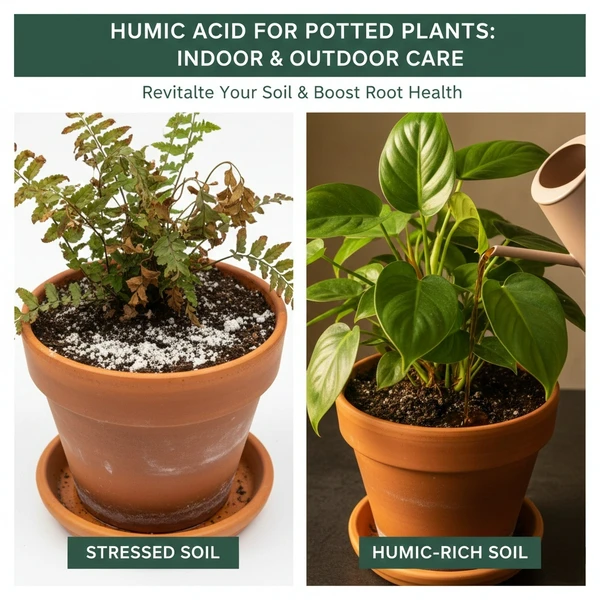
Applying humic acid isn’t a complex science experiment. It’s a simple addition to your Sunday watering routine.
If you see a white, crusty ring on the inside of your pots or on the soil surface, you have a salt problem. This is a byproduct of synthetic fertilizers and tap water minerals. These salts act like a straw in reverse—they suck moisture out of your plant’s roots.
This is where humic acid shines as a container soil amendment. It acts as a natural buffer, breaking down these mineral salts and making them easier to flush out. A study in the Journal of Plant Nutrition suggests that humic acid can mitigate the negative effects of high salinity, protecting delicate root hairs from “salt burn.”
Q: Will humic acid stain my pots or saucers? A: Because it’s highly concentrated organic matter, it is dark! While it won’t usually stain glazed ceramic, it can leave a “tea stain” on porous terracotta. Always wipe spills immediately and use a saucer to protect your floors.
Q: Can I use it on succulents and cacti? A: Yes, but keep it rare! Succulents prefer “lean” soil. A single application in the spring is usually enough to give them a root health boost for the entire year.
Q: How often should I use it indoors vs. outdoors? A: Outdoor pots deal with more evaporation and stress, so every 3–4 weeks is great. Indoor plants have a slower metabolism; once every 2 months is plenty to keep the soil “alive.”
Q: Does it smell? A: High-quality humic acid is virtually odorless. It might have a very faint, earthy scent (like a forest floor after rain), but it won’t make your living room smell like a farm.
Your potted plants are your roommates—and nobody likes a roommate who’s stressed out! By adding humic acid to your indoor and outdoor care routine, you’re ensuring your plants have the strongest foundation possible.


