


If you’re into gardening or commercial farming, you’ve likely heard of “Black Gold”—humic acid. It’s the powerhouse of soil health, promising better nutrient uptake and thirstier roots. But here’s the dirt: not all humic products are created equal.
With the market booming, some products are more “black” than they are “gold.” If you don’t want to pay premium prices for what is essentially crushed coal, you need to know how to spot the real deal. Let’s dive into the science of humic acid purity and how to protect your soil (and your wallet).
Before checking the bottle, look at the source. The highest quality products usually derive from Leonardite humic acid.
Leonardite is a softened form of coal that has been oxidized over millions of years. Think of it as “super-compost.” It is significantly more bio-active than humic acid derived from peat or raw lignite. If a label doesn’t mention the source, that’s your first red flag.
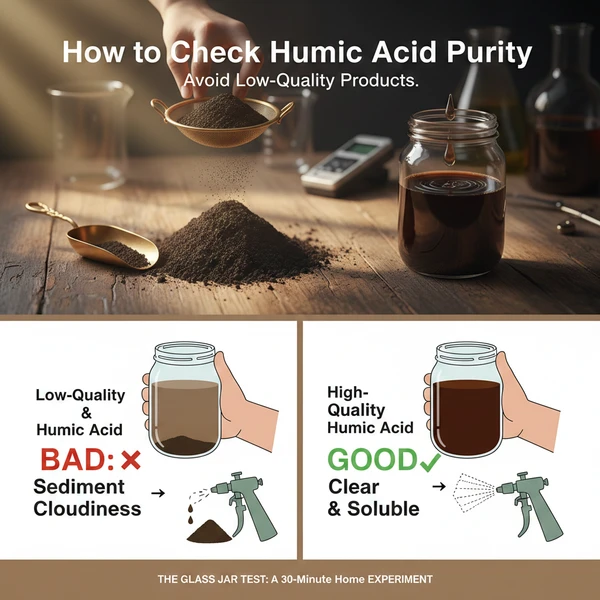
When evaluating humic acid content, you need to look past the marketing fluff. Here are the three pillars of purity:
High-quality dry powders usually boast a humic acid purity of 60% to 80%. If a liquid product claims 50% concentration, be skeptical—physics usually limits stable liquid concentrates to around 12–15%.
If you use drip irrigation or sprayers, soluble humic acid (usually found as Potassium Humate) is non-negotiable.
Cation Exchange Capacity (CEC) measures how well the humic acid can hold onto nutrients like Calcium and Magnesium. Pure humic acid has a very high CEC. According to research on soil organic matter dynamics, high CEC values are a direct indicator of the functional groups that make humic acid actually work.
Reading a humic label is like reading a nutrition label, but with more “chemistry traps.”
Want to test your current bottle? Try the Jar Test:
Q: Can I just use raw coal instead of refined humic acid? A: Please don’t! Raw coal isn’t “oxidized,” meaning its nutrients aren’t available to plants. You’ll be waiting a few million years for it to work. Stick to refined leonardite humic acid.
Q: Is a darker liquid always better? A: Not necessarily. Just like coffee, you can make a weak brew look dark. Always check the laboratory-certified percentage on the COA (Certificate of Analysis).
Q: Does humic acid expire? A: Generally, no. As a stable carbon source, it can last for years if kept dry and out of direct sunlight.
Investing in humic acid purity is the difference between feeding your soil and just staining it black. Always prioritize solubility, check for Leonardite sources, and don’t be afraid to ask your supplier for a COA.
Research Reference: For those who want to geek out on the molecular structure of these substances, check out this study on Humic Substances by the International Humic Substances Society (IHSS).


