Humic Acid for Plant Growth:Nutrient Uptake& Microbial Support
Ever feel like you’re pouring expensive fertilizers into your garden, but your plants just aren’t thriving? You might be right—it’s often a “delivery” issue, not a nutrient shortage. For anyone serious about gardening or farming, the real secret isn’t more fertilizer; it’s humic acid.
Dubbed the “black gold” of soil health, humic acid acts like a vital bridge between your soil and your plants’ roots. It’s a natural powerhouse that changes how plants eat, breathe, and grow.
Let’s break down how this organic wonder works—from unlocking stubborn nutrients to feeding the underground world of soil microbes.
1. How It Unlocks “Trapped” Nutrients (N-P-K & More)
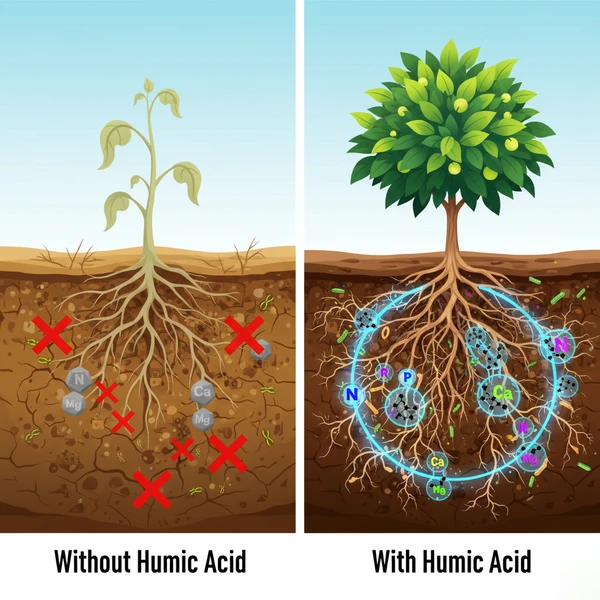
Think of soil as a locked safe. Key minerals like phosphorus or calcium might be physically there, but they’re chemically bound up—out of reach for plant roots. This is where humic acid steps in.
The Chelation Effect
Humic acid molecules are complex carbon chains with a high Cation Exchange Capacity (CEC). They work through chelation—from the Greek word for “claw.” Essentially, humic acid grabs onto nutrient ions, shielding them from reacting with other minerals or washing away.
Phosphorus (P): In alkaline soils, phosphorus binds with calcium; in acidic soils, it sticks to iron or aluminum. Humic acid breaks those bonds and delivers phosphorus directly to roots.
Nitrogen (N): Nitrogen is volatile and easily leaches away. Humic acid helps hold it in the root zone, so you don’t have to reapply as often.
Studies back this up: Research in the Journal of Plant Nutrition shows humic substances boost availability of both major and trace nutrients like iron and zinc, which are key for chlorophyll production (Taylor & Francis Online).
2. Fueling Your Soil’s “Underground Workforce”
Healthy soil is alive—a bustling ecosystem. In just one gram, you can find up to a billion bacteria. These microbes are like tiny chefs, breaking down organic matter into food plants can use.
Humic Acid: Microbial Superfood
At its core, humic acid is concentrated carbon—the main energy source for soil life.
It stimulates mycorrhizal fungi, which attach to roots and act like a nutrient-sharing network.
It feeds nitrogen-fixing bacteria, giving them the carbon fuel they need to thrive.
It improves soil structure, creating tiny aggregates that let air and water move freely. This prevents compacted, oxygen-starved conditions that harm beneficial microbes.
By supporting these microbes, you’re building a self-sustaining nutrient cycle right under your feet.
3. What You’ll Actually See in the Garden
The benefits aren’t just hidden—they show up where it counts.
Explosive Root Growth: Plants treated with humic acid develop more lateral roots and fine root hairs, helping them reach water during dry spells.
Better Stress Resilience: With improved nutrient uptake, plants become stronger and more resistant to heat, cold, and soil salinity.
Improved Soil Texture: Humic acid darkens the soil (helping it warm faster in spring), helps sandy soils retain moisture, and lets clay soils drain better.
According to a review in Agronomy, humic acids act as biostimulants, enhancing plants’ natural defense systems against pests and disease (MDPI).
FAQs: Quick Answers
Q: Is humic acid a fertilizer?
A: Not exactly. Fertilizer is the “food.” Humic acid is the “delivery system” that ensures plants can actually use it. Without it, much of your fertilizer may go to waste.
Q: Can I use it on my lawn?
A: Absolutely. It’s great for breaking down thatch and helping water and nutrients penetrate deeper.
Q: How do I read a humic acid label?
A: Look for the percentage of humic acids (often sourced from Leonardite). Liquid formulas typically contain 6–12%, while granular versions can be higher.
Q: Does it change soil pH?
A: It acts as a buffer, helping to stabilize pH. While slightly acidic itself, its main role is to help plants thrive even in less-than-ideal pH conditions.
The Bottom Line
Whether you’re a large-scale grower or a backyard gardener, humic acid is a game-changer. By improving nutrient uptake and nurturing soil life, you’re working with nature—not against it—for a healthier, more resilient garden.