


With the increasing global demand for high-quality coffee and the growing emphasis on sustainable agriculture, humic acid, as a natural soil amendment, has gained widespread attention in coffee bean cultivation. This article systematically explores the application of humic acid in coffee cultivation, including its mechanism of improving soil properties, promoting coffee tree growth, enhancing stress resistance, and optimizing coffee quality. Relevant experimental data and practical cases from major coffee-producing regions such as Brazil and India are cited to verify its application effects. Finally, common questions about the use of humic acid in coffee cultivation are answered, providing a theoretical and practical reference for the sustainable development of the coffee industry.
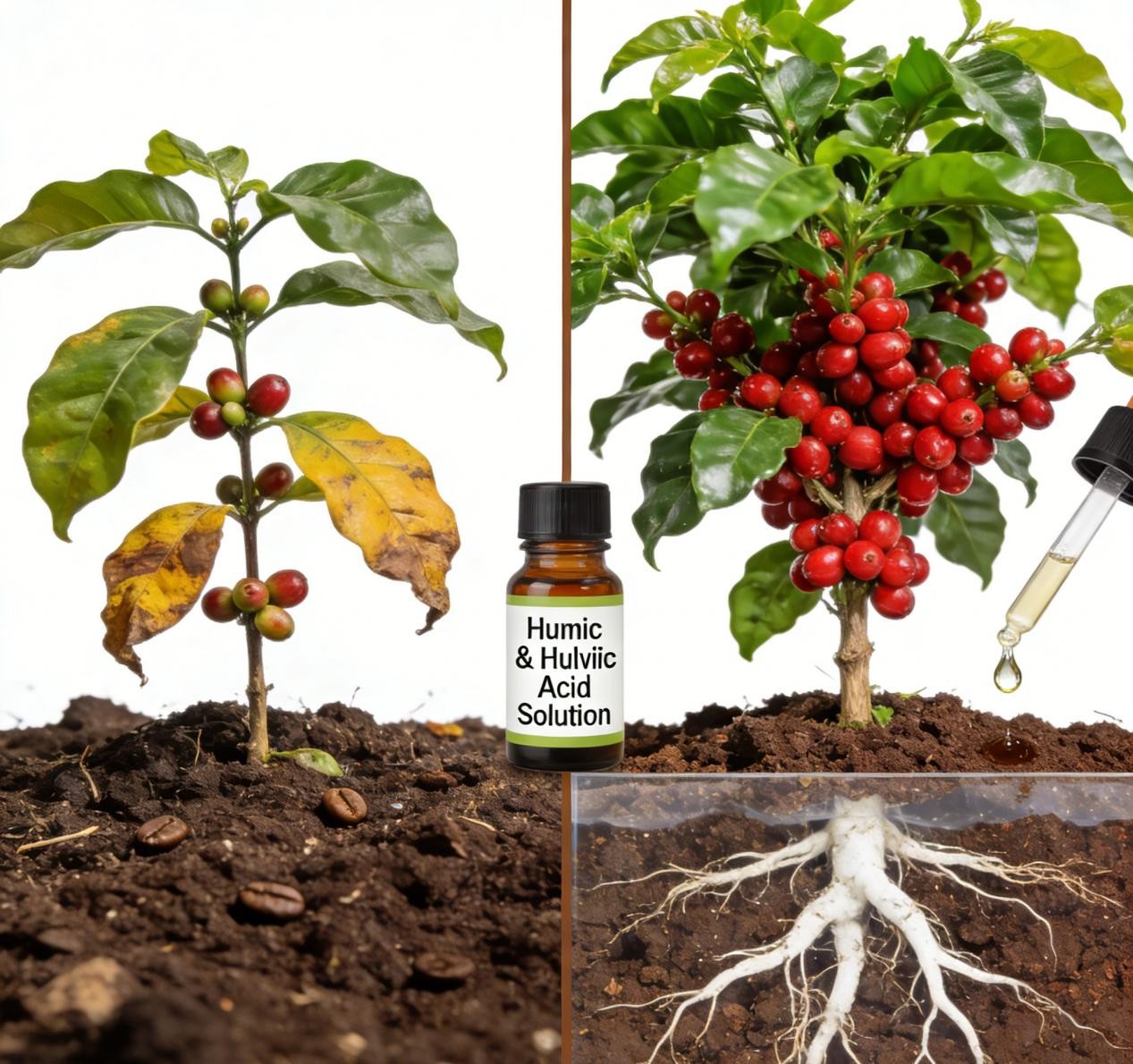
Coffee, as one of the most popular beverages globally, its quality and yield are closely related to soil conditions. In recent years, long-term intensive cultivation has led to problems such as soil degradation, decreased fertility, and reduced microbial activity in many coffee-growing areas, which seriously restrict the sustainable development of the coffee industry. Humic acid is a complex organic substance formed by the decomposition and transformation of plant residues under the action of microorganisms. It is rich in functional groups such as phenolic hydroxyl, carboxyl, and methoxyl, which endow it with unique properties in improving soil structure and promoting plant growth. As a natural and environmentally friendly agricultural input, humic acid has shown great potential in solving the problems faced by coffee cultivation.
Humic acid plays a crucial role in optimizing soil structure. It can combine with soil particles to form stable aggregates, thereby improving soil aeration and water retention capacity. Research shows that in loamy sand soil coffee plantations, the application of humic acid can significantly increase the number of soil aggregates, reducing water evaporation and nutrient leaching. In addition, humic acid can regulate soil pH value, alleviating the harm of acidic soil to coffee trees, which is particularly important for coffee-growing areas with acidic soil. At the same time, as a carbon source and energy carrier, humic acid promotes the growth and reproduction of beneficial microorganisms in the soil, enhances soil enzyme activity, and accelerates nutrient cycling, thereby improving overall soil fertility.
Humic acid can effectively promote the growth and development of coffee trees by improving nutrient absorption and regulating physiological processes. A two-year field experiment conducted at the Central Coffee Research Institute in Karnataka, India, showed that the combined application of humic acid (10 kg per acre as soil application and 600 mL/200 L as foliar spray 25 days after blossom) with recommended doses of fertilizer significantly increased the growth indicators of coffee trees. The total nodes per branch, crop nodes per branch, flower buds, and total number of fruits per branch reached 17.45, 9.4, 208.65, and 153.31 respectively, and the fruit set percentage was 3.28. Compared with the control group without humic acid, the coffee yield increased significantly in both growing seasons. Similarly, in Brazilian coffee-growing areas, the application of humic acid increased coffee tree growth rate by 15% and yield by approximately 20%, while reducing the use of chemical fertilizers.
Coffee trees are often affected by various abiotic stresses such as drought, salinity, and low temperature during growth. Humic acid can enhance the stress resistance of coffee trees by regulating the level of hormones in plants and improving the activity of antioxidant enzymes. In arid regions, the application of humic acid improves soil water retention capacity, enabling coffee tree roots to absorb water more effectively, thereby enhancing drought resistance. Experiments have shown that coffee plantations applying humic acid have significantly improved drought resistance, reducing yield losses caused by water shortage. In addition, humic acid can also reduce the damage of salt and alkali stress to coffee trees and improve the adaptability of coffee trees to harsh environments.
The application of humic acid not only increases coffee yield but also optimizes its quality. Soil organic matter content is an important factor affecting coffee quality, and humic acid can significantly increase soil organic matter content. Research indicates that coffee beans grown in soil rich in humic acid often have more abundant flavor characteristics, showing obvious fruit aroma, floral aroma, or chocolate aroma. The study on small-grain coffee shows that soil organic matter content is positively correlated with total sugar content of coffee beans, which is an important factor affecting the sweetness of coffee. In addition, Colombian research has shown that the application of organic fertilizers containing humic acid can increase the cupping score of coffee beans by 0.5-1 point, improving the body and softening the acidity.
A1: The combined application of soil application and foliar spray is recommended. For soil application, humic acid granules can be applied at a dose of 10 kg per acre combined with base fertilizer. For foliar spray, a 600 mL/200 L humic acid solution can be sprayed 25 days after blossom, which can effectively improve the absorption efficiency and application effect.
A2: According to the growth cycle of coffee trees and soil conditions, it is generally applied 1-2 times a year. Soil application can be carried out before the rainy season, and foliar spray can be carried out during the key growth periods such as the flowering and fruiting stages.
A3: Yes, humic acid is highly compatible with chemical fertilizers. The combined application can not only improve the utilization rate of chemical fertilizers, reduce nutrient loss but also enhance the growth-promoting effect on coffee trees. It should be noted that they should be mixed evenly when applying.
A4: Yes, humic acid is a natural organic substance derived from plant residues. Its application does not contain synthetic chemicals, which is in line with the relevant requirements of organic coffee certification and can help achieve sustainable organic coffee cultivation.
[1] Society of Chemical Industry. (2020). Humic Acid As Foliar and Soil Application Improve the Growth, Yield and Quality of Coffee (cv. C × R) in Western Ghats of India. Retrieved from https://www.aminer.cn/pub/5f7850fb9fced0a24b349f74
[2] National Center for Biotechnology Information. (2020). Humic acid as foliar and soil application improve the growth, yield and quality of coffee (cv. C × R) in Western Ghats of India. PubMed. https://pubmed.ncbi.nlm.nih.gov/33006779/
[3] Core. (2015). Humic substances and its distribution in coffee crop under cover crops and weed control methods. Retrieved from https://core.ac.uk/download/pdf/190034463.pdf
[4] 2025-2030 Humic Acid Coffee Plantation Soil Conservation and Flavor Characteristics Correlation Report. Docin. https://www.docin.com/touch_new/preview_new.do?id=4905554454
[5] RI UFLA. Rooting biostimulants for Coffea arabica L. cuttings. Retrieved from http://repositorio.ufla.br/bitstream/1/42568/1/ARTIGO_Rooting%20biostimulants%20for%20Coffea%20arabica%20L.%20cuttings.pdf


