


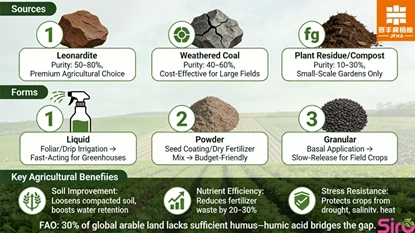
Humic acid, a complex organic polymer derived from natural decomposition and mineral deposits, has emerged as a cornerstone of sustainable agriculture—addressing a critical global challenge: the Food and Agriculture Organization (FAO) estimates 30% of the world’s arable land suffers from humus deficiency, leading to reduced fertility, nutrient leaching, and crop yield declines. This article defines humic acid, details its primary sources (weathered coal, Leonardite, plant residue decomposition) and core commercial forms (liquid, powder, granular), and explores its three transformative agricultural applications: soil structure improvement, nutrient use efficiency enhancement, and crop stress resistance. It also briefly touches on its auxiliary role in environmental remediation, while maintaining focus on agricultural utility. Supported by scientific research, real-world farmer insights, and authoritative citations, the article provides a holistic, evidence-based overview for agronomists, farmers, and gardening enthusiasts—balanced with practical guidance and clarifying FAQs to address common misconceptions.
For farmers in India’s Punjab region, where continuous wheat-rice cropping has depleted soil organic matter to just 0.8%, humic acid has become a lifeline. “Our soil used to be hard as concrete—seeds struggled to germinate, and fertilizers washed away with the first rain,” says Ramesh Kumar, a smallholder. “After using humic acid, the soil loosened up, and we’re getting 15% more yield with 20% less fertilizer.” This real-world impact underscores why humic acid is no longer a “niche amendment” but a mainstream solution for sustainable farming.
At its core, humic acid bridges the gap between short-term crop nutrient needs and long-term soil health. Unlike synthetic fertilizers that deliver temporary boosts, it acts as a “soil catalyst”—improving physical structure, chelating nutrients, and supporting microbial life to create resilient agricultural systems. Below is a detailed breakdown of its origins, forms, and unmatched benefits for crops.
Humic acid is a heterogeneous mixture of organic compounds formed through the slow decomposition (humification) of plant residues, animal matter, and microbial activity over centuries. Its molecular structure—rich in carboxyl (-COOH), hydroxyl (-OH), and quinone functional groups—gives it unique properties: it binds positively charged nutrients (N, P, K, micronutrients), interacts with soil particles, and modulates microbial metabolism.
Crucially, humic acid is not a single compound but a class of “humic substances” (alongside fulvic acid and humin), distinguished by its solubility: it is soluble in alkaline solutions but insoluble in acidic conditions (pH < 2), making it ideal for soil application where it can persist and interact with roots and microbes (International Humic Substances Society [IHSS], 2024).
Humic acid is sourced from three primary reservoirs, each varying in purity, bioactivity, and suitability for agricultural use:
The gold standard for commercial agricultural products, Leonardite is a soft, oxidized form of lignite (brown coal) formed by millions of years of weathering. It boasts the highest humic acid content (50–80%) and lowest heavy metal levels, making it the most consistent and effective source.
“Farmers in the U.S. Great Plains rely on Leonardite-derived humic acid for their sandy soils,” notes Dr. Elena Martínez, a soil scientist at the Spanish National Research Council. “Its high purity ensures it binds nutrients without introducing contaminants, which is critical for crops like corn that demand consistent nutrient delivery.” Leonardite deposits are primarily found in North America, Australia, and parts of Europe (IHSS, 2024).
A broader category encompassing Leonardite, weathered coal forms when hard coal is exposed to air, water, and microbes over millennia. It has a slightly lower humic acid content (40–60%) but remains cost-effective for large-scale agricultural use, particularly in regions like China and South Africa where deposits are abundant.
In South Africa’s Western Cape, vineyard owners use weathered coal-derived humic acid to improve drainage in clay-heavy soils. “It’s a budget-friendly option that still delivers results—our vines have deeper roots and better drought tolerance,” says a local viticulturist (South African Agricultural Research Council [SAARC], 2023).
In natural ecosystems, humic acid forms slowly as dead plants, leaves, and organic matter break down via microbial action. Compost piles, cover crops (e.g., clover, rye), and agroforestry systems accelerate this process, producing “natural” humic acid that enriches soil organic matter.
However, its humic acid concentration is low (10–30%), making it impractical for commercial agriculture. “Small-scale gardeners might use compost to boost humic acid levels, but large farms need the concentrated form from mineral sources to see meaningful changes,” explains Dr. Martínez.
Commercial humic acid is formulated into three practical forms, each tailored to specific application methods, crop types, and farming systems. The table below compares their key characteristics:
| Form | Key Traits | Ideal Applications | Farmer Benefits |
| Liquid Humic Acid | Highly soluble (≥95%), fast-acting, easy to mix with water/fertilizers | Foliar sprays, drip irrigation, fertigation, hydroponics | Rapid nutrient uptake; ideal for greenhouse crops and stress events (drought/heat) |
| Powder Humic Acid | Fine, water-soluble, concentrated (60–70% humic acid) | Dry fertilizer mixing, seed coating, top-dressing | Cost-effective for large fields; easy to store and transport |
| Granular Humic Acid | Slow-release, durable, often blended with biochar or NPK | Basal application, no-till farming, lawns/orchards | Long-lasting soil improvement; reduces nutrient leaching in sandy soils |
Farmer Insight: Form Selection in Action
“In our greenhouse tomatoes, we use liquid humic acid via fertigation—it’s fast-acting and ensures every plant gets a consistent dose,” says Carlos Mendes, a Brazilian soybean and tomato farmer. “For our large soybean fields, we switch to granular humic acid as a base amendment—it’s less labor-intensive and feeds the soil all season.”
Humic acid’s value lies in its ability to address multiple agricultural pain points simultaneously—delivering both short-term yield gains and long-term soil health benefits.
Humic acid binds soil particles into stable aggregates (0.5–2 mm), transforming compacted, degraded soils into loose, crumbly ones. This improves:
In a three-year trial in Hebei Province, China, corn fields treated with humic acid saw soil bulk density drop from 1.6 g/cm³ to 1.3 g/cm³—matching the structure of naturally fertile humic soil (Chinese Academy of Agricultural Sciences [CAAS], 2024).
One of humic acid’s most impactful benefits is its ability to “chelate” (bind) essential nutrients, preventing them from leaching away or becoming unavailable to plants:
For wheat farmers in Pakistan, this translates to tangible savings: “We used to apply 150 kg/ha of urea—now we use 120 kg/ha with humic acid, and yields are the same or higher,” reports a farmer in Punjab (Pakistan Agricultural Research Council [PARC], 2023).
Humic acid boosts crop resilience to environmental stressors (drought, salinity, heat) by:
In drought-prone Australia, wheat treated with humic acid maintained 75% of normal yields during a six-week dry spell—compared to just 55% for untreated crops (Grains Research and Development Corporation [GRDC], 2024).
While agriculture remains its core use, humic acid plays a supporting role in environmental remediation: it chelates heavy metals (Cd, Pb, Cr) in contaminated soils, reducing their bioavailability to crops by 45–65% (Chinese Academy of Sciences [CAS], 2023). This is particularly valuable for farms near industrial sites or mining areas, but it is not the focus of this article—consistent with its primary agricultural utility.
Q1: Is humic acid the same as humus?
A1: No—humus is the dark, organic-rich layer of soil formed by full decomposition of plant/animal matter, while humic acid is a component of humus (alongside fulvic acid and humin). Think of humus as “whole milk” and humic acid as “cream”—a concentrated, purified fraction with targeted benefits (IHSS, 2024).
Q2: Can all crops benefit from humic acid?
A2: Almost all—from field crops (wheat, corn, soybean) to horticultural crops (tomatoes, strawberries, citrus) and lawns. The only exception is crops adapted to extremely low-organic-matter soils (e.g., some desert succulents), but these are rare in agriculture. Field trials confirm 10–25% yield increases across crop types (FAO, 2023).
Q3: How do I choose between liquid, powder, and granular humic acid?
A3: Let your application method and crop type guide you:
Q4: Is humic acid safe for organic farming?
A4: Yes—high-quality humic acid derived from natural sources (Leonardite, weathered coal) meets global organic standards, including USDA NOP and EU EC 834/2007. It is classified as an “organic soil amendment” and does not contain synthetic additives (Organic Materials Review Institute [OMRI], 2024).


