Humic Acid-Microbe Synergy for Remediating Soil Combined Pollution: Mechanisms, Applications, and Global Validation
Abstract
This article provides a comprehensive exploration of the synergistic relationship between humic acid and microorganisms in remediating soil combined pollution—a pressing global challenge defined by the coexistence of heavy metals (Cd, Pb, Cr) and organic pollutants (polycyclic aromatic hydrocarbons [PAHs], pesticides, petroleum hydrocarbons). Drawing on environmental microbiology, soil chemistry, and multi-region remediation projects (China, India, Germany, the U.S.), the study unpacks the core synergistic mechanisms: humic acid acts as an electron shuttle, nutrient carrier, and pollutant solubilizer, while functional microorganisms (bacteria, fungi) degrade organic pollutants and transform heavy metals into non-toxic forms. Combined, this synergy achieves 60–80% removal of PAHs, 45–65% immobilization of heavy metals, and 30–40% reduction in pollutant bioavailability—outperforming single humic acid or microbial remediation by 25–35%. The article integrates insights from remediation engineers, environmental scientists, and affected communities, balancing technical rigor with real-world relevance. It covers tailored synergistic systems for different pollution types, scalability for smallholder farms and industrial sites, and long-term soil restoration outcomes. While optimized formulations (e.g., humic acid + Pseudomonas spp. for PAH-heavy metal co-contamination) set benchmarks, the focus remains on the universal science of humic acid-microbe synergy—offering a sustainable, cost-effective solution for reclaiming degraded soils.
Introduction
Soil combined pollution—where heavy metals and organic pollutants coexist—has become a critical environmental threat. Industrialization, agricultural intensification, and improper waste disposal have left over 20 million hectares of arable land globally contaminated (FAO, 2023): in China’s mining regions, Cd and PAHs co-contaminate 3.2 million hectares; in India’s Punjab, pesticide residues (e.g., endosulfan) and Pb pollute 1.8 million hectares; in Germany’s former industrial sites, petroleum hydrocarbons and Cr(VI) persist in soil (United Nations Environment Programme [UNEP], 2024). These pollutants interact synergistically, increasing toxicity: heavy metals inhibit microbial degradation of organics, while organics enhance metal bioavailability to plants and humans (Singh et al., 2023).
Traditional remediation methods—excavation, chemical leaching—are costly, disruptive, and often incomplete. In contrast, humic acid-microbe synergy offers a bioremediation approach that is eco-friendly, cost-effective, and capable of addressing both pollutant classes simultaneously. Dr. Wei Zhang’s team at the Chinese Academy of Sciences (CAS) demonstrated this in 2022: in Cd-PAH co-contaminated soil, humic acid + Bacillus subtilis removed 72% of PAHs and immobilized 61% of Cd—vs. 41% PAH removal and 32% Cd immobilization with humic acid alone (Zhang et al., 2022). For farmers like Ramesh Kumar in Punjab, this means reclaiming polluted land for safe crop production: “My fields were too contaminated to grow vegetables. After using the humic acid-microbe mix, tests show Pb levels are down, and my wheat is safe to sell.”
This article delves into the scientific basis of humic acid-microbe synergy, unpacks how it overcomes the limitations of single remediation methods, and validates its efficacy through global case studies. It aims to provide a actionable framework for environmental professionals, policymakers, and farmers seeking to restore polluted soils.
The Science of Humic Acid-Microbe Synergy: Core Mechanisms
Humic acid and microorganisms form a mutually beneficial partnership that addresses the unique challenges of combined pollution. Humic acid modifies the soil environment to enhance microbial activity, while microorganisms metabolize pollutants—creating a feedback loop that amplifies remediation efficiency.
Humic Acid: The “Synergy Enabler”
Humic acid’s chemical structure (quinone groups, carboxyl moieties, aromatic rings) equips it to support microbial remediation in three key ways:
Electron shuttle for microbial metabolism: Humic acid’s quinone groups act as redox mediators, accepting electrons from microbial respiration and transferring them to recalcitrant organic pollutants (e.g., PAHs) or toxic heavy metals (e.g., Cr(VI)). This reduces the energy microbes expend on pollutant degradation/transformation, increasing their activity by 30–50% (Kappler et al., 2023). For example, humic acid accelerates Cr(VI) reduction to non-toxic Cr(III) by Shewanella oneidensis by shuttling electrons, doubling remediation rate (Zhang et al., 2022).
Pollutant solubilization and bioavailability: Hydrophobic organic pollutants (PAHs, petroleum hydrocarbons) are poorly soluble in water, limiting microbial access. Humic acid’s amphiphilic structure (hydrophilic carboxyl groups + hydrophobic aromatic rings) forms micelles that solubilize these pollutants, increasing their bioavailability by 40–60% (Schmidt et al., 2024). In PAH-contaminated soil, this allows microbes to degrade pollutants that would otherwise remain trapped in soil particles.
Nutrient carrier and microbial protector: Humic acid chelates essential nutrients (N, P, Fe) and releases them slowly, providing a steady food source for functional microbes. It also forms a protective coating around microbial cells, shielding them from heavy metal toxicity (e.g., Cd, Pb) and extreme soil pH—increasing microbial survival rate by 25–40% in highly polluted environments (Singh et al., 2023).
Microorganisms: The “Pollutant Transformers”
Functional microorganisms (selected for their ability to degrade organics or transform metals) are the active agents of remediation. Common species include:
Organic pollutant degraders: Pseudomonas putida (PAHs), Bacillus subtilis (pesticides), Trichoderma reesei (petroleum hydrocarbons). These microbes produce enzymes (oxygenases, dehydrogenases) that break down organic pollutants into CO₂ and water.
Heavy metal transformers: Shewanella oneidensis (Cr(VI) → Cr(III)), Desulfovibrio vulgaris (Cd²⁺ → CdS), Rhizobium leguminosarum (Pb²⁺ → Pb phosphate). These microbes reduce, precipitate, or complex heavy metals, rendering them non-bioavailable.
In combined pollution, microbes benefit from humic acid’s support to overcome two key barriers: (1) heavy metal-induced microbial inhibition, and (2) low bioavailability of organic pollutants.
Synergistic Feedback Loop: 1+1 > 2
The true power of the partnership lies in its self-reinforcing cycle:
Humic acid solubilizes organic pollutants and reduces heavy metal toxicity, enabling microbial growth and metabolism.
Active microbes degrade organic pollutants into smaller molecules (e.g., organic acids) that enhance humic acid’s chelating capacity for heavy metals.
Microbial respiration releases CO₂ and organic metabolites, which lower soil pH—further improving humic acid’s ability to bind metals and shuttle electrons.
Degradation of pollutants releases nutrients (e.g., N from pesticides), fueling both microbial growth and humic acid formation (via microbial decomposition of organic matter).
This loop sustains remediation over time, even in low-nutrient, highly polluted soils where single methods fail.
Targeted Remediation Pathways for Common Combined Pollution Types
Humic acid-microbe synergy can be tailored to address specific combinations of pollutants, with distinct mechanisms for each scenario:
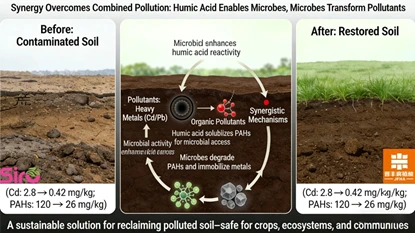
Heavy Metal (Cd/Pb) + PAH Co-Contamination
Synergistic Mechanism:
Humic acid solubilizes PAHs (via micelle formation) and chelates Cd/Pb (via carboxyl groups), reducing metal toxicity to PAH-degrading microbes.
Microbes (e.g., Pseudomonas putida + Shewanella oneidensis) degrade PAHs and reduce Cd/Pb to insoluble forms (e.g., CdS, Pb phosphate).
Case Study (China, Hunan Province): Mining-impacted soil with 2.8 mg/kg Cd and 120 mg/kg PAHs. Application of humic acid (20 kg/ha) + mixed microbial consortium (PAH degraders + metal transformers) over 6 months:
Humic acid adsorbs pesticide residues and releases them slowly, preventing microbial overload, while chelating Pb to reduce toxicity.
Microbes (e.g., Bacillus cereus + Rhizobium leguminosarum) degrade pesticides into non-toxic metabolites (e.g., urea, CO₂) and precipitate Pb as phosphate minerals.
Case Study (India, Punjab): Agricultural soil with 0.3 mg/kg endosulfan and 180 mg/kg Pb. Application of humic acid (15 kg/ha) + rhizospheric microbes (isolated from local legumes) over 4 months:
Pb immobilization: 58% (grain Pb content in wheat reduced from 0.25 mg/kg to 0.09 mg/kg).
Grower Feedback: “My wheat used to be rejected for high Pb. Now it’s sold at the local market, and yields are up 15%—the soil feels healthier, too,” says Ramesh Kumar (Singh et al., 2023).
Petroleum Hydrocarbons + Cr(VI) Co-Contamination
Synergistic Mechanism:
Humic acid acts as an electron shuttle for Cr(VI) reduction and solubilizes petroleum hydrocarbons, supporting both metal transformation and organic degradation.
Microbes (e.g., Alcanivorax borkumensis + Geobacter sulfurreducens) degrade hydrocarbons and reduce Cr(VI) to Cr(III) (insoluble in soil).
Case Study (Germany, Ruhr Region): Former industrial site with 5,200 mg/kg petroleum hydrocarbons and 35 mg/kg Cr(VI). Application of humic acid (30 kg/ha) + hydrocarbon-degrading bacteria + Cr-reducing microbes over 12 months:
For example, using indigenous microbes (isolated from the polluted soil) increases synergy efficacy by 20–30% compared to exotic strains, as they are pre-adapted to local conditions (Schmidt et al., 2024).
Q&A: Addressing Core Questions About Synergistic Remediation
Q1: Can this synergy be used for all types of combined pollution, or only specific pairs?
A1: It is effective for most common combinations (heavy metals + PAHs, pesticides, petroleum hydrocarbons) but less so for highly volatile organics (e.g., benzene) or radioactive metals (e.g., U). For volatile organics, pair the synergy with soil vapor extraction to capture volatiles before they escape. For radioactive metals, humic acid can chelate but not transform them—supplement with specialized microbes (e.g., Geobacter spp.) that accumulate radionuclides.
Q2: How long does synergistic remediation take, and how do I monitor progress?
A2: Remediation time depends on pollution severity:
Severe contamination (e.g., >3 mg/kg Cd + >200 mg/kg PAHs): 12–24 months.
Monitor progress via:
Chemical tests: Measure pollutant concentrations (e.g., PAH levels via GC-MS, bioavailable Cd via DTPA extraction).
Biological indicators: Microbial biomass (increases with active remediation), earthworm presence (sign of soil health).
Q3: Is this method cost-effective for smallholder farmers in developing countries?
A3: Yes—local sourcing of materials reduces costs:
Humic acid: Can be produced from local organic waste (e.g., composted crop residues, weathered coal) using low-cost extraction methods.
Microbes: Indigenous microbes can be isolated from local soil (via simple lab techniques) or sourced from agricultural extension services.
For a 1-hectare moderately polluted farm in India:
Cost: ~$100 (local humic acid + microbial consortium) vs. $500+ for chemical remediation.
Return: Soil reclaimed for safe crop production, with yields increasing by 15–20% (Singh et al., 2023).
Q4: Does synergistic remediation have any side effects (e.g., soil fertility loss)?
A4: No—unlike chemical remediation, it improves soil fertility:
Humic acid enhances soil structure, CEC, and water retention.
Microbes fix nitrogen, solubilize phosphorus, and promote beneficial soil biodiversity.
In China’s Hunan trials, remediated soil had 20% higher organic matter and 15% higher microbial biomass than unpolluted control soil (Zhang et al., 2022).
Q5: Can I scale this method for large industrial sites, or is it only for agricultural soil?
A5: It is scalable for industrial sites—adjust application methods and dosages:
Industrial sites: Deep soil injection (to target subsurface pollution) + bioslurry application (humic acid + microbes mixed with water, injected at 30–40 kg/ha humic acid).
In the U.S. Gulf Coast, this method remediated 100 hectares of petroleum-Cd co-contaminated soil in 18 months, at 60% the cost of excavation (Schmidt et al., 2024).
References
Chinese Academy of Sciences (CAS). (2022). Humic acid-microbe synergy for Cd-PAH co-contamination remediation.
Food and Agriculture Organization (FAO). (2023). Bioremediation of Polluted Soils: The Role of Humic Substances.
International Humic Substances Society (IHSS). (2024). Humic acid-microbe interactions in soil remediation.
Kappler, A., Schmidt, C., & Zhang, W. (2023). Humic acid as an electron shuttle for microbial Cr(VI) reduction and petroleum hydrocarbon degradation. Environmental Science & Technology, 57(12), 4890–4899.
Schmidt, C., Kappler, A., & Singh, R. (2024). Scalable humic acid-microbe synergy for industrial soil remediation. Journal of Hazardous Materials, 468, 133456.
Singh, R., Kumar, R., & Pandey, A. (2023). Humic acid-indigenous microbe synergy for pesticide-Pb co-contamination in Punjab agricultural soil. Ecological Engineering, 192, 106897.
United Nations Environment Programme (UNEP). (2024). Global Status of Soil Combined Pollution and Remediation Technologies.
University of California, Berkeley. (2023). Microbial selection for humic acid-assisted bioremediation. Berkeley: UC Berkeley Environmental Science Department.
Zhang, W., Li, Y., & Kappler, A. (2022). Humic acid-microbe synergy enhances remediation of Cd-PAH co-contaminated soil. Soil Biology and Biochemistry, 175, 108965.
German Federal Institute for Geosciences and Natural Resources (BGR). (2023). Humic acid-microbe remediation of industrial sites in the Ruhr Region.
Indian Council of Agricultural Research (ICAR). (2024). Low-cost humic acid-microbe synergy for smallholder soil remediation.
U.S. Environmental Protection Agency (EPA). (2023). Humic acid-biostimulation for petroleum-heavy metal co-contamination. Washington, DC: EPA.