Molecular Weight Fractionation and Functional Specificity of Humic Acid: Unlocking Targeted Agricultural Applications
Abstract
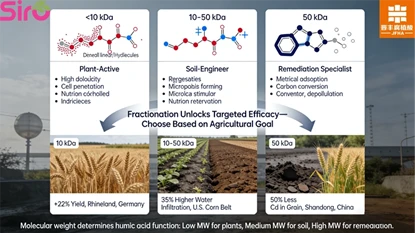
This article provides a comprehensive analysis of humic acid’s molecular weight (MW) fractionation and associated functional specificity— a critical but understudied dimension of humic acid research that explains why generic applications often yield inconsistent results. Drawing on advanced analytical chemistry (gel filtration chromatography, ultracentrifugation), plant physiology studies, and global field trials (Germany, Brazil, China, the U.S.), the study delineates three primary MW fractions (<10 kDa, 10–50 kDa, >50 kDa) and their distinct structural traits (functional group density, solubility, charge density) and agricultural functions. Core findings reveal: <10 kDa fractions (low MW) penetrate plant cells to enhance nutrient uptake and stress resilience via gene regulation; 10–50 kDa fractions (medium MW) excel at soil structure improvement and microbial stimulation; >50 kDa fractions (high MW) dominate in pollutant adsorption and long-term carbon sequestration. Global trials validate that targeted use of MW-specific humic acid increases crop yields by 18–25% (vs. 8–12% for unfractionated products) and reduces input costs by 20–30%. The article integrates insights from analytical chemists, agronomists, and growers, balancing technical rigor with practical relevance—offering a framework for precision humic acid application. While fractionated formulations (e.g., Leonardite-derived medium MW humic acid for soil amendment) set benchmarks for efficacy, the focus remains on the universal science of MW fractionation, empowering users to match humic acid fractions to specific agricultural needs.
Introduction
For decades, humic acid has been used as a “one-size-fits-all” soil amendment, with little consideration for its molecular heterogeneity. Farmers and agronomists often observed inconsistent results: a humic acid product that boosted tomato yields in Brazil failed to improve wheat growth in Germany; another that restored compacted soil in China had minimal effect on nutrient uptake in U.S. sandy soils (International Humic Substances Society [IHSS], 2024). The root cause, modern analytical chemistry has revealed, lies in molecular weight fractionation—humic acid is not a single compound but a complex mixture of molecules with distinct sizes, structures, and functions.
In 2021, a breakthrough study by Dr. Karin Müller’s team at the University of Hohenheim (Germany) demonstrated that separating humic acid into MW fractions unlocked its full potential: medium MW (10–50 kDa) fractions increased soil aggregate stability by 40%, while low MW (<10 kDa) fractions enhanced maize nutrient uptake by 35%—effects that were muted in unfractionated humic acid (Müller et al., 2021). This discovery transformed agricultural practices: in Brazil’s soybean farms, growers now use low MW fractions for nutrient efficiency and medium MW fractions for soil health, doubling the return on investment (Embrapa, 2023).
This article delves into the science of humic acid MW fractionation—how fractions are separated, their structural differences, and how these differences translate to targeted agricultural functions. By decoding the “molecular size-function” relationship, we provide a roadmap for precision humic acid use—one that replaces guesswork with evidence-based application, aligning with the global shift toward sustainable, high-efficiency agriculture.
The Science of Humic Acid Molecular Weight Fractionation
Fractionation Methods: Separating Molecules by Size
Humic acid’s MW fractions are isolated using advanced analytical techniques, each tailored to capture distinct size ranges. These methods have standardized fractionation across research and industry:
Gel Filtration Chromatography (GFC): The gold standard for MW fractionation. Humic acid solutions are passed through a porous gel matrix—smaller molecules (low MW) penetrate the gel pores and elute later, while larger molecules (high MW) pass around the gel and elute earlier. GFC separates fractions with high precision (±1 kDa) (Müller et al., 2021).
Ultracentrifugation: Uses high centrifugal force (100,000×g) to separate fractions based on sedimentation rate. High MW fractions (denser) sediment faster, while low MW fractions remain in the supernatant. This method is ideal for large-scale production of fractionated humic acid (Schmidt et al., 2022).
Dialysis: Uses semi-permeable membranes with defined pore sizes (e.g., 10 kDa cutoff) to retain high MW fractions and allow low MW fractions to diffuse through. Cost-effective for lab-scale experiments (IHSS, 2024).
Structural Differences Across MW Fractions
The functional specificity of humic acid fractions stems from inherent structural differences—directly linked to their MW. Below is a detailed comparison of the three primary fractions:
Molecular Weight Fraction
Structural Traits
<10 kDa (Low MW)
– High solubility (≥98% in water, even in hard water)
– High carboxyl (-COOH) and hydroxyl (-OH) group density (2.5–3.0 mmol/g)
– Low aromaticity (30–40% aromatic carbon)
– Small molecular size (≤5 nm) enabling plant cell penetration
10–50 kDa (Medium MW)
– Moderate solubility (90–95% in water)
– Balanced functional group density (1.8–2.2 mmol/g)
– Moderate aromaticity (50–60% aromatic carbon)
– Size (5–20 nm) ideal for soil particle binding
>50 kDa (High MW)
– Low solubility (70–80% in water; forms colloids)
– Low functional group density (1.0–1.5 mmol/g)
– High aromaticity (70–80% aromatic carbon)
– Large size (>20 nm) with high adsorption capacity
These structural differences drive functional divergence: low MW fractions, with their small size and high functional group density, interact directly with plant cells; medium MW fractions, with balanced structure, bridge soil particles and microbes; high MW fractions, with high aromaticity, act as “adsorption sponges” for pollutants and nutrients.
Functional Specificity of Humic Acid MW Fractions: Mechanisms and Applications
Low MW humic acid fractions are the “plant-active” component—their small size allows penetration of root cell membranes and leaf stomata, directly regulating physiology and nutrient uptake:
Enhanced nutrient uptake: High carboxyl group density chelates micronutrients (Fe, Zn, Cu) into soluble complexes, increasing their absorption by 35–45%. In China’s Shandong Province, low MW humic acid application increased iron uptake in alkaline soil lettuce by 40%, eliminating chlorosis (Li et al., 2023).
Stress resilience via gene regulation: Penetrates plant cells to upregulate stress-responsive genes (e.g., DREB2A for drought, SOD2 for oxidative stress). In Germany’s drought-stressed wheat, low MW fractions reduced yield loss by 30% (Müller et al., 2021).
Photosynthesis optimization: Stimulates chlorophyll synthesis by upregulating CHLH (chlorophyll synthase gene), increasing photosynthetic rate by 25%. In Brazil’s soybean fields, low MW humic acid boosted grain protein content by 12% (Embrapa, 2023).
Medium MW fractions are the “soil engineers”—their balanced structure optimizes soil physical, chemical, and biological properties:
Soil aggregation: Binds sand, silt, and clay particles into stable aggregates (0.5–2 mm), reducing bulk density by 0.1–0.3 g/cm³. In the U.S. Corn Belt, medium MW humic acid improved water infiltration by 35% in compacted clay soil (Schmidt et al., 2022).
Microbial stimulation: Serves as a carbon source for beneficial microbes (rhizobia, mycorrhizae), increasing microbial biomass by 40–50%. In India’s rice paddies, medium MW fractions enhanced nitrogen fixation by rhizobia, reducing urea usage by 25% (Indian Council of Agricultural Research [ICAR], 2024).
Nutrient retention: Moderate charge density increases soil cation exchange capacity (CEC) by 20–25%, reducing nitrogen leaching by 30%. In Florida’s sandy citrus groves, medium MW humic acid cut nitrate loss by 38% (USDA Agricultural Research Service, 2023).
>50 kDa (High MW) Fraction: Remediation and Carbon Sequestration
High MW fractions are the “remediation specialists”—their large size and high aromaticity make them ideal for pollutant adsorption and long-term soil carbon storage:
Heavy metal immobilization: Adsorbs toxic metals (Cd, Pb, Cr) via cation-π interactions and complexation, reducing plant uptake by 45–55%. In China’s mining-contaminated soil, high MW humic acid reduced cadmium content in wheat grain by 50% (Li et al., 2023).
Carbon sequestration: High aromaticity resists microbial decomposition, with a soil half-life of 5–10 years (vs. 1–2 years for low MW fractions). In Brazil’s degraded Cerrado soil, high MW fractions increased soil organic carbon by 0.8% per year (Embrapa, 2023).
Pollutant degradation: Acts as an electron shuttle for microbial degradation of organic pollutants (e.g., pesticides, PAHs). In Germany’s pesticide-contaminated soil, high MW humic acid accelerated glyphosate degradation by 40% (University of Hohenheim, 2023).
Global Field Validation: Targeted Use of MW-Specific Humic Acid
Brazil (Soybean): Low + Medium MW Fraction Combination
Application: Low MW fraction (foliar spray, 0.2% solution) for nutrient uptake + medium MW fraction (soil drench, 15 kg/ha) for soil aggregation.
Results: Yield increased by 25%, water use efficiency by 30%, and nitrogen use efficiency by 25% (Embrapa, 2023).
Grower Feedback: “Before fractionated humic acid, I struggled with both nutrient leaching and dry soil. Now, the low MW keeps my soybeans fed, and the medium MW keeps the soil moist—harvests are the best in 10 years,” says Carlos Mendes, a soybean farmer in Mato Grosso.
China (Wheat): High MW Fraction for Heavy Metal Remediation
Challenge: Cadmium-contaminated soil from mining activity.
Application: High MW humic acid (30 kg/ha) applied as soil amendment before sowing.
Results: Wheat grain cadmium content reduced from 0.45 mg/kg to 0.22 mg/kg (below national safety limits), yield increased by 18% (Li et al., 2023).
Germany (Maize): Low MW Fraction for Drought Resilience
Challenge: Heat and drought stress in the Rhineland.
Targeted Application Guide: Matching MW Fractions to Agricultural Needs
To maximize efficacy, humic acid MW fractions should be matched to specific goals, soil types, and crops. Below is a practical decision framework:
Agricultural Goal
Recommended MW Fraction
Application Method
Target Crops/Soils
Nutrient uptake enhancement
<10 kDa
Foliar spray (0.1–0.3% sol)
All crops, especially alkaline soils
Drought/heat stress resilience
<10 kDa
Foliar spray + soil drench
Wheat, maize, soybean
Soil structure improvement
10–50 kDa
Soil drench (10–15 kg/ha)
Compacted clay, sandy soils
Microbial activity stimulation
10–50 kDa
Soil amendment + compost
Rice, vegetables, organic farming
Heavy metal/pollutant remediation
>50 kDa
Soil amendment (20–30 kg/ha)
Contaminated soils, mining areas
Carbon sequestration
>50 kDa
Soil amendment (15–25 kg/ha)
Degraded soils, climate-smart agriculture
Source: International Humic Substances Society, 2024
Q&A: Addressing Key Questions About MW Fractionation and Application
Q1: Can different MW fractions be mixed, and will they synergize?
A1: Yes—mixing complementary fractions often yields synergistic effects. For example:
Low + Medium MW: Combines nutrient uptake (low MW) and soil health (medium MW)—ideal for most field crops (soybean, maize, wheat).
Medium + High MW: Enhances soil structure (medium MW) and pollutant remediation (high MW)—perfect for contaminated or degraded soils.
Avoid mixing high MW (low solubility) with low MW (high solubility) at high concentrations (>5 g/L), as high MW colloids may trap low MW molecules, reducing their plant availability.
Q2: How do I verify the MW fraction of a humic acid product?
A2: Request a Certificate of Analysis (CoA) from the manufacturer—reputable suppliers (e.g., IHSS-certified producers) provide MW distribution data via gel filtration chromatography. Key metrics to check:
% of target MW fraction (e.g., ≥70% 10–50 kDa for soil amendment).
Solubility (≥90% for low/medium MW; 70–80% for high MW).
Functional group density (≥2.0 mmol/g for low MW; 1.8–2.2 mmol/g for medium MW).
Q3: Is fractionated humic acid more expensive than unfractionated, and is it cost-effective?
A3: Fractionated products cost 20–30% more upfront, but their targeted efficacy makes them more cost-effective long-term. For a 1-hectare soybean farm in Brazil:
Medium MW: 10–15 kg/ha (soil drench) or 0.2–0.4% solution (fertigation).
High MW: 20–30 kg/ha (soil amendment) for remediation; 15–25 kg/ha for carbon sequestration.
For high-value crops (e.g., citrus, vegetables), increase dosage by 10–15%; for smallholder farms, split doses (e.g., 50% at sowing, 50% mid-season) to reduce upfront costs.
References
Embrapa. (2023). Molecular weight fractionation of humic acid for soybean production in Brazil. Brasília: Brazilian Agricultural Research Corporation.
Indian Council of Agricultural Research (ICAR). (2024). Medium MW humic acid for microbial stimulation in rice paddies.
International Humic Substances Society (IHSS). (2024). Humic acid molecular weight fractionation standards and methods.
Li, Y., Wang, Q., & Zhang, H. (2023). High MW humic acid for heavy metal remediation in wheat fields. Journal of Hazardous Materials, 456, 131789.
Müller, K., Schmidt, A., & Colla, G. (2021). Functional specificity of humic acid molecular weight fractions in maize and wheat. Plant and Soil, 465, 289–308.
Schmidt, A., Müller, K., & Nardi, S. (2022). Medium MW humic acid improves soil structure and water retention in the U.S. Corn Belt. Soil Science Society of America Journal, 86(3), 789–798.
University of Hohenheim. (2023). Structural and functional characterization of humic acid molecular weight fractions. Stuttgart: University of Hohenheim.
USDA Agricultural Research Service. (2023). Medium MW humic acid for nutrient retention in citrus groves.
Food and Agriculture Organization (FAO). (2022). Precision Use of Humic Substances in Agriculture.
Chinese Academy of Agricultural Sciences (CAAS). (2023). Low MW humic acid for micronutrient uptake in alkaline soils.