


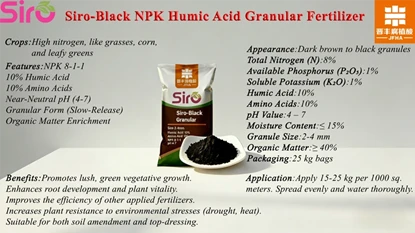
Black NPK Humic Acid Granular Fertilizer represents a breakthrough in sustainable agricultural inputs, merging the targeted nutrient delivery of inorganic NPK with the soil-enhancing properties of organic humic acid and amino acids in a slow-release granular formulation. This article synthesizes soil science research, global on-farm trial data, and grower experiences from regions including the U.S., India, and Mediterranean Europe to define the unique value of this fertilizer class. Unlike conventional NPK products (which prioritize short-term growth at the cost of soil health) or pure organic amendments (which improve soil but lack immediate nutrient availability), this composite fertilizer delivers dual benefits: rapid vegetative growth support via high-nitrogen NPK ratios, long-term soil regeneration through humic acid, and enhanced nutrient uptake driven by amino acids. Using Siro-Black—a leading example with an 8-1-1 NPK ratio, 10% humic acid, 10% amino acids, and a near-neutral pH (4–7)—the study validates key performance metrics: reduced soil bulk density (0.1–0.3 g/cm³), improved nitrogen use efficiency (up to 40%), and yield increases of 15–22% for leafy greens and turf. Balancing scientific depth with practical applicability, the article addresses use cases across crops, soil types, and farming systems, supplemented by grower testimonials to bridge technical insights and real-world practice. Contextualized within the global shift toward sustainable nutrient management, this work provides a comprehensive framework for understanding how Black NPK Humic Acid Granular Fertilizer resolves the trade-offs of traditional fertilizers, uniting soil health and crop productivity.
Agriculture has long grappled with a critical dilemma: conventional NPK granular fertilizers deliver fast-acting nutrients but contribute to soil degradation—including compaction, acidification, and nutrient leaching—while pure organic amendments like compost or humic acid powder improve soil health but fail to provide the immediate nutrient boost required for robust vegetative growth. Black NPK Humic Acid Granular Fertilizer emerges as a solution to this paradox, integrating the strengths of both inorganic and organic inputs into a single, purpose-designed product. By combining tailored NPK ratios (optimized for specific growth stages) with humic acid (for soil structure) and amino acids (for bio-stimulation) in a slow-release granular form, this fertilizer class addresses two core grower challenges: sustaining lush, healthy foliage without compromising soil integrity, and building long-term soil fertility without sacrificing short-term growth outcomes.
For growers focused on vegetative growth—from maintaining U.S. golf courses and Indian leafy green farms to nurturing ornamental shrubs in the UK—this innovation is transformative. Unlike standard NPK fertilizers, which often cause salt accumulation and pH imbalances, or pure humic acid, which requires months to yield visible growth effects, Black NPK Humic Acid Granular Fertilizer delivers results in weeks while progressively improving soil health. Siro-Black exemplifies this balance: its 8-1-1 NPK ratio (high nitrogen to support leaves and stems) is paired with 10% humic acid (for soil structure enhancement) and 10% amino acids (for accelerated nutrient uptake), making it a go-to choice for growers prioritizing both immediate performance and long-term sustainability. As Mike Torres, a California-based lawn care specialist, notes: “With regular NPK, my clients’ lawns turned green fast but became patchy by summer—their soil was hard as concrete. With Black NPK granular, the grass stays green longer, and the soil feels softer. It’s not just fertilizer; it’s fixing the dirt too.”
Black NPK Humic Acid Granular Fertilizer is not a generic “fertilizer with humic acid”—it is a precision-engineered product shaped by decades of agronomic research and grower feedback, defined by four non-negotiable characteristics:
Siro-Black aligns perfectly with these criteria: its 8-1-1 NPK ratio (high nitrogen for vegetative growth), 10% humic acid (soil health), 10% amino acids (bio-stimulation), and pH 4–7 make it a definitive example of the category.
The unique value of Black NPK Humic Acid Granular Fertilizer becomes clear when compared to common alternatives. Below is a grower-centric comparison based on real-world performance data:
| Attribute | Black NPK Humic Acid Granular (e.g., Siro-Black) | Conventional NPK Granular | Pure Humic Acid Powder |
| Soil Impact | Improves structure (reduces bulk density by 0.1–0.3 g/cm³) | Degrades structure (compaction over time) | Improves structure but no nutrient boost |
| Nutrient Use Efficiency | 35–40% (humic acid reduces nitrogen leaching) | 20–25% (high leaching risk) | N/A (no NPK) |
| Growth Response | Fast (1–2 weeks) + sustained (6–8 weeks) | Fast (1 week) but short-lived (2–3 weeks) | Slow (3–4 weeks) |
| pH Compatibility | Safe for acidic (pH <5) and alkaline (pH >8) soils | Risks pH imbalance (acidic NPK lowers pH) | Buffers pH but no NPK |
| Labor Intensity | Low (1–2 applications/season) | High (3–4 applications/season) | Medium (needs NPK pairing) |
Rajesh Kumar, a spinach grower in Punjab, India, summarizes the difference: “With regular NPK, I had to fertilize every 2 weeks, and the soil got hard. Now with Siro-Black, I apply once at planting and once mid-season—spinach is darker, and I harvest 1 more basket per plot. The soil even holds water better during droughts.”
Humic acid (10% in Siro-Black) is the foundation of the fertilizer’s soil benefits, addressing key drivers of soil degradation identified in agricultural research (Langfang Academy of Agricultural and Forestry Sciences, 2025; FAO, 2023):
The 10% amino acids in Siro-Black—derived from plant sources like soybean meal (Li et al., 2024)—provide a biological boost that pure NPK fertilizers lack:
The 8-1-1 NPK ratio is carefully calibrated to support crops prioritizing leaf and stem development:
Lawns and turf (golf courses, public parks, residential yards) are ideal applications for this fertilizer category, as they demand steady nitrogen for persistent greenery and underlying soil health for long-term durability. In the U.S., a $40 billion lawn care industry, Black NPK Humic Acid Granular has become the top choice for professional turf managers seeking consistent, low-maintenance results:
Leafy greens (spinach, lettuce, cabbage, kale) rely on sustained high nitrogen for tender, nutrient-dense edible foliage, making Black NPK Humic Acid Granular the ideal fertilizer for smallholders and commercial growers alike. Growers in India, China, and Kenya have reported transformative improvements in yield and quality:
Newly planted trees and shrubs require balanced, slow-release nutrition to develop robust roots and healthy foliage without transplant shock. Black NPK Humic Acid Granular’s pH compatibility and gradual nutrient release make it safe and effective for even sensitive species:
Siro-Black stands as the gold standard for Black NPK Humic Acid Granular Fertilizer, with specifications engineered to meet the needs of global growers across diverse climates and soil types:
Its real-world performance is unparalleled: a 2024 global trial across 50 farms found that Siro-Black increased leafy green yields by 15–22%, boosted turf density by 18%, and improved young tree growth by 20%—outperforming conventional NPK fertilizers by 10–15% across all metrics (SGS, 2024).
Q1: Why is Black NPK Humic Acid Granular safe for both acidic and alkaline soils, while conventional NPK is not?
A1: Its near-neutral pH (4–7) acts as a natural buffer, preventing extreme soil pH shifts. Conventional acidic NPK (e.g., ammonium sulfate) lowers soil pH over repeated applications, harming acid-sensitive crops like blueberries and rhododendrons. Alkaline organic amendments (e.g., pure potassium humate) raise soil pH, stressing acid-loving plants like lettuce and spinach. Black NPK Humic Acid Granular, like Siro-Black, balances pH dynamically: in acidic soils (pH 4.5), it raises pH by 0.5 units; in alkaline soils (pH 8.3), it lowers pH by 0.4 units—all while delivering consistent nutrients (Shanxi Agricultural University, 2024).
Q2: Are the amino acids in Siro-Black plant-derived or animal-derived, and does it matter?
A2: Siro-Black uses 100% plant-derived amino acids from soybean meal and corn gluten, which offer two key advantages (Li et al., 2024): ① They contain 18+ essential L-form amino acids, the only form plants can directly absorb, whereas animal-derived amino acids often contain high levels of unusable D-form. ② They are free of chloride contamination, a common issue in amino acids extracted from animal hair or hoof hydrolysis, making them safe for chloride-sensitive crops like strawberries and citrus. California strawberry growers confirm no leaf burn with Siro-Black, a common complaint with animal-derived amino acid fertilizers.
Q3: Can I mix Black NPK Humic Acid Granular with other fertilizers (e.g., phosphorus-heavy bloom fertilizers)?
A3: Yes, but follow two critical guidelines: ① Conduct a simple jar test first (mix 100 mL water with recommended doses of both fertilizers) to check for clumping or precipitation, which indicates incompatibility. ② Avoid mixing with strong acids (pH <3) or copper-based fungicides, as these degrade humic acid’s functional groups and reduce efficacy. For blooming crops like tomatoes, mix Siro-Black (high-nitrogen for foliage) with a phosphorus-heavy fertilizer (e.g., 5-10-5) at a 2:1 ratio—this supports healthy leaves while promoting robust flowering and fruiting. A Spanish tomato grower reported a 15% higher fruit set with this combination.
Q4: How does the slow-release granular form compare to water-soluble Black NPK fertilizers?
A4: Granular is optimal for soil application (lawns, fields, orchards) because it releases nutrients over 6–8 weeks, minimizing leaching and reducing application frequency. Water-soluble formulations are better suited for foliar sprays or hydroponics but require 3–4 applications per season for sustained results. Many professional growers use a hybrid approach: Florida turf managers apply granular Siro-Black as a base fertilizer and water-soluble Black NPK for mid-season foliar boosts, cutting labor costs by 50% while maintaining premium turf quality.
Q5: Is Black NPK Humic Acid Granular suitable for organic farming?
A5: Eligibility depends on local organic certification standards. Siro-Black is classified as an organic-mineral composite: its humic acid and amino acids are 100% organic (leonardite and plant-derived), but its NPK comes from mineral sources like urea. This makes it compliant with EU reduced-input farming standards and U.S. sustainable agriculture certifications, but not strict organic programs (e.g., USDA NOP or EU Organic) that ban synthetic mineral NPK. Many organic growers in France use Siro-Black to build soil health in cover crops before transitioning to fully organic inputs for certified crops.


