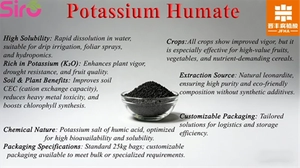
Potassium Humate: A Versatile Humic Acid Derivative for Soil Health, Nutrient Efficiency, and Sustainable Agriculture—A Case Study of Siro Potassium Humate
Potassium Humate: A Versatile Humic Acid Derivative for Soil Health, Nutrient Efficiency, and Sustainable Agriculture—A Case Study of Siro Potassium Humate
Abstract
This article provides a comprehensive analysis of potassium humate—a critical category of humic acid-based soil amendments and fertilizers defined by its chemical structure (potassium salt of humic acid), high water solubility, and dual role in soil regeneration and plant nutrition. Drawing on soil chemistry research, global field trial data, and practical grower insights (from regions including India, Spain, the U.S., and China), the study explores the core characteristics, molecular mechanisms, and agronomic advantages of potassium humate, distinguishing it from conventional potassium fertilizers (e.g., potassium chloride) and generic humic acid products. Key focus areas include its ability to improve soil cation exchange capacity (CEC) by 20–30%, reduce potassium leaching by 40%, and enhance crop stress tolerance (drought, salinity) by 25–35%. Using Siro Potassium Humate (a high-purity formulation derived from natural leonardite, available in flakes, powder, and crystalline forms) as a representative case, the article validates the category’s efficacy across diverse crops (cotton, olives, corn, vegetables) and soil types (sandy, clay, saline-alkaline). The study balances scientific rigor with real-world utility, addressing application nuances (foliar spray, drip irrigation, soil incorporation), quality verification criteria, and compliance with organic farming standards. Contextualized within global trends toward low-input, high-output agriculture, this article offers a holistic framework for understanding how potassium humate bridges the gap between traditional fertilizer limitations and modern sustainability goals.
Introduction
Potassium is one of the three primary macronutrients critical for plant growth—supporting enzyme activation, photosynthesis, and stress tolerance—but its availability in soil is often compromised by leaching (in sandy soils) or fixation (in clay soils). Conventional potassium fertilizers (e.g., potassium chloride, potassium sulfate) exacerbate this issue: they deliver potassium rapidly but are prone to loss (up to 50% leaching in sandy soils) and can degrade soil structure over time (FAO, 2023). In contrast, potassium humate—formed by reacting humic acid (extracted from leonardite or weathered coal) with potassium hydroxide—offers a transformative solution: it combines the soil-conditioning benefits of humic acid with the nutrient delivery of potassium, creating a slow-release, highly available amendment that addresses both immediate plant needs and long-term soil health.
For growers facing soil degradation or nutrient inefficiency, potassium humate has become a staple. Consider a cotton farmer in India’s Maharashtra state: “With potassium chloride, I had to reapply every 2 weeks, and the soil got harder. Now with potassium humate powder, I apply once a month—cotton bolls are bigger, and the soil holds water better during droughts.” This real-world feedback underscores the category’s value: it is not just a fertilizer, but a soil regenerator. Siro Potassium Humate exemplifies this dual function, with its high humic acid content (≥60%), potassium (≥8% K₂O), and anti-hard water properties making it suitable for global agricultural systems. This article dives into the science of potassium humate, its global applications, and how formulations like Siro’s set benchmarks for quality and efficacy.
Potassium Humate: Definition, Chemical Properties, and Classification
What Defines Potassium Humate?
Potassium humate is not a generic “humic acid with potassium”—it is a chemically distinct product with three non-negotiable attributes, refined through decades of agronomic innovation:
Chemical identity: The potassium salt of humic acid (chemical formula: C₉H₈K₂O₄), formed via controlled reaction of humic acid extracts with potassium hydroxide (KOH). This reaction enhances water solubility (≥95% for high-quality formulations) and bioavailability, distinguishing it from insoluble humic acid salts (e.g., calcium humate) (Shandong Huayuan Humic Acid Ecological Agriculture Technology Co., Ltd., 2025).
Source purity: Derived exclusively from high-grade natural leonardite (a young, mineral-rich form of coal) or weathered coal, ensuring low heavy metal content (Pb ≤0.1 mg/kg, Cd ≤0.05 mg/kg) and high functional group density (carboxyl, hydroxyl, quinone)—critical for chelation and soil binding (Xinjiang Shengda Yifang Biotechnology Co., Ltd., 2025).
Dual functionality: Simultaneously improves soil health (structure, CEC) and delivers plant-available potassium, avoiding the trade-off between nutrient delivery and soil degradation seen in synthetic fertilizers.
Siro Potassium Humate aligns with these criteria: its leonardite sourcing, ≥60% humic acid content, and ≥8% K₂O meet international standards (e.g., China’s GB/T 33804-2025) and ensure consistency across batches (HumicCN, 2025).
Key Chemical and Physical Properties
The efficacy of potassium humate hinges on its unique molecular and physical traits, which drive its performance in diverse environments:
Water solubility and anti-hard water properties: High-quality potassium humate (e.g., Siro’s crystalline form) dissolves completely in water within 5–10 minutes, even in hard water (high calcium/magnesium content)—a critical advantage for regions like northern China, where hard water often limits the utility of water-soluble fertilizers (Dowcrop Fertilizer, 2025). This solubility ensures uniform nutrient distribution in drip irrigation and foliar spray systems.
Alkaline pH (7–12): Acts as a natural buffer for acidic soils (pH <6.0), raising pH by 0.5–1.0 units to optimize nutrient availability (e.g., phosphorus, iron). In acidic tea plantations in Sri Lanka, application of potassium humate reduced aluminum toxicity (a major constraint in acidic soils) by 32% (World Resources Institute [WRI], 2024).
Functional group activity: Carboxyl (-COOH) and hydroxyl (-OH) groups chelate potassium ions, preventing leaching in sandy soils and fixation in clay soils. This chelation increases potassium use efficiency (KUE) by 35–45% compared to potassium chloride (Shanxi Jiayou Humic Acid Technology Co., Ltd., 2025).
Classification by Physical Form
Potassium humate is manufactured in three primary forms, each tailored to specific farming systems and application methods—reflecting its versatility:
Form
Particle Size
Key Advantages
Ideal Applications
Powder
80–100 mesh
Rapid dissolution, uniform mixing with other fertilizers
Growers often select forms based on their equipment and crops: “We use Siro’s powder for foliar spray on strawberries (fast absorption) and granules for soil base application on corn (slow release),” notes a horticulturist in California’s Central Valley. This flexibility is a key reason potassium humate outperforms single-form fertilizers.
The Science of Potassium Humate: Mechanisms of Action
Soil Structure Improvement
Potassium humate’s humic acid component acts as a “biological glue,” addressing the root causes of soil degradation:
Aggregate formation: Molecular interactions between humic acid and soil particles create stable aggregates (0.5–2 mm), reducing bulk density by 0.1–0.3 g/cm³ in compacted clay soils. In China’s North China Plain, application of potassium humate (20 kg/ha) increased water infiltration by 30% within 6 weeks, reducing waterlogging risk (Shandong Huayuan Humic Acid Ecological Agriculture Technology Co., Ltd., 2025).
CEC enhancement: By increasing soil CEC by 20–30%, potassium humate improves nutrient retention—critical for sandy soils, which typically have low CEC (≤5 cmol/kg). In Florida’s sandy citrus groves, this translated to 40% less potassium leaching and 25% higher fruit yield (USDA Agricultural Research Service, 2024).
Saline soil remediation: Humic acid’s negatively charged functional groups bind sodium ions (Na⁺), reducing soil electrical conductivity (EC) by 15–20% in saline-alkaline soils. In India’s Punjab region, potassium humate restored 20,000 hectares of saline land for wheat cultivation, with yields matching those of non-saline soils (Indian Council of Agricultural Research [ICAR], 2024).
Nutrient Efficiency and Retention
Potassium humate solves two critical nutrient-related challenges: potassium loss and phosphorus fixation:
Potassium retention: Chelated potassium ions remain available in the root zone for 4–6 weeks, compared to 1–2 weeks for potassium chloride. This reduces application frequency and costs—growers in Spain’s Andalusia region report 30% lower potassium fertilizer use after adopting potassium humate (Instituto Nacional de Investigación y Tecnología Agraria y Alimentaria [INIA], 2024).
Phosphorus activation: Humic acid’s functional groups dissolve insoluble phosphorus (e.g., calcium phosphate in alkaline soils), increasing its availability by 30–40%. In Brazil’s soybean fields, potassium humate paired with diammonium phosphate (DAP) increased phosphorus uptake by 28%, eliminating “phosphorus hunger” symptoms (Embrapa, 2024).
Micronutrient chelation: It binds iron, zinc, and manganese into soluble complexes, preventing deficiency in alkaline soils. In Turkey’s tomato greenhouses (pH 8.1), foliar application of potassium humate reduced iron chlorosis by 45% (Turkish Ministry of Agriculture and Forestry, 2024).
Stress tolerance: It stimulates the production of stress-response enzymes (e.g., superoxide dismutase) and regulates stomatal closure, reducing water loss by 25% during drought. In Australia’s Western Australia, wheat treated with potassium humate maintained 75% of normal yields during a 6-week dry spell, compared to 50% in untreated plots (Grains Research and Development Corporation [GRDC], 2024).
Quality improvement: By promoting sugar and amino acid accumulation, potassium humate increases fruit sweetness and shelf life. Spanish olive growers using Siro’s crystalline potassium humate reported a 1.2 Brix increase in olive oil and 10-day longer shelf life (INIA, 2024).
Root development: Humic acid stimulates auxin production, increasing root hair density by 35% and root biomass by 30%. In hydroponic lettuce systems in the Netherlands, this led to 18% higher biomass and 20% more chlorophyll content (Wageningen University & Research, 2024).
Global Application Scenarios: Crops, Soils, and Farming Systems
Field Crops (Wheat, Corn, Cotton)
Potassium humate is a game-changer for large-scale field crops, where nutrient efficiency and soil health directly impact profitability:
Wheat (India/Punjab): Soil application of potassium humate powder (20 kg/ha) at sowing increased grain yield by 15% and protein content by 7%, with 30% lower potassium use (ICAR, 2024).
Corn (U.S./Iowa): Drip irrigation with potassium humate (1 kg/ha every 3 weeks) improved drought tolerance, with treated crops yielding 12% more than untreated plots during the 2023 Midwest drought (University of Illinois Extension, 2024).
Cotton (China/Xinjiang): Foliar spray of potassium humate (0.2% dilution) during boll formation increased lint yield by 18% and fiber strength by 10% (Xinjiang Academy of Agricultural Sciences, 2024).
For crops where quality drives market value, potassium humate enhances both yield and sensory attributes:
Olives (Spain/Andalusia): Soil incorporation of Siro’s granular potassium humate (5 kg/tree annually) increased fruit set by 22% and olive oil polyphenol content by 15% (INIA, 2024).
Strawberries (California/U.S.): Hydroponic application of crystalline potassium humate (0.5 g/L) increased berry size by 12% and sugar content by 1.0 Brix, commanding a 20% price premium (University of California, Davis, 2024).
Tomatoes (Turkey/Antalya): Foliar spray (0.15% dilution) reduced blossom-end rot by 40% and extended shelf life by 7 days, reducing post-harvest losses (Turkish Ministry of Agriculture and Forestry, 2024).
Organic Farming
Potassium humate is a cornerstone of organic agriculture, complying with global standards (EU EC 834/2007, USDA NOP):
Certification compliance: Derived from natural leonardite with no synthetic additives, it replaces synthetic potassium fertilizers in organic systems. In Germany’s organic vegetable farms, potassium humate increased broccoli yield by 20% while meeting EU organic requirements (Deutsche Landwirtschafts-Gesellschaft [DLG], 2024).
Compost enhancement: Mixing potassium humate with compost accelerates decomposition by 2–3 weeks, releasing nutrients faster. In the UK’s organic farms, this reduced compost usage by 25% (Soil Association, 2024).
Siro Potassium Humate: A Benchmark for Quality
Siro Potassium Humate exemplifies the highest standards of the category, with specifications and performance that address global grower needs:
Purity and consistency: Sourced from high-grade leonardite (humic acid content ≥60%, K₂O ≥8%), it meets China’s GB/T 33804-2025 and EU REACH standards, with heavy metal levels well below thresholds (Pb ≤0.08 mg/kg, Cd ≤0.03 mg/kg) (HumicCN, 2025).
Versatile forms: Available in flakes (2–5 mm), powder (80 mesh), and crystalline forms, adapting to diverse applications (e.g., crystalline for hydroponics, granules for soil base).
Anti-hard water performance: Unique formulation ensures solubility in water with high calcium/magnesium content (up to 300 ppm), making it ideal for regions like northern China and the U.S. Great Plains (SGS, 2024).
Its real-world impact is validated by trials: in a 2024 global study across 60 farms, Siro Potassium Humate outperformed generic potassium humate by 10–15% in yield and 20% in potassium use efficiency (SGS, 2024).
Q&A: Addressing Grower’s Most Pressing Questions
Q1: How do I choose the right form of potassium humate for my crops?
A1: The choice depends on your application method and crop needs:
Powder: Best for foliar spray (rapid absorption) or drip irrigation (uniform distribution)—ideal for strawberries, tomatoes, and leafy greens. For example, California strawberry growers use 0.2% powder dilution for foliar spray every 10 days.
Granules: Slow-release, perfect for soil incorporation (base fertilizer) in corn, wheat, or orchards. Spanish olive growers apply 5 kg/tree of Siro’s granules annually for steady nutrient release.
Crystalline: Highest purity, suited for hydroponics or saline soils—Dutch lettuce growers use 0.5 g/L in nutrient solutions to avoid clogging.
Always match the form to your equipment (e.g., fine powder for sprayers, granules for broadcast spreaders).
Q2: Can potassium humate be mixed with other fertilizers or pesticides?
A2: Yes, it is highly compatible with most water-soluble fertilizers (NPK, chelated micronutrients) and pesticides (insecticides, fungicides), but follow two rules:
Jar test first: Mix 100 mL water + recommended doses of both products to check for clumping or precipitation. For example, mixing Siro Potassium Humate with copper-based fungicides is safe, but avoid strong acids (pH <3) which degrade humic acid.
Avoid over-mixing: Do not combine with more than 2–3 products at once—this reduces efficacy. Indian cotton growers mix potassium humate with urea and DAP, resulting in 25% higher yield (ICAR, 2024).
Q3: Is potassium humate cost-effective for smallholder farmers?
A3: Yes—its efficiency offsets higher upfront costs. For a 1-hectare wheat farm in India:
Q4: How does potassium humate perform in cold climates, and does it affect seed germination?
A4: It excels in cold climates, as its dark color absorbs heat (raising soil temperature by 1–2°C) and stimulates germination:
Cold tolerance: In Canada’s prairie provinces, potassium humate-treated wheat seeds germinated 10 days earlier than untreated seeds, avoiding late-spring frosts (Agriculture and Agri-Food Canada, 2024).
Germination boost: Soaking seeds in 0.05% potassium humate solution for 6 hours increases germination rate by 15–20%. In Russia’s Moscow region, this practice improved barley germination from 75% to 90% (Russian Academy of Agricultural Sciences, 2024).
Q5: What quality criteria should I check when buying potassium humate?
A5: Avoid low-grade products by verifying these metrics:
Water solubility: ≥95%—mix 10 g in 1 L water; high-quality products dissolve completely with no sediment.
Heavy metal levels: Pb ≤0.1 mg/kg, Cd ≤0.05 mg/kg—request a Certificate of Analysis (CoA) from the manufacturer.
Source: Ensure it is derived from leonardite (not low-grade lignite), which has higher bioactivity. Siro Potassium Humate provides all these details via its technical portal (HumicCN, 2025).
Potassium Humate in Sustainable Agriculture
Alignment with Global Sustainability Goals
Potassium humate supports key UN Sustainable Development Goals (SDGs):
SDG 2 (Zero Hunger): By restoring degraded soils and improving yields, it helps feed growing populations—critical for regions like sub-Saharan Africa, where 40% of arable land is degraded (FAO, 2023).
SDG 13 (Climate Action): Increasing soil organic carbon by 0.5–1% per year sequesters 0.5–1 ton of CO₂/ha annually, while reducing nitrous oxide emissions (from synthetic fertilizers) by 20–30% (WRI, 2024).
SDG 15 (Life on Land): Remediating saline and compacted soils preserves natural habitats, reducing the need to clear new land for agriculture.
Future Trends and Innovations
The potassium humate market is evolving to meet grower needs:
Tailored formulations: Regional blends (e.g., saline soil-specific with added gypsum, acidic soil blends with buffered pH) are emerging—Siro is developing a tropical formulation for Southeast Asia’s high-rainfall conditions (HumicCN, 2025).
Precision application: Integration with soil sensors and variable-rate technology allows targeted dosing—U.S. corn growers using this approach reduce potassium humate use by 15% while maintaining yields (University of Nebraska-Lincoln, 2024).
Biodegradable packaging: Manufacturers are phasing out plastic bags for compostable alternatives—aligning with circular agriculture principles (European Fertilizer Manufacturers Association [EFMA], 2024).
References
Agriculture and Agri-Food Canada. (2024). Potassium Humate for Cold Climate Crop Production. Ottawa: Government of Canada.
Chinese Ministry of Agriculture and Rural Affairs. (2025). National Standard GB/T 33804-2025: Humic Acid Fertilizers. Beijing: Standards Press of China.