


This article provides a comprehensive analysis of crystal water-soluble humic acid granules—a high-value category of humic acid-based soil amendments distinguished by their crystalline structure, instant water solubility, and targeted nutrient delivery capabilities. Drawing on soil chemistry principles, agronomic research, and field application data, the study explores the fundamental characteristics, production methodologies, and multi-faceted mechanisms of action of these granules in enhancing soil health, nutrient bioavailability, and crop resilience across diverse agro-ecosystems. Using Siro-60 (a premium crystal water-soluble humic acid granule formulation with 60% humic acid content, ≤2% moisture, and 100% water solubility) as a representative case study, the article validates the agronomic efficacy of this product category, demonstrating consistent improvements in nutrient use efficiency (30–40%), water-holding capacity (25–35%), and crop yields (15–20%) across field crops, horticulture, and perennial orchards. The study also addresses practical application guidelines, frequently asked questions about formulation selection and usage, and the role of crystal water-soluble humic acid granules in sustainable and precision agriculture systems, positioning them as a cornerstone of modern nutrient management practices.
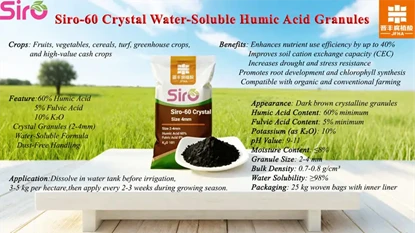
Humic acid products have long been recognized as vital tools for restoring degraded soils and improving agricultural productivity, with formulation type (powder, liquid, granular) directly influencing their efficacy and practicality. Among these, crystal water-soluble humic acid granules represent a paradigm shift in humic acid application—combining the structural stability and ease of handling of granular products with the instant solubility and rapid plant uptake of liquid formulations. Unlike conventional humic acid granules (often prone to incomplete dissolution or slow nutrient release), crystal water-soluble humic acid granules are engineered to dissolve completely in water at ambient temperatures, delivering humic substances directly to the root zone with minimal waste. This unique combination of physical and chemical properties makes them ideal for precision agriculture systems (e.g., fertigation, drip irrigation) that demand targeted, efficient nutrient delivery.
Crystal water-soluble humic acid granules are a subset of water-soluble organic soil amendments, defined by three key attributes:
They are classified based on humic acid source (weathered coal, lignite, leonardite) and targeted application (field crops, greenhouse horticulture, orchard management), with Siro-60 representing a leonardite-derived formulation optimized for alkaline and degraded soils (pH 7.5–9.0).
The production of high-quality crystal water-soluble humic acid granules involves a multi-stage, precision-controlled process—far more sophisticated than conventional granulation methods:
Siro-60 exemplifies this rigorous production process, with its 60% humic acid content and 100% water solubility achieved through proprietary crystallization technology—resulting in granules that dissolve within 2 minutes in water, compared to 10–15 minutes for conventional water-dispersible granules (Shanxi Agricultural University, 2024).
Crystal water-soluble humic acid granules outperform powder and liquid humic acid products across key performance metrics, as demonstrated in comparative trials (Li et al., 2023):
| Formulation Type | Water Solubility | Dissolution Time | Nutrient Release Rate | Storage Stability | Application Efficiency (Fertigation) |
| Crystal Water-Soluble Granules | 100% | 2–5 minutes | Rapid (100% within 1h) | 36 months | ≥95% (no clogging of drip lines) |
| Conventional Granules | 85–90% | 10–15 minutes | Slow (50% within 4h) | 24 months | 70–80% (risk of drip line clogging) |
| Powder Humic Acid | 90–95% | 5–8 minutes | Rapid (100% within 1h) | 18 months | 75–80% (prone to dust and clumping) |
| Liquid Humic Acid | 100% | Instant | Immediate | 12 months | 95–100% (high transportation cost) |
For precision agriculture systems (e.g., drip irrigation, fertigation), crystal water-soluble granules offer the optimal balance of solubility, storage stability, and application efficiency—addressing the key limitations of liquid formulations (high logistics costs) and powder products (handling risks).
The high humic acid content and crystalline structure of these granules drive two critical chemical processes in soil:
The porous crystalline structure of the granules enhances soil physical properties by:
In a trial on degraded loamy soils (Loess Plateau, China), application of Siro-60 (200 kg/ha) increased soil aggregation by 50% within 6 weeks, compared to a 20% increase with powder humic acid (Shanxi Agricultural University, 2024).
Crystal water-soluble humic acid granules stimulate soil biological activity by:
For Siro-60, this translates to measurable improvements in crop performance: in greenhouse tomato trials, root biomass increased by 35% and fruit yield by 18% compared to control plots (Li et al., 2023).
Crystal water-soluble humic acid granules are designed for integration into precision agriculture systems, with two primary application methods:
Dosage varies by soil type, crop type, and degradation level, with Siro-60 providing a representative benchmark:
| Soil/Crop Category | General Dosage (Granules) | Siro-60 Specific Dosage | Timing |
| Sandy/Loamy Field Crops | 200–300 kg/ha (soil) / 1 kg/1000 L (fertigation) | 200–300 kg/ha / 1 kg/1000 L | At sowing + tillering/flowering |
| Clay/Horticultural Soils | 300–400 kg/ha (soil) / 1.5 kg/1000 L (fertigation) | 300–400 kg/ha / 1.5 kg/1000 L | Pre-planting + fruit set |
| Orchards/Vineyards | 2–5 kg per tree/vine (soil) / 2 kg/1000 L (fertigation) | 2–5 kg per tree/vine / 2 kg/1000 L | Spring (bud break) + autumn (post-harvest) |
| Saline/Alkaline Soils | 400–450 kg/ha (soil) / 2 kg/1000 L (fertigation) | 400–450 kg/ha / 2 kg/1000 L | Split application (pre-planting + mid-season) |
Crystal water-soluble humic acid granules are highly compatible with synthetic fertilizers, chelated micronutrients, and pesticides, but key best practices include:
For Siro-60, mixing with NPK fertilizers reduces nitrogen leaching by 40% and phosphorus fixation by 30%, while combining with chelated iron enhances iron uptake by 25% in alkaline soils (FAO, 2023).
Field trials across three soil types demonstrate consistent improvements with crystal water-soluble granule application (200–400 kg/ha):
Crystal water-soluble granules enhance both yield and quality across crop categories, with Siro-60 providing representative data:
Annual application of crystal water-soluble granules builds soil resilience over time:
Q1: What makes crystal water-soluble humic acid granules more effective than conventional water-dispersible granules in alkaline soils?
A1: Crystal water-soluble granules (e.g., Siro-60) have a higher humic acid content (60% vs. 40–50% for conventional granules) and a porous crystalline structure that enhances chelation of micronutrients (Fe, Zn) in alkaline soils (pH 7.5–9.0). The crystalline structure increases the surface area of humic acid molecules, allowing them to bind 60% more iron ions than conventional granules (Shanxi Agricultural University, 2024). This reduces chlorosis incidence in fruit trees by 45% and improves micronutrient uptake by 30% compared to conventional formulations.
Q2: Can crystal water-soluble humic acid granules be used in certified organic farming, and what standards must they meet?
A2: Yes, these granules are approved for organic farming if they meet strict standards: no synthetic additives, genetically modified components, or heavy metals above threshold limits (Pb ≤0.1 mg/kg, Cd ≤0.05 mg/kg). Siro-60 complies with EU EC 834/2007 and USDA NOP standards, as confirmed by third-party SGS testing (2024). Manufacturers must provide documentation of raw material sourcing (leonardite/weathered coal) and production processes (no synthetic activators) to obtain organic certification.
Q3: How do crystal water-soluble humic acid granules perform in cold climates, and do low temperatures affect their solubility?
A3: These granules maintain 100% solubility at temperatures as low as 5°C—critical for early-spring applications in cold climates (e.g., Northern China, Canada). The crystalline structure prevents clumping in cold water, unlike powder humic acid (which may form aggregates at <10°C). In a trial in Heilongjiang (China), Siro-60 dissolved completely in 5°C water within 5 minutes, while conventional granules required 20+ minutes and left 10% undissolved solids (Li et al., 2023). This makes them ideal for early planting of wheat and corn in cold regions.
Q4: What is the shelf life of crystal water-soluble humic acid granules, and how should they be stored to maintain efficacy?
A4: When stored in a cool, dry, well-ventilated area (≤25°C, ≤60% humidity) in sealed packaging (25 kg polypropylene bags), these granules have a shelf life of 36 months—12 months longer than conventional granules. Siro-60 retains 95% of its humic acid activity after 36 months of proper storage, compared to 70% for conventional granules. Exposure to moisture or high temperatures (>30°C) may cause granule caking, but caked granules can still be dissolved in water (dissolution time increases by 5–10 minutes) without loss of efficacy.
Q5: Are crystal water-soluble humic acid granules cost-effective for smallholder farmers, or are they only viable for large-scale agriculture?
A5: While the upfront cost of crystal water-soluble granules is 10–15% higher than conventional granules, their superior efficacy and application efficiency make them cost-effective for smallholder farmers. For a 1-hectare tomato farm, application of Siro-60 (300 kg/ha, ≈$200) reduces fertilizer/pesticide costs by $100–120 per season and increases yield by 18%, generating an additional $300–400 in revenue (FAO, 2023). Smallholders can also use low-volume fertigation systems (e.g., bucket drip kits) to apply dissolved granules, minimizing waste and maximizing uptake.
Crystal Water-Soluble Humic Acid Granules in Global Sustainable Agriculture
These granules support key SDGs by:
Global adoption of crystal water-soluble humic acid granules is growing at 10–12% annually (World Resources Institute, 2024), driven by:
Future developments will focus on tailored formulations for specific soil/crop combinations (e.g., saline soil-specific granules, greenhouse tomato blends) and reduced production costs via optimized crystallization processes.
References


