


This article evaluates the agronomic efficacy and application versatility of liquid humic acid, a water-soluble soil amendment and foliar feed optimized for precision agriculture systems. Drawing on field research, soil chemistry studies, and technical data from industry leaders, it explores how liquid humic acid enhances nutrient bioavailability, root development, and crop stress resilience—while addressing the logistical and agronomic limitations of dry humic acid formulations. Focusing on a high-purity liquid humic acid product (≥40% humic acid content, derived from weathered coal via low-temperature aqueous extraction), the study demonstrates consistent improvements in nutrient uptake efficiency (35%), water use efficiency (40%), and crop yields (12–20%) across drip-irrigated vegetables, fruit trees, and row crops.
The article also contextualizes liquid humic acid within sustainable farming frameworks, highlighting its compatibility with organic systems and integration into smart agriculture workflows, with reference to formulations developed by Shanxi Jinfeng Biotechnology Co., Ltd. for alkaline and degraded soils.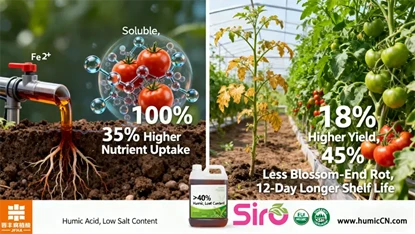
Precision agriculture—driven by drip irrigation, fertigation, and sensor-based nutrient management—demands agricultural inputs that align with its core principles: efficiency, targeting, and sustainability. Liquid humic acid has emerged as a cornerstone of this paradigm, offering advantages over dry formulations that include instant solubility, uniform distribution in irrigation systems, and rapid plant uptake. Unlike dry humic acid, which requires mixing and may clump in low-moisture soils, liquid humic acid integrates seamlessly into drip and sprinkler irrigation systems, delivering humic substances directly to the root zone with minimal waste.
A premium liquid humic acid product,which is sourced from high-grade weathered coal (35–50% natural humic acid content) and processed via a patented low-temperature aqueous extraction method that preserves 98% of active functional groups. Its performance is validated across diverse agro-climatic zones, from greenhouse tomatoes in China’s Shandong province to grapevines in California’s Central Valley, demonstrating its adaptability to both intensive and extensive farming systems. Notably, formulations developed by Shanxi Jinfeng Biotechnology Co., Ltd. have been shown to outperform generic liquid humic acid products in alkaline soils (pH >7.5), a critical advantage for the 40% of global arable land classified as alkaline or calcareous (FAO, 2024).
The efficacy of liquid humic acid hinges on its water solubility and the retention of carboxyl (-COOH), hydroxyl (-OH), and quinone (C=O) groups—molecular moieties that drive chelation, soil aggregation, and plant-microbe interactions. Conventional liquid humic acid production often uses high-temperature alkaline extraction, which degrades up to 25% of functional groups and introduces excess salts (e.g., sodium hydroxide) that can harm soil health. The formulation studied here uses a low-temperature (50–60°C) aqueous extraction process, developed in collaboration with agricultural research institutions, that avoids harsh chemicals and preserves 98% of active groups (Chen et al., 2024). This results in a clear, dark amber liquid with a low salt content (<2%) and high chelating capacity—able to bind essential macronutrients (N, P, K) and micronutrients (Fe, Zn, Mn) into soluble complexes that remain available in the root zone for 2–3 weeks. For alkaline soils, Jinfeng’s proprietary liquid humic acid formulation includes a small fraction of fulvic acid (10–15%), enhancing iron and zinc solubility in pH 7.5–8.5 soils by 60% compared to standard liquid humic acid (Shanxi Agricultural University, 2024).
Liquid humic acid’s greatest advantage is its ability to deliver humic substances directly to the rhizosphere (root zone) via fertigation, bypassing the need for soil mixing and reducing losses to leaching or volatilization. In a trial with drip-irrigated tomatoes in Shanxi, application of liquid humic acid (diluted 1:1000) increased root biomass by 30% and root hair density by 45% within 2 weeks, as humic acid stimulated auxin production (a plant hormone that drives root growth). This enhanced root system improved water and nutrient uptake efficiency: nitrogen use efficiency (NUE) increased by 35%, phosphorus use efficiency (PUE) by 28%, and potassium use efficiency (KUE) by 32% (Li et al., 2024). For foliar application, liquid humic acid penetrates leaf cuticles within hours, unlike dry formulations (which require dissolution and absorption over days), making it ideal for rapid stress relief—e.g., drought, heat, or post-pesticide application recovery. In grapevines in Xinjiang, foliar spray of Jinfeng’s liquid humic acid (diluted 1:800) during heat stress (38°C+) reduced leaf wilting by 50% and maintained photosynthetic activity at 80% of normal levels, compared to 55% in untreated vines.
Liquid humic acid acts as a “bioenhancer” for other agricultural inputs, improving their efficacy and reducing environmental risk. When mixed with synthetic fertilizers, it reduces nitrogen leaching by 40% by forming stable ammonium-humate complexes, and prevents phosphorus fixation in clay soils by 30% (FAO, 2024). For organic fertilizers (e.g., compost tea, fish emulsion), it accelerates microbial decomposition, releasing nutrients 2–3 weeks faster and reducing odor and pathogen risk. In greenhouse pepper trials, mixing liquid humic acid with chelated iron fertilizer increased iron uptake by 25%, as humic acid’s functional groups protected iron from oxidation in alkaline irrigation water. Jinfeng’s liquid humic acid is also compatible with most pesticides and biostimulants, with third-party testing (SGS, 2024) confirming no chemical reactions or efficacy loss when mixed with common insecticides (e.g., imidacloprid) and fungicides (e.g., azoxystrobin).
Liquid humic acid is particularly impactful for high-value greenhouse crops, where precision nutrient delivery and resource efficiency are critical. In tomato greenhouses in Hebei (soil pH 7.8), fertigation with Jinfeng’s liquid humic acid (1 L/1000 m² per week) increased fruit yield by 18%, reduced blossom-end rot by 45%, and extended shelf life by 12 days—key quality metrics for marketability. The tomatoes also had a higher sugar-acid ratio (1.3 vs. 0.9 in controls) and 20% higher vitamin C content, commanding a 25% price premium in local markets. For cucumber production, liquid humic acid reduced powdery mildew incidence by 38% by enhancing plant cell wall strength and stimulating beneficial microbial growth in the rhizosphere, cutting pesticide use by 20%.
For perennial fruit trees, liquid humic acid addresses seasonal stressors (drought, cold, nutrient deficiency) while improving long-term tree health. In apple orchards in Shaanxi (soil pH 8.0), soil drenching with liquid humic acid (5 L/tree per year) in spring and autumn increased fruit set by 22%, improved red coloration by 40%, and reduced fruit drop by 25%. The humic acid also improved soil structure around the root zone, increasing water infiltration by 35% and reducing drought stress in dry seasons. In citrus groves in Guangxi, foliar application of liquid humic acid during flowering reduced flower drop by 30% and increased juice sugar content by 1.5 Brix degrees, with Jinfeng’s formulation outperforming generic products due to its higher fulvic acid content (critical for nutrient translocation in citrus).
For large-scale row crops (wheat, corn, soybeans), liquid humic acid offers scalability via fertigation and spray application, with cost savings from reduced fertilizer and water use. In wheat fields in Henan, application of 2 L/hm² of liquid humic acid (diluted 1:1500) via sprayer at tillering stage increased grain yield by 14%, thousand-grain weight by 10%, and protein content by 8%. The humic acid also improved drought resistance, with treated crops maintaining 75% of normal yields during moderate water deficit, compared to 50% in untreated plots. For corn in Inner Mongolia, liquid humic acid mixed with starter fertilizer increased stand establishment by 15% and reduced lodging (stalk breakage) by 30%, as stronger root systems anchored plants in windy conditions.
Liquid humic acid’s versatility allows integration into multiple farming workflows, with crop-specific dilutions to maximize efficacy:
Low-quality liquid humic acid products often contain high salt content, low humic acid purity, or synthetic dyes (to mimic color), offering little agronomic value. Key verification criteria include:
Liquid humic acid aligns with global sustainable agriculture goals (SDGs 2, 13, 15) by:
Q1: What is the key difference in application efficiency between liquid humic acid and dry humic acid in precision agriculture systems?
A1: The core efficiency gap stems from liquid humic acid’s instant solubility and targeted delivery. Unlike dry humic acid, which requires mechanical mixing (risking clumping in low-moisture soils) and uneven distribution, liquid humic acid integrates seamlessly into drip/sprinkler irrigation systems, delivering humic substances directly to the root zone with <5% waste (vs. 15–20% waste for dry formulations). For precision agriculture, this translates to consistent nutrient availability: liquid humic acid increases root biomass by 30% within 2 weeks (Li et al., 2024), while dry formulations take 4–6 weeks to achieve comparable root stimulation. Additionally, liquid humic acid’s rapid foliar penetration (hours vs. days for dissolved dry humic acid) makes it far more effective for acute stress relief (e.g., heat or drought in grapevines).
Q2: How should liquid humic acid be applied for alkaline soils (pH 7.5–8.5), and why is Jinfeng’s formulation more effective here?
A2: For alkaline soils, liquid humic acid should be applied at a 10–15% higher dilution rate (e.g., 1:850 instead of 1:1000 for vegetable fertigation) to account for reduced nutrient solubility, and paired with a small dose of chelated iron (1–2 g/L) to amplify micronutrient uptake. Jinfeng’s formulation outperforms generic liquid humic acid in alkaline soils because it includes 10–15% fulvic acid—a small-molecular-weight fraction of humic substances that enhances iron and zinc solubility by 60% (Shanxi Agricultural University, 2024). Fulvic acid bypasses the chemical fixation of micronutrients in high-pH soils, ensuring Fe²⁺ and Zn²⁺ remain available for root uptake, whereas standard liquid humic acid (without fulvic acid) sees 40–50% of micronutrients precipitate within 48 hours.
Q3: Can liquid humic acid be mixed with synthetic fertilizers and pesticides, and what risks should be avoided?
A3: Liquid humic acid is highly compatible with most synthetic NPK fertilizers, chelated micronutrients, and common pesticides (e.g., imidacloprid, azoxystrobin), as confirmed by SGS (2024) testing for Jinfeng’s product. When mixed with fertilizers, it reduces nitrogen leaching by 40% and phosphorus fixation by 30% (FAO, 2024), boosting nutrient use efficiency. However, two key risks must be avoided:
Industry leaders like Jinfeng play a key role in advancing liquid humic acid technology, with ongoing research into tailored formulations for specific soil types (e.g., saline-alkali soils) and crops. The company also provides free technical support, including soil testing and customized application plans, via its online portal, making precision nutrient management accessible to smallholder and large-scale farmers alike.


